Chip shares rally on Wall Street and in South Korea as UK probes Paramount-Warner Bros merger

US home sales accelerated to their fastest pace this year in May, rising 3.2% month-on-month to an annualised rate of 4.17 million, according to data from the National Association of Realtors (NAR). The figure beat forecasts and marked the highest level since December, with NAR chief economist Lawrence Yun attributing the momentum to improving affordability and income gains that are outpacing home price growth.
The positive housing data came alongside a narrowing of the US trade deficit, which fell to $55.9bn in April from $56.6bn. The US Census Bureau and the Bureau of Economic Analysis reported that exports of goods rose by $8.7bn to $221.3bn, driven largely by a $6.4bn jump in crude oil exports as the Iran war disrupted supplies from the Middle East. Capital goods exports increased by $4bn, while industrial supplies and materials rose by $2.5bn. Fuel oil added $1.3bn and other petroleum products $1.0bn. Nonmonetary gold fell by $5.8bn, and other precious metals declined by $1.9bn. Consumer goods exports rose by $1.7bn. Grace Zwemmer, US economist at Oxford Economics, said the strength in exports relative to imports posed “some upside risk” to the firm’s forecast that net trade would drag 0.6 percentage points off GDP in the second quarter. She added that imports of capital goods — particularly computers, accessories and semiconductors — remained strong thanks to ongoing demand for AI hardware, noting that “the reliance on electronics equipment from abroad means that AI spending has had a marginal impact on GDP so far”.
Confidence among small US companies continued to slip. The NFIB Small Business Optimism Index fell 0.6 points in May to 95.3, remaining below its 52-year average. The Uncertainty Index rose three points to 91, well above the historical average of 68. NFIB chief economist Bill Dunkelberg said that while “AI investment spending has contributed to some excitement in the economy”, many small business owners were struggling with “significant and unpredictable hikes in fuel prices” arising from the Iran war, which are harder to pass on to customers than for larger rivals. The survey also registered a notable drop in hiring plans and job openings, reaching the lowest levels in six years.
Wall Street opened higher, with the S&P 500 rising 0.55% to 7,446 points and the tech-focused Nasdaq gaining 0.75%, as technology shares continued to recover from last week’s sell-off. The Philadelphia Semiconductor Sector (SOX) index added 1.8% in early trading, building on Monday’s 5.6% gain. Intel shares rose 2.1% and Nvidia gained 0.5%. The bounce followed a sharp sell-off on Friday, when the SOX plunged 10.26% — its worst day since March 2020 and the fourth-worst session since data began in 1994, according to Deutsche Bank’s Jim Reid. Oxford Economics told clients the correction was a “healthy unwinding of stretched sentiment” and “an attractive opportunity to add to long US equity positions, particularly in AI”. Recent reports have indicated that Google and Nvidia are considering Intel as a backup chip manufacturer for advanced processors, with Google already ordering Tensor Processing Units from Intel for production in 2028. Analysts expect Intel Foundry Services to become profitable in the second half of 2027.
In Europe, Germany’s DAX rose 0.5% and France’s CAC added 0.75%, while Italy’s FTSE Mib gained almost 2%. London’s FTSE lagged behind, reflecting the City’s lack of tech listings.
China’s exports surged 19.4% year-on-year in May, accelerating from 14.1% in April, driven by strong global demand for AI-related products. Chip exports more than doubled, while exports of hi-tech products rose 50.9%, automatic data processing machines 66%, mobile phones 44.3%, autos 39.3% and ships 31%, reported Lynn Song, ING’s chief economist for Greater China. China’s trade surplus expanded to $105.43bn. Exports to the US jumped more than 35% in May, the strongest growth since early 2021, although the overall share of Chinese exports going to the US remains near historic lows.
CMA to Scrutinise $110bn Media Mega-Merger
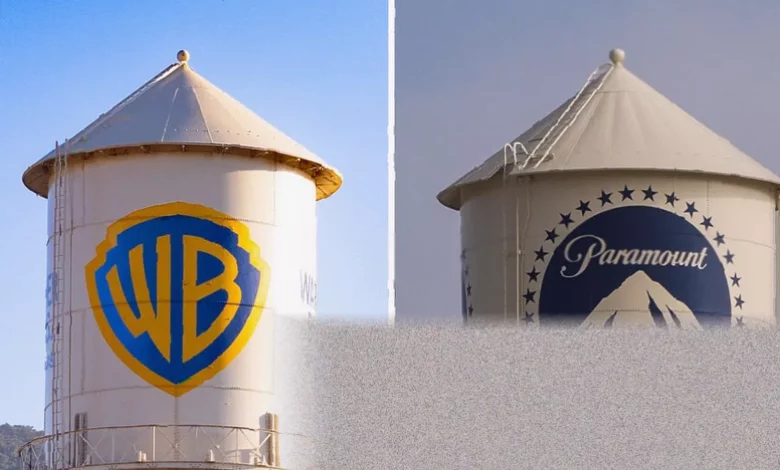
Britain’s competition watchdog has opened a formal Phase 1 investigation into Paramount Skydance’s $110bn takeover of Warner Bros Discovery (WBD). The Competition and Markets Authority (CMA) said it will decide by 7 August whether the deal warrants a more detailed Phase 2 inquiry under the Enterprise Act 2002, focusing on whether it could lead to a “substantial lessening of competition” in any UK market. The regulator had previously invited interested parties to submit comments, a period that has now closed.
The acquisition values WBD at an enterprise value of approximately $110bn, including assumed debt, with an equity value around $81bn. Paramount will pay $31.00 per share in cash for all outstanding WBD shares. The merger would create a media powerhouse controlling the Paramount and HBO Max streaming services, Channel 5 and TNT Sports — which broadcasts Champions League, Premier League and Olympic events — as well as the Hollywood studios behind franchises such as Superman, Batman and Top Gun, and HBO’s content library including Game of Thrones, The White Lotus and Succession. The deal also brings together news networks CNN and CBS.
Paramount’s board agreed the deal after fighting off a rival bid from Netflix. WBD shareholders voted to back the acquisition in April. A Paramount spokesperson said in an emailed statement: “Today’s milestone is consistent with our expected timeline. We look forward to continuing to work constructively with the Competition and Markets Authority and all regulatory agencies as they advance their review process.”
Analysts have warned that the merger could result in thousands of job losses and stifle creative innovation in Hollywood. More than 1,000 film and TV industry professionals — including Joaquin Phoenix, Ben Stiller, Mark Ruffalo, Yorgos Lanthimos and Kristen Stewart — signed an open letter two months ago arguing that the deal would “prioritise the interests of a small group of powerful stakeholders over the broader public good”. The Ellison family, close allies of Donald Trump, have also come under scrutiny. Paramount’s CEO, David Ellison, is the son of billionaire Larry Ellison, the founder of Oracle. If a Phase 2 inquiry were to find competition concerns, the CMA could demand remedies such as divestments.
Corporate Shake-Ups and Market Positioning
BP has announced a restructuring that splits the oil giant into two business segments — upstream and downstream — replacing its previous three-segment structure. Upstream will cover BP’s oil and gas regions, including exploration, development and production. Downstream will handle refining, terminals, pipelines, mobility and convenience, biofuels, aviation, hydrogen and the Castrol lubricants business. Renewable energy divisions such as solar and offshore wind will sit within the Technology division, as BP “continues to advance a capital-light model in these areas”. Chief executive Meg O’Neill, who outlined the restructure in mid-April, said the changes were intended to “reduce complexity and strengthen execution”, adding: “We are moving firmly towards a simpler, stronger and more valuable BP.”
The former star investor Neil Woodford and his UAE-registered company W4.0 have hit out at the Financial Conduct Authority after the regulator launched civil proceedings alleging the platform is providing unauthorised investment advice. The FCA is seeking an injunction to prevent Woodford and W4.0 from continuing the activities while the case proceeds. W4.0 said it had “deliberately informed readers that we were not regulated and did not provide financial advice” and claimed it was set up to operate outside the UK regulatory perimeter. The company said it had been engaged in dialogue with the FCA for nine months and had made changes in response, adding: “It is regrettable that the FCA has chosen to litigate instead.” Woodford’s firm indicated it would not halt operations. The FCA’s action follows previous provisional fines and a proposed ban against Woodford and his former firm relating to the collapse of the Woodford Equity Income Fund in 2019.
Institutional investors appear to be stockpiling cash ahead of a wave of high-profile initial public offerings. Wall Street bank BNY noted that money market fund assets under management jumped more than $109bn last week to a record $7.89tn. While higher yields are a factor, BNY said investors may also be gathering “dry powder” to deploy into upcoming IPOs, including SpaceX’s offering expected later this week. SpaceX is targeting a valuation of around $1.75 trillion, which would make it the seventh-most valuable US company. Other anticipated listings include OpenAI and Anthropic. BNY cautioned that such large IPOs could lead to a significant liquidity drain from other parts of the market as portfolios are rebalanced.
The Bank of England has warned the public against AI-generated scams after deepfake videos of Reform UK leader Nigel Farage and Bank governor Andrew Bailey fighting on the set of BBC One’s Question Time spread on the social media platform X. Governor Andrew Bailey urged people to be “vigilant”, saying such scams are “designed to criminally exploit the public, especially the vulnerable”. The Bank has reported the videos to X and informed Reform UK. Cybersecurity firm Bitdefender has linked the deepfakes to a broader, coordinated global investment scam network potentially connected to Russian-language criminal groups.
The International Air Transport Association (Iata), supported by the FAA and EASA, has launched a safety campaign urging passengers to “save a life, not a bag” after a growing number of evacuations filmed by passengers appeared on social media showing people retrieving luggage from burning planes. Iata senior vice-president Nick Careen said the first priority was to educate passengers that it was “most important to leave hand baggage behind”. Retrieving bags can increase evacuation time, block exits and aisles, damage slides and cause injury, he said.