Oil prices surged nearly 5% on Monday as renewed conflict between Iran and Israel raised fears that the Strait of Hormuz – a critical chokepoint for global energy supplies – would remain closed. Brent crude, the international benchmark, rose to $97.60 a barrel after Iran and Israel exchanged fire following an Israeli strike on Beirut, intensifying the biggest escalation between the two countries since a ceasefire paused the war in April.
The Israeli strike on Sunday targeted “command centres” in Beirut’s southern suburbs in retaliation for Hezbollah firing at northern Israel, killing two people and wounding 20. It was the first such attack on the area since April 17. Iran retaliated with missile and drone strikes, with state television reporting explosions in Isfahan, Tabriz and Tehran. President Donald Trump, who had earlier told the Financial Times he would dictate to Israeli Prime Minister Benjamin Netanyahu how the war should be conducted, later told Fox News he was “not happy” about the Beirut strikes and that they were not coordinated with the United States. Trump added that he believes a deal with Iran is close and that further strikes could jeopardise negotiations.
Oil Prices Surge as Strait of Hormuz Remains Blocked
Brent crude had fallen to as low as $93 a barrel last week, but Monday’s jump reflected growing anxiety over the Strait of Hormuz, through which a fifth of the world’s oil and gas supply normally flows. The waterway has been largely blocked by Iran since February 28, following a US-Israeli air war against Iran. Daily commercial vessel transit remains severely limited – only about ten ships were recorded on the 100th day of the conflict, with approximately 2,000 vessels stranded in the Gulf. A “dual blockade” is in effect, with the US Navy blockading Iranian ports while Iran restricts other traffic. Shipping lines have rerouted to avoid both the Strait and the Red Sea, causing severe congestion at Southeast Asian transshipment hubs. Container shipping costs have soared, with the spot rate for a 40-foot container from Asia to the US West Coast jumping 20% in the last week alone.
Shares in oil companies BP and Shell rose in London as the price surge boosted the sector. However, the broader market mood was dominated by a steep sell-off in technology stocks, which dragged indices lower across Asia and Europe.
Tech Stocks Tumble Amid AI Valuation Fears
Monday’s declines followed a sharp sell-off in US tech stocks at the end of last week. The tech-heavy Nasdaq index lost nearly 5% of its value, while the S&P 500 dropped 2% on a weekly basis, ending nine consecutive weeks of gains. The Philadelphia Semiconductor Index fell more than 10% on Friday, its steepest drop since March 2020, hammering chipmakers on both sides of the Atlantic.
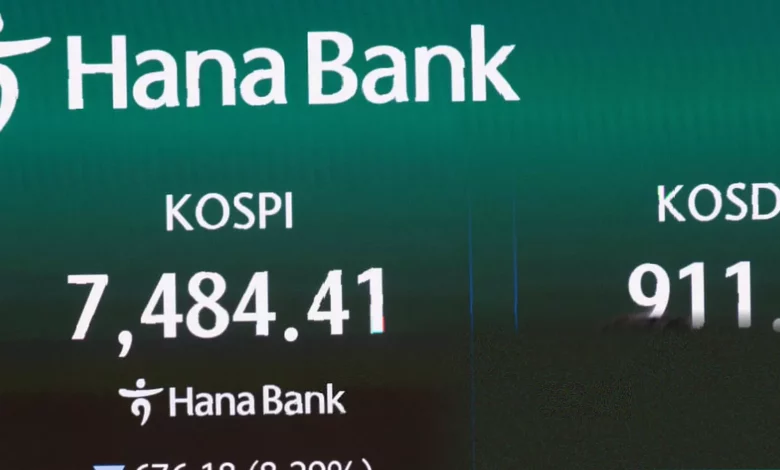
In Asia, the South Korean Kospi index plunged as much as 8.8% on Monday, triggering a circuit breaker that halted trading for 20 minutes – its biggest daily fall since March 4 and a 15% decline from its recent peak. Samsung Electronics and SK Hynix led the losses, with shares dropping 8.51% and 7.29% respectively. Japan’s Nikkei 225 closed down 3.85%, while Hong Kong’s Hang Seng fell 1.52% to its lowest level since March 30.
European markets also opened sharply lower. London’s FTSE 100 fell 0.4%, with jet engine maker Rolls-Royce and British Airways’ parent company IAG among the biggest fallers. Germany’s DAX, France’s CAC 40 and Spain’s IBEX 35 all declined. Shares in European companies at the heart of the artificial intelligence boom were particularly hard hit. Chip equipment maker ASML fell 3.2% to trade at $1,643.39, while BE Semiconductor Industries (Besi) dropped 4.5%. The German tech firm Aixtron slid nearly 6% to €54.64 – already below its last closing price of €59.20 and well above analysts’ consensus target of €42.70. Nokia, the Finnish telecoms firm, fell 5% to $14.38, despite having surged more than 160% year-to-date on the back of its AI infrastructure narrative.
Investor Sentiment Sours on Interest Rate Outlook
The rout reflects deepening concern among investors about the valuations of AI stocks, particularly as the prospect of higher inflation and interest rates this year grows. A strong US jobs report for May, showing 172,000 positions added, has bolstered expectations that the Federal Reserve will keep rates elevated for longer. Higher borrowing costs disproportionately affect tech companies, which rely on cheap debt to finance capital expenditure and are often valued on future earnings rather than current profits.
Susannah Streeter, chief investment strategist at the broker Wealth Club, said markets were now pricing in a greater likelihood of a rate rise from the Fed this year. “Fears of higher interest rates come just as tech giants, which have some of the deepest cash pockets, are seeking fresh funding to help finance eye-watering capital expenditure plans,” she said. “The demand is voracious right now, but there is concern that assets being invested in today, at a time when the technology is so expensive, could become obsolete further down the road.”
Charu Chanana, chief investment strategist at the investment bank Saxo, said: “The market is becoming more selective on AI. Investors now want clearer proof of earnings delivery, monetisation, capex discipline and funding returns. This looks more like a positioning reset than a regime break. The AI story is not over, but easy AI enthusiasm may be.”