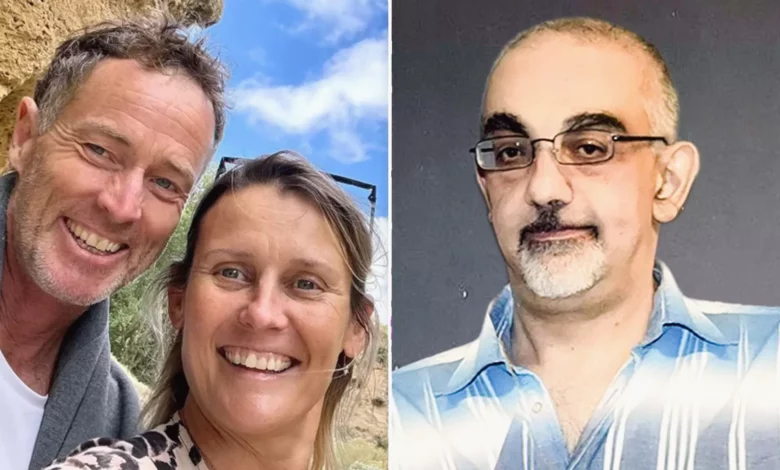
Britain has spent nearly £1 million of taxpayers’ money holding an Iranian stalker in maximum-security prisons for more than 16 years beyond his minimum sentence – while the same individual is now being cited as a potential bargaining chip in efforts to free a British couple from an Iranian jail.
Lindsay and Craig Foreman, both 53, were detained in Iran in January 2025 while on a round-the-world motorcycle tour. They were sentenced to 10 years in prison on espionage charges, which they strenuously deny, and are being held in Tehran’s notorious Evin prison. Their appeal against the conviction was rejected in February 2026 and the case has now been referred to the Supreme Court. Since May 2026, the couple have been on hunger strike to protest their detention conditions and the denial of phone calls and visits. Lindsay Foreman’s health has reportedly deteriorated significantly, with weight loss, low blood sugar and difficulty walking.
The Foremans’ ordeal
The couple’s son, Joe Bennett, has repeatedly urged the UK government to explore the possibility of a prisoner exchange involving Richard Jan, who was once described by police as “Britain’s worst stalker”. Bennett believes that Iranian officials have made clear signals that Jan’s return to Iran is the “only avenue” to secure his parents’ release. “If there’s a solution out there to get my parents back, why are we not exploring it?” he asked. He has also questioned the financial sense of keeping Jan behind bars. “At a time when public finances are under huge pressure, spending close to £1m keeping Richard Jan imprisoned beyond tariff feels increasingly hard to justify, especially if it is not leading to any meaningful progress or outcome.”
The cost of Jan’s incarceration since his minimum tariff expired in August 2010 is estimated at more than £900,000, according to Ministry of Justice figures on annual costs per prisoner. This sum does not include his healthcare, which is funded separately by NHS England. The average cost of a prison place in the UK is around £60,000 per year, and foreign national offenders collectively cost taxpayers an estimated £630 million annually.
The Foremans have been visited in Evin by the UK’s ambassador to Tehran, who has also facilitated calls with their family. The Foreign, Commonwealth and Development Office continues to advise against all travel to Iran, citing the significant risk of arrest or detention for British nationals.
The Richard Jan conundrum
Richard Jan, now 59, was sentenced to life imprisonment in July 2004 for a seven-year stalking campaign that terrorised approximately 200 victims. His crimes included arson with intent to endanger life and causing public nuisance. He was given a minimum tariff of seven and a half years, meaning he became eligible for parole or deportation from August 2010. Instead, he has remained in Category A prisons such as HMP Wakefield and HMP Frankland for over 23 years.
A deportation order was issued by the Home Office in 2013, but the Ministry of Justice blocked his removal, citing fears that it would undermine public confidence in the justice system. The Parole Board has twice refused to recommend his release to Iran – in October 2021 and December 2024 – because it would be unable to impose licence conditions there. Jan was a dual British-Iranian national until he renounced his British passport in prison, meaning he can never be freed in the UK. His lawyer, Mladen Kesar, has described him as “effectively trapped”.
Jan’s health is rapidly deteriorating. He now uses a wheelchair and has been transferred in recent days from HMP Frankland – which also holds Milly Dowler’s killer Levi Bellfield and Sarah Everard’s murderer Wayne Couzens – to a secure hospital. His mother, Peggy Jan, 90, has said he has been “left to rot”. His friend Peter Stanley, a chemistry teacher, argued that Jan has “done his time” and noted that murderers are often released more quickly. “I think they [the government] should take up the Iranians on this issue and release him to Iran, where he’ll be much better looked after,” Stanley said. “It would be a win-win situation, in the sense that it could be part of an exchange whereby the British couple could be released at the same time.”
Iranian officials have made “longstanding requests” for Jan’s return, the Iranian embassy has confirmed, describing his case as a “humanitarian” matter. They have repeatedly expressed concern about his mental and physical health and called for him to receive urgent medical care in Iran. His case was reportedly raised during negotiations in 2021 for the release of British-Iranian mother Nazanin Zaghari-Ratcliffe, who was freed in March 2022 after the UK settled a £400 million arms debt. More recently, an Iranian official holding the Foremans raised Jan’s case six months ago, according to reports.
Government response and the standoff
The UK government has so far refused to deport Jan, despite the Labour administration making the removal of foreign national offenders a key priority. Home Secretary Shabana Mahmood has warned that offenders “will be sent packing”. In August, new powers were introduced allowing foreign criminals to be deported after serving just 30 per cent of their sentence. Those serving life sentences, like Jan, are considered for deportation under the Tariff-Expired Removal Scheme once their minimum term is up – provided a deportation order is in place and there are no other barriers. Yet the Ministry of Justice has continued to block Jan’s removal, declining to comment on the cost figures.
A UK government spokesperson has warned against publicising the Foreman family’s appeal, stating: “There is no truth whatsoever to the claims of a potential exchange arrangement, and giving credence to these claims is not only wrong, but risks hindering all the other efforts currently being made by this government to secure the Foremans’ release.” However, Justice Secretary David Lammy appeared to leave the door slightly ajar. Speaking on Sky, he denied that the government’s mind is “closed” to an exchange, adding: “Those arrangements can be made. It would not be right for me to comment on the particularities, because it would undermine the discussions that we are having with the Iranians.” His comments have been seen as encouraging by Richard Ratcliffe, the husband of Nazanin Zaghari-Ratcliffe, who had previously rejected the idea of a swap involving a convicted criminal.
The Foremans’ MP, Tony Vaughan, has urged the government to fully explore whether Jan’s removal could help secure the couple’s release. “It’s an obvious issue that needs to be looked at, given Iran’s history of hostage taking,” Vaughan said. “I understand the position of His Majesty’s Government, that they don’t do prisoner swaps, but this wouldn’t need to be done by way of a prisoner swap. There would be other ways to do it – simply discharging their statutory obligations to deport foreign national offenders, which is in the public interest as a principle.”