Starmer tells tech firms to prevent children from sending or receiving nude images or face new laws

Tech companies face legal changes if they fail to protect children from explicit images, the prime minister has warned, giving the industry a three-month deadline to introduce device-level controls or face fines and potential criminal liability for their bosses.
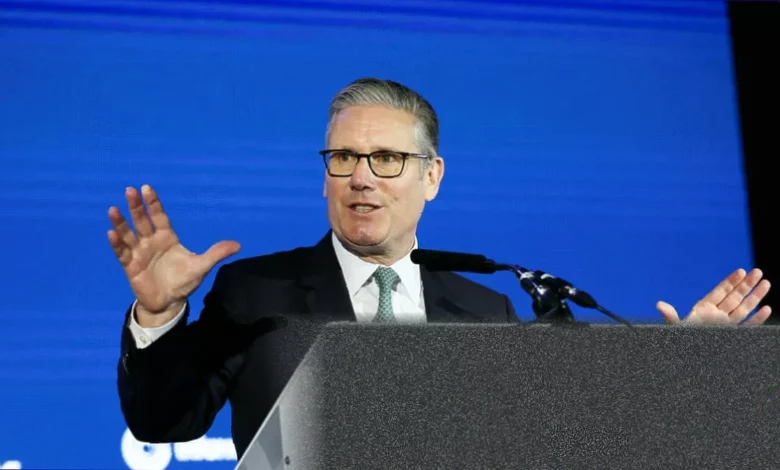
In a speech opening London Tech Week, Keir Starmer called on companies operating in the UK to activate built‑in features that prevent children from sending or receiving sexually explicit pictures on smartphones and tablets. If they do not act within three months, the government will bring forward legislation to force compliance. The Home Office said the proposed restrictions will apply to all UK devices, both existing and newly sold, and will require operating system providers and retailers to ensure that children cannot take, share or view nude images online. Adults will retain the ability to access such content after completing an age‑verification process.
Starmer said the move would make Britain the first country in the world where it is technically impossible for children to generate or view naked images on their own devices. “For too long, people have been told that is simply the price of modern tech, that nothing can be done, that government is powerless, that parents just have to accept it,” he said. “I reject that completely, because tech should adapt to the needs of society, not the other way around.” He cited the government’s previous action against the AI tool Grok, which was used to produce non‑consensual intimate images, as evidence of its willingness to act decisively. “Where technology poses a threat to our people, to our children, we will act quickly and firmly,” Starmer added.
The Home Office highlighted the work of the British internet safety firm SafeToNet, whose “HarmBlock” technology can detect and block nude content in real time, including during livestreams, and prevent images being taken if the camera identifies a child. The department said the technology that would allow companies to comply already exists but is applied inconsistently, often switched off by default and limited to blurring rather than blocking. Apple has already introduced age checks for iPhone users, making it the first company to activate safety features by default for those not verified as over 18, though the department noted that nudity detection is not yet applied to the camera, third‑party messaging services or search functions. The government now wants Apple and Google to block nudity across entire devices by default, with deactivation only possible through age assurance.
Campaigners welcome move; privacy groups raise alarm
Online safety campaigners broadly welcomed the announcement. Chris Sherwood, chief executive of the NSPCC, said online grooming, sexual exploitation and the proliferation of child sexual abuse material could be prevented if tech companies introduced nudity‑blocking technology at the device level. “This marks a major step forward in our fight against online child sexual abuse,” he said. Kerry Smith, chief executive of the Internet Watch Foundation, said a significant portion of child sexual abuse material is self‑generated by children as a result of grooming, coercion or manipulation. “We need device‑level detection and blocking alongside platform‑level protections,” Smith said, adding that the government’s plan would play a powerful role in a whole‑system response.
Richard Pursey, chair of SafeToNet, said the government was right to act and that its HarmBlock technology proved it is possible to make devices safe by default. “Let’s be blunt: manufacturers have built devices capable of facilitating illegal, explicit, image‑based harm to children,” he said. “With this world‑leading announcement we are finally shifting the battleground of a child’s online safety to the device.”
However, the civil liberties and privacy campaign group Big Brother Watch reacted with outrage. Its director, Silkie Carlo, described the plans as “outrageous” and said they would fail to address the underlying causes of online harm. She warned that the proposals would result in “population‑wide ID checks” for anyone using a phone, tablet or laptop, effectively creating a “backdoor digital ID requirement” that would end internet anonymity and privacy for millions of adults. “No one in a democracy should need to show their passport just to get online,” Carlo said. She argued that the government’s plan would replace meaningful tech and parental responsibility with “performative, authoritarian government control” that children could easily circumvent by using adult‑registered devices. “Planned restrictions on messaging, streaming and browsing raise the potential of spyware in our pockets that will be exploited for other purposes before long,” she added, warning that the UK risked becoming “one of the most authoritarian internet regimes in the world”.
Political context and criticism of Starmer’s timing
The prime minister’s announcement comes after Jess Phillips, who resigned as safeguarding minister last month, criticised him for not acting more quickly on the same plan. She said she had been pushing for it for more than a year. The Guardian’s Jessica Elgot observed that the speech “encapsulates much of Labour’s MPs frustration with him – ultimatums rather than action, talk big, act small”, adding that it gave the impression of “someone dragged kicking and screaming to enact their own policies”.
Separately, The Times has reported that Starmer is also considering a ban on “harmful” social media platforms for under‑16s, potentially using a hybrid system that combines elements of the Australian ban with the outlawing of specific features such as infinite scrolling, push notifications and autoplay. The children’s commissioner for England, Dame Rachel de Souza, has urged the government to go further and include 16‑ and 17‑year‑olds, as well as gaming platforms. “If we are genuinely seeking to safeguard children from harm, we cannot allow 16‑ and 17‑year‑olds to have lesser protection,” she said. De Souza, who is currently co‑producing government guidance on the appropriate age for a child to have a smartphone, said children themselves tell her that social media harms their sleep and that they want help reducing use. “We should ban the companies from having access to our children until they prove that they are actually worthy of them,” she told BBC Radio 4’s Today programme.
The Department for Work and Pensions also used the occasion to launch a trial of an “AI work assistant” designed to help the unemployed find work, offering 24‑hour guidance on career development and job applications.
By‑election backdrop
The flurry of announcements comes against the backdrop of the upcoming Makerfield by‑election, where the former Greater Manchester mayor Andy Burnham is the Labour candidate. Polling by Survation has shown Burnham leading his Reform UK rival Robert Kenyon by ten points. The pollster Peter Kellner, analysing the figures on his Substack blog, said tactical voting was helping Labour: support for the Greens, Liberal Democrats and Conservatives had fallen from 22 per cent at the general election to just four per cent now. Kellner concluded that a “big win” for Burnham – defined as a victory with a larger majority than the combined Reform UK and Restore Britain vote – was “more likely than not”, though he would not bet on it.
An unnamed minister quoted in The Times gave a blunt assessment of the prime minister’s strategy: “Keir has entered his legacy era. The conversations are now all, ‘What is announceable in time before Makerfield?’”