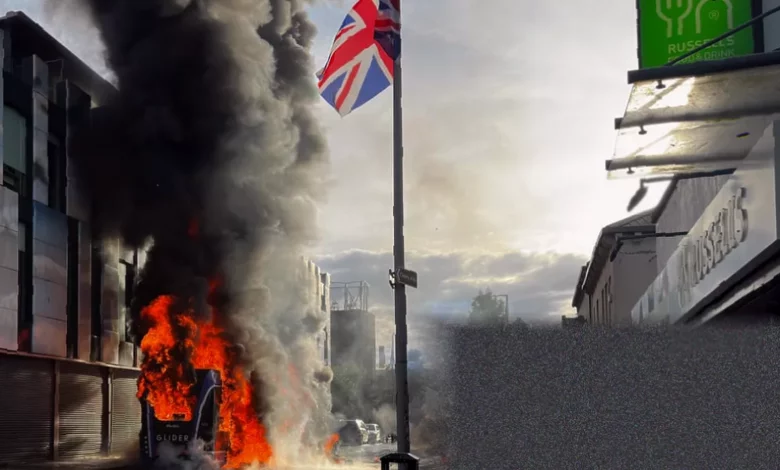
Far-right agitators incited violence across Northern Ireland on Tuesday night after a stabbing attack in Belfast, with crowds torching vehicles and blocking roads in scenes of disorder that police condemned as the work of “faceless” online provocateurs. Stephen Yaxley-Lennon, who uses the name Tommy Robinson, and the billionaire owner of X, Elon Musk, were among those who shared graphic footage of the assault and urged followers to take to the streets.
Vehicles ablaze as disorder spreads
Protesters hijacked and set fire to a Glider bus on the Newtownards Road in east Belfast and torched cars near the Shankill Road and in Newtownabbey, sending plumes of smoke into the sky as sirens sounded and a police helicopter circled overhead. Roads were blocked in multiple locations as crowds, some wearing masks and hoods, gathered. Assistant Chief Constable Ryan Henderson of the Police Service of Northern Ireland described “sporadic pockets of disorder” and appealed for calm, urging people to “avoid any activity that could place themselves or others at risk”. He asked all “voices of influence” within local communities to encourage peaceful protest and discourage violence.
The unrest came hours after police charged a 30‑year‑old asylum seeker from Sudan in connection with the stabbing. Chief Constable Jon Boutcher – who took up his post in October 2023 and previously led Bedfordshire Police and the Operation Kenova investigation – warned the public not to be “fooled or duped by people online”. He stressed that those inciting disorder “know nothing about this brilliant, vibrant place” and highlighted the “toxic” nature of online discourse, noting that it risked driving ordinary people to act out of character. The PSNI has increased its presence across Northern Ireland in response.
The attack that sparked the violence
The stabbing occurred at about 10.30pm on Monday outside a block of flats in north Belfast. Video shared widely on social media showed a man straddling another man on the ground and striking at his head and neck. A kitchen knife was recovered from the scene. Police said the victim, a man in his 40s, suffered serious injuries to his eyes, face and back. Bystanders intervened to stop the assault; one man, later named locally as Maitiu Mag Tighearnan, used a hurling stick against the attacker multiple times.
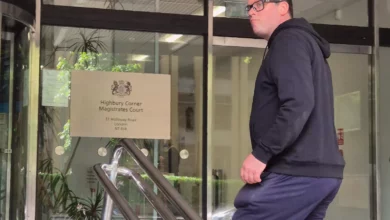
The suspect, a Sudanese asylum seeker, has been charged with attempted murder, possession of an article with a blade or point in a public place, and threats to kill. He is due to appear at Belfast Magistrates’ Court on Wednesday. According to Chief Constable Boutcher, the suspect was granted leave to remain in the United Kingdom on 28 September 2023. Boutcher told a press conference: “I’m informed that he made his way from Sudan to Paris at dates unknown, and from Paris he flew to Dublin at a date yet to be determined.” The suspect then travelled from Dublin to Belfast by bus on 10 February 2023 and claimed asylum. “There is no trace of this suspect on any of our national security databases, and he was not known to the Police Service of Northern Ireland. I’ve been in direct contact with the head of terrorism policing in the UK. At this stage, we have no information to suggest that this was terrorist-related,” Boutcher said.
Far‑right figures and online incitement
The role of far‑right figures in stoking the unrest has drawn widespread condemnation. Stephen Yaxley‑Lennon shared the attack video and posted calls for protests in central London and elsewhere in the UK, providing specific locations. Elon Musk, who owns the social media platform X, posted a list of potential protest areas and wrote: “Only by protesting REPEATEDLY and LOUDLY will there be any change!!” Right‑wing commentators from England and the United States, including the MP Rupert Lowe, also posted about the attack.
Politicians and community leaders accused the far right of deliberately seeking to foment disorder in Northern Ireland and across the UK. The PSNI and Garda have previously warned that agitators from outside Ireland amplify far‑right disinformation through social media, making it challenging to police. The recent unrest follows a pattern of similar violence: in June 2025, riots broke out in Ballymena, Newtownabbey, Carrickfergus and Larne after a protest concerning an alleged sexual assault, with ethnic minorities reportedly targeted. In April 2021, riots involving petrol bombs, hijacked vehicles and attacks on police officers occurred in Newtownabbey, the Sandy Row area of Belfast, and Derry, linked to post‑Brexit tensions. More recently, in June 2026, riots erupted in Southampton on the fringes of a protest following the release of bodycam footage related to the fatal stabbing of student Henry Nowak; far‑right agitators including Tommy Robinson amplified narratives around that incident. The far right has a long history in the UK, with movements ranging from fascism to white nationalism, and in recent years there has been a growing threat from extreme right‑wing terrorism.
Reform UK’s home affairs spokesperson, Zia Yusuf, linked the Belfast attack to immigration policy, stating: “The horror of what you have seen in Belfast is a direct result of treacherous Tory and Labour immigration policy. Reform has already announced a total ban on visas for anyone from Sudan. Enough is enough.”
Political and community response
Political leaders across the spectrum condemned both the original assault and the ensuing violence. Prime Minister Keir Starmer called the attack “sickening”, saying: “I have absolutely no tolerance for abhorrent scenes of violence like this on our streets. My thoughts are first and foremost with the victim, and I thank the first responders, including members of the public who intervened.” First Minister Michelle O’Neill urged the public not to be persuaded by social media accounts to start causing disorder. “For all of those people out there who are stoking up tensions in that social media space, who are happy to raise tensions, they do not represent us. We are good people and I don’t want to see anybody living in fear,” she said. Stormont Justice Minister Naomi Long echoed the appeal, describing the images as “deeply disturbing and traumatising to view” and warning of “bad faith actors who want to stir trouble”.
The impact on immigrant communities was immediate. Sudanese business owners on Sandy Row, a loyalist area of central Belfast, closed their stores with steel shutters by 4pm and said they planned to stay at home that night. The Belfast Islamic Centre cancelled evening prayers. “We are telling our congregation to go home, don’t go out, look after your children, don’t share rumours and do listen to the authorities,” said Ameer Ibrahim, a project manager who spoke in a personal capacity.