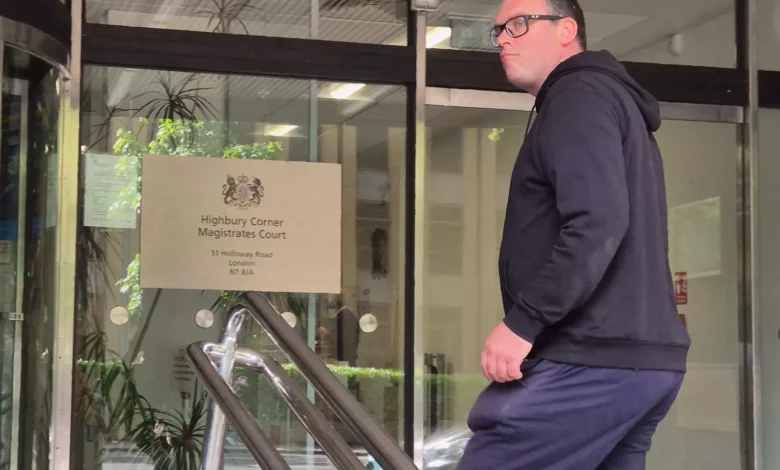
A man has been convicted under a new law banning sex-based harassment, in the first prosecution of its kind since the legislation came into force at the start of this month.
David Stroud, 44, of Dartford, was sentenced at Highbury Corner Magistrates’ Court after pleading guilty to harassing a woman on a train because of her sex. The incident took place on 3 April – just two days after the new offence under Section 4B of the Public Order Act 1986 took effect on 1 April. Stroud was also sentenced for a separate 22-month stalking campaign against another victim, for which he had been on bail at the time of the train harassment. He received a 12-month community order, 15 days of rehabilitation activity, 150 hours of unpaid work, and a 90-day alcohol abstinence monitoring tag. District Judge Caroline Jackson additionally imposed a five-year restraining order for the stalking victim.
The court heard that Stroud sat next to the woman on a train from Hastings to London that departed at about 8.50pm. She was on the phone to her boyfriend. Stroud attempted to make conversation but the victim, a lone female traveller, tried to ignore him. He was “constantly leaning on to the woman” and moved closer, telling her “you’re magical” before grabbing her hair – an act she perceived to be sexual. She said she could smell alcohol on his breath. Stroud told her: “You’re never going to find someone who loves your hair as much as I do.” When she replied that she already had a partner, he asked: “Can I kiss you?” She told him: “Absolutely not.”
The victim’s boyfriend, who heard the exchange over the phone, contacted British Transport Police, who arrested Stroud at London Bridge station. When questioned under caution, Stroud claimed: “It’s just banter. We had banter together, do you know what I mean?” He added: “I’ve done nothing wrong to her.” The victim later described feeling “trapped, powerless and petrified”. She said the experience left her unable to travel alone and needing company whenever she leaves the house, because she is a woman. She also said she felt “very uncomfortable” and “cornered”, and that the incident changed how she approaches everyday activities.
The new sex-based harassment law
The conviction marks the first use of Section 4B of the Public Order Act 1986, introduced by the Protection from Sex-based Harassment in Public Act 2023. That act received Royal Assent on 18 September 2023 after being brought forward as a Private Members’ Bill by former Conservative MP Greg Clark and Lord Wolfson of Tredegar. The new offence criminalises behaviour that intentionally causes harassment, alarm or distress because of a person’s sex or presumed sex. Crucially, the behaviour does not have to be sexual in nature – it is enough that the victim is targeted because of their sex.
The law is designed to cover street harassment, public transport incidents, parks and other public places, but it can also apply in private places, with the exception of dwellings. It fills a gap between conduct that is serious but may not meet the threshold for sexual assault, according to Olivia Rose, deputy chief Crown prosecutor and the Crown Prosecution Service’s lead on stalking. Those found guilty face a maximum prison sentence of two years, a fine, or both – a significantly higher maximum than the existing Section 4A offence, which carries only six months’ imprisonment.
The Crown Prosecution Service said it hoped the prosecution would send a clear message. “If you think you are going to get away with sex-based harassment because you consider it just to be friendly banter, it isn’t,” said Rose. “This is a serious offence and you will be prosecuted. I want to send a message to victims so they feel that they can come forward, because they will be taken seriously.”
British Transport Police, which has made 26 arrests under the new law since it came into effect, had urged the government to introduce the legislation to bolster efforts against sex-based harassment on the railway. The alcohol abstinence monitoring tag imposed on Stroud – which monitors alcohol levels in sweat and was rolled out nationally in 2020 – reflects the court’s view that alcohol was a contributing factor. Breaching the requirement can lead to further sanctions, including imprisonment.
The stalking offence for which Stroud was also sentenced involved a separate victim: his ex-partner’s adult daughter. The court heard he frequently visited her home, sent unwanted gifts and more than 200 emails. Stalking Protection Orders, which can be applied for by police to intervene early, typically last between two and five years. In this case, the five-year restraining order was made specifically to protect the stalking victim.
The victim of the train harassment said she hoped her case would encourage others to report similar incidents. “This justice proves it’s worth reporting to police as it will be taken seriously,” she said.