A protest by a pro-Palestine activist who climbed Big Ben barefoot and remained on the landmark for more than 15 hours cost British taxpayers £67,000, a court has heard. The figure, representing lost revenue from cancelled parliamentary tours and operations, was disclosed at Southwark Crown Court during the trial of Daniel Day, who denies causing a public nuisance.
The Financial Toll
Alison Giles, the director of security for Parliament, told the court that the £67,000 loss was an estimate of the revenue that would have been generated from visitors and which ordinarily helps offset the running costs of the Houses of Parliament. “Ultimately it is a cost to the British taxpayer because those funds are used to offset the running costs of the Houses of Parliament,” she said.
More than 2,500 visits – largely by tourists – were cancelled on Saturday 8 March 2025, when Day scaled the Elizabeth Tower. Maintenance workers and business pass holders were also prevented from accessing the Westminster estate. Ms Giles explained that all security personnel and police were focused on the incident and that it would have been “absolutely inappropriate” to allow visits to continue with a man in a “precarious position” at height.
Transport for London separately lost an estimated £25,000 in bus fares. Clint Robertson of TfL told the court that diversions and curtailed routes meant passengers “would have avoided the buses because of the disruption”.
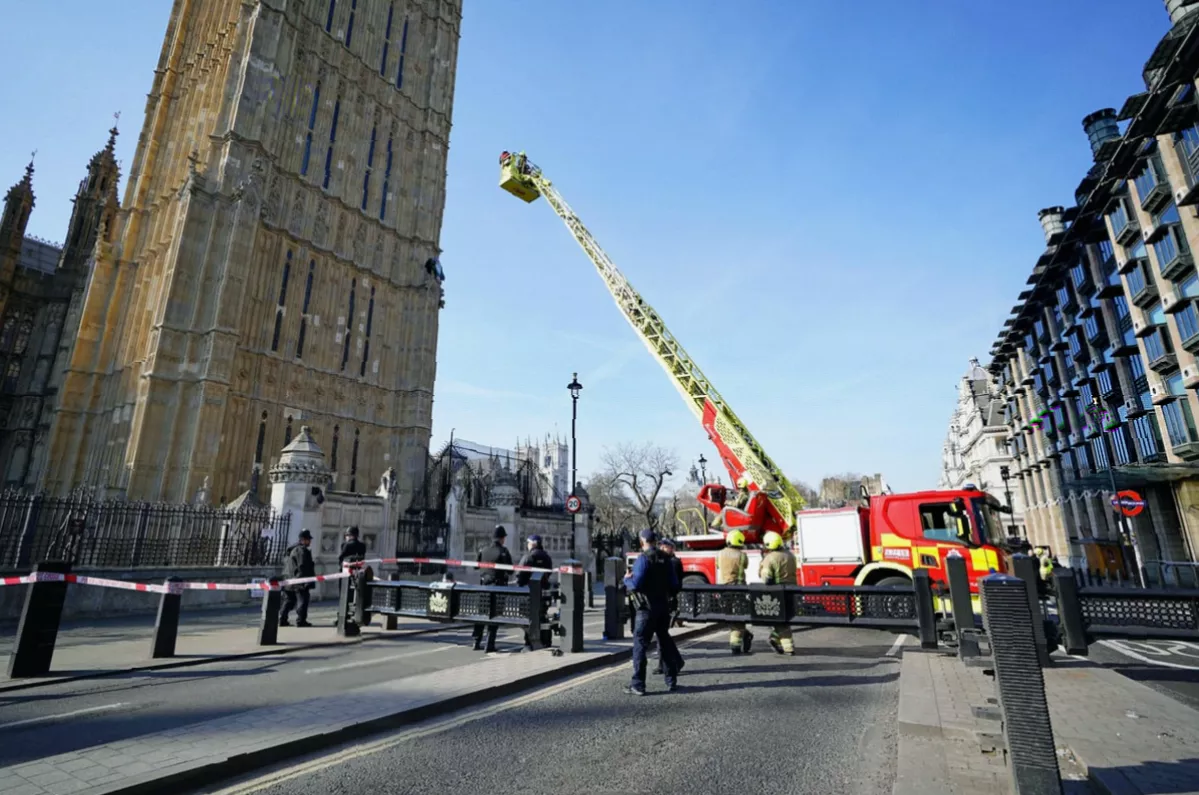
The wider cost of policing and the emergency response has been calculated at £190,786.96. This includes £169,856.87 in opportunity costs – the value of officers diverted from other duties – an estimated £20,000 in overtime, and £930.09 in internal fleet costs. The London Fire Brigade put its own attendance cost at £30,960 excluding VAT, or £37,152 including VAT, based on a charge of £430 per hour for special service calls.
Disruption and Emergency Response
Day, 30, from Westcliff-on-Sea, Essex, began climbing the Elizabeth Tower at around 7.20am on 8 March and did not come down until after midnight. He was barefoot, waved a Palestine flag and wore a keffiyeh, live-streaming his actions on Instagram while shouting slogans including “Free Palestine” and “Israel is a terrorist state”.
Police spotted him within three minutes and immediately began managing the incident. Westminster Bridge was closed, along with sections of Parliament Square, Bridge Street and access off the Embankment. Road blocks were put in place and bus routes were diverted. At one point sympathetic protesters blocked a fire engine on Bridge Street, a sight that Chief Inspector Jonathan Waterfield described as “one of those things that is hard to believe when you see it play in front of your eyes”.
Mattresses were placed at the base of the tower as a safety measure because of fears Day might fall. A cherry picker with a police negotiator was brought in to try to persuade him to come down. Specialist rope-trained officers from the Metropolitan Police, the London Fire Brigade and the London Ambulance Service were all deployed. Ms Giles said the priority was “safeguarding life”.
The court heard that officers who would normally have been dealing with 999 calls, domestic violence and crime hotspots were redeployed from their local boroughs across the capital to replace those on duty in central London. Chief Inspector Waterfield had to move officers from a planned static protest outside the BBC and from another location in east London that was being “targeted” for patrol as a crime hotspot.
Crowds of supporters gathered, chanting “Free Palestine” and calling Day a hero. The negotiator reported “real concerns” that the interaction between Day and the crowd – who were holding Palestinian flags and sympathising with him – could cause him to slip. Day was shouting to the group on Bridge Street, and at one point threatened to climb higher if police came too close. His feet were bleeding on the stone, and concerns were raised about his attire in the dropping temperatures.
The incident prompted a security review of the Elizabeth Tower, ordered by Commons Speaker Sir Lindsay Hoyle, after questions were raised about how Day managed to scale the structure without immediate challenge.
The Denial
Daniel Day denies intentionally or recklessly causing a public nuisance and trespassing on a protected site. He has pleaded not guilty and was remanded in custody at one stage before being released on conditional bail. The trial at Southwark Crown Court continues.
He has said he was protesting against British involvement in the conflict in Gaza and what he described as “police repression and state violence”. Previous protests at the same site include an Extinction Rebellion activist who climbed scaffolding around the tower in 2019 and an anti-lockdown protester who did so in October 2020.