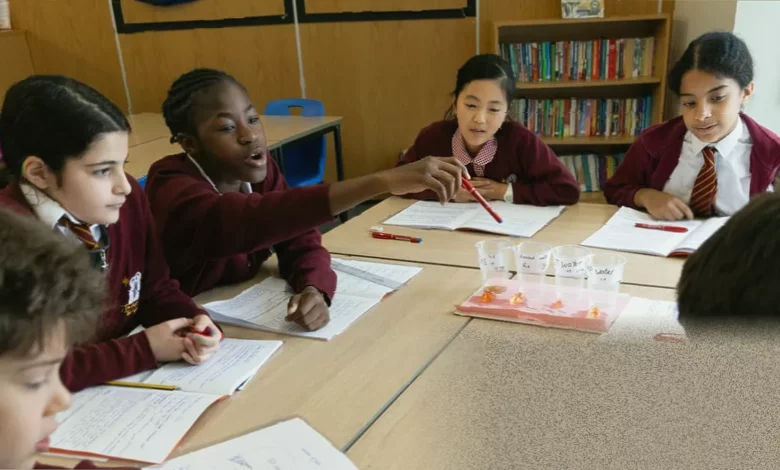
Pupils at a London primary school have successfully banned teachers from using smartphones – along with laptops, tablets and monitors – after proposing a monthly screen-free day designed to get the whole community looking up from their devices.
Sophie Janashia, a Year 6 pupil at Holy Family Catholic Primary School in Ealing, west London, first raised the idea with classmates and teachers, arguing that a single school-wide day without screens could benefit everyone. “It’s very important to me because I see people I know spending all their time on screens and it means sometimes we are together but we’re not really together,” she said.
The initiative, now a regular monthly event known as screen-free Monday, applies to staff as well as pupils. Teachers give up interactive whiteboards, video clips and their own phones, reverting to traditional, hands-on classroom activities. Deputy head Yvonne Rutherford said the move had forced some teachers to rethink their lesson delivery and adopt a more creative approach to designing activities. “It’s been great to see,” she added.
Sophie’s proposal has resonated beyond the classroom. The school’s screen-free days have attracted visits from other local schools curious about how to replicate the idea, and have drawn the attention of government ministers. Sophie herself has discussed the issue with Liz Kendall, the technology secretary, who is considering plans to ban or restrict social media for under-16s. Kanishka Narayan, the minister for AI and online safety, has also visited the school to speak with Sophie and fellow pupils who serve as online safety ambassadors.
Parental engagement that surprised the school
What has most astonished the school’s leadership, however, is the level of parent participation. “We didn’t really expect parents to take part,” Rutherford admitted. “But it seems that after talking about it with their children, and reading about it in the school newsletters, they’ve wanted to be involved.”
After the first screen-free Monday, parents began sending in photographs of family activities they had done in the evening instead of staring at screens. The school now receives a flood of such images every month: children playing cards, reading books, going for walks, and playing sport with their parents. The impact on family life has been substantial. Fabiola Vicente, a parent of a Year 6 pupil, said the initiative made her more conscious of her own phone habit. “It’s a bad habit that crept up on me,” she explained. She now makes a deliberate effort to leave her phone in another room on other days of the week as well.
Another parent, Hisae Suzuki, described her daughter as having been “a little bit addicted” to screens. The screen-free days, she said, acted as “a good reminder – we all knew about it but we didn’t do anything about it, we needed a trigger.” Suzuki added: “My daughter and I have had to change our attitudes, and we know that the power of habit is very strong.”
Pupils themselves have noticed the difference at home. Leo, a student at the school, said his parents joined in after the first screen-free day. “We started playing games after dinner instead of watching TV. I’ve got more time left after homework and violin practice.” He admitted he sometimes has to remind his parents to stick to the rule and once caught his father playing video games at night. “But I caught him,” he said with a note of triumph.
Other children said they valued mealtimes where parents were less distracted by their phones. “Sometimes when they are using their phone, they say they have to because it’s for work, but I don’t think it is,” one child remarked, to nods from classmates.
Teacher reaction and government interest
For teachers, the shift has been equally significant. Giving up digital tools has meant returning to chalk-and-talk methods and more interactive, physical activities. Rutherford said the process had been a valuable professional exercise, prompting staff to design lessons that rely on direct engagement rather than on-screen resources.
The wider policy environment is also changing. Ofsted now checks school mobile-phone policies during inspections, and there is a government push for schools to be “phone-free by default.” Holy Family itself received an “Outstanding” rating from Ofsted in May 2024, with inspectors praising its exemplary behaviour, quality of education, personal development, leadership and early-years provision. The report specifically noted the school’s commitment to online safety, with pupils acting as ambassadors for their peers.
At the national level, the government is actively exploring measures to restrict social media for under-16s. A consultation on the issue received strong parental backing, with reports indicating that 90 per cent of parents favour Australian-style restrictions. Potential options under consideration include outright bans, age limits, or curfews on app usage. Official guidance already sets recommended screen-time limits for children aged 5 to 16 and specific advice for under-fives.
Research into screen time suggests that excessive use can harm children’s language development, attention spans and social-emotional skills, though parent involvement in co-viewing content and in screen-free conversations can mitigate some effects. The ongoing debate reflects differing views on whether outright bans or managed usage are more effective, and whether children’s perceptions of reasonable limits align with those of their parents.
Rutherford summed up the initiative’s real achievement as the conversations it has sparked. “The discussions have been the best things, getting parents involved and families taking part,” she said.