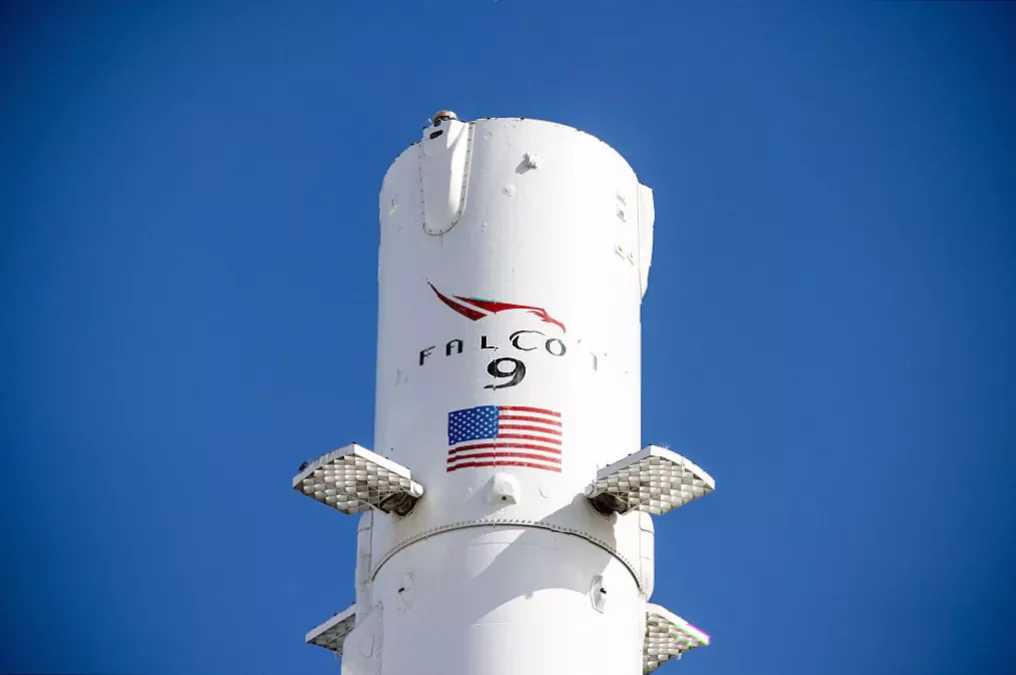
A single launch of SpaceX’s Falcon 9 rocket consumes between 14% and 18% of the world’s daily helium production in one ignition sequence. With SpaceX launching dozens of times a year and ambitions to far exceed that frequency, the demand for this obscure gas is climbing faster than the market can supply. The satellite industry is already planning for annual launch volumes of 3,700 to 5,000 by 2030 as mega-constellations reach full deployment, and Goldman Sachs forecasts 70,000 low Earth orbit satellite launches globally between 2025 and 2031. Every single satellite that goes up needs helium. There is no alternative.
Rocket demand and the binding constraint
Elon Musk has stated plainly that there is not enough helium produced on Earth to sustain a high-flight-rate Starship programme. The constraint was significant enough that the vehicle had to be redesigned around it. SpaceX’s S-1 registration statement, filed ahead of its anticipated public listing, conspicuously omits any reference to risk associated with helium supply — a material operational risk the company’s own CEO has acknowledged. The rocket industry is not alone in its hunger for helium; it is merely the most visible consumer of a gas that underpins every major growth theme in the global economy.
Supply vulnerability: a fragile and concentrated chain
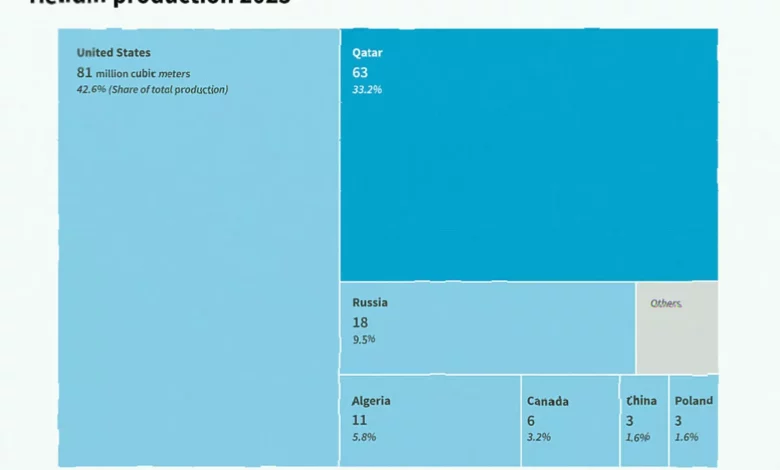
Helium cannot be manufactured. It is extracted as a by-product of natural gas processing, and only in a handful of locations where underground concentrations — typically ranging from 0.3% to 4% by volume — are commercially viable. The United States and Qatar together account for more than 75% of global supply. Russia produces a significant share but that supply is largely unavailable to Western markets due to sanctions. Algeria and Canada contribute smaller fractions; everyone else is a rounding error.
Qatar’s share, roughly 30% of world production, flows from a single industrial complex at Ras Laffan, the world’s largest helium production base. In March 2026, Iranian missile and drone strikes forced QatarEnergy to cease production of liquefied natural gas and associated products, including helium, from that complex. Almost one-third of the world’s helium supply was removed from the market overnight. Spot prices doubled immediately and are expected to rise further. The south site at Ras Laffan took direct hits and will not restart before late summer 2026; some reports indicate that around 14% of Qatar’s helium export capacity — equivalent to 4–5% of global supply — could be offline for years. QatarEnergy declared force majeure on affected contracts. Analysts say permanent capacity reductions will take years to recover fully.
The Strait of Hormuz was the trigger, not the underlying problem. Even before the first missile flew, this market had endured four recognised major shortages over the past two decades — in 2006–07, 2012, 2018–19 and 2021 — each lasting two to three years before any equilibrium was restored. The conflict simply made the market’s structural deficit visible.
Why helium cannot be stockpiled
Compounding the supply picture is the nature of helium itself. It is the second-lightest gas on Earth and escapes containment at a rate that makes strategic stockpiling impossible. Helium is formed deep underground through the radioactive decay of elements such as uranium and thorium, then becomes trapped in natural gas reservoirs from which it is extracted. Its low boiling point and tiny atomic structure mean that even the most robust storage vessels leak over time. You cannot build a meaningful reserve. When supply breaks, the market has no buffer. This characteristic explains why previous shortages have dragged on for years: there is no stockpile to draw down, and new production capacity takes years to bring online because it is tied to the economics of natural gas extraction.
Helium supply is inelastic — it cannot be quickly increased to meet rising demand. Most sales occur through long-term contracts, but spot prices can fluctuate dramatically. During the current crisis, contract prices are expected to rise significantly. In times of shortage, the industry typically prioritises critical sectors such as medicine and chipmaking, leaving other users to scramble for whatever is left.
Competing industries: semiconductors, healthcare and quantum computing
Now consider who is competing for that inelastic pool of supply. Semiconductor makers use helium at nearly every stage of wafer production, and there is no substitute for its role in extreme ultraviolet (EUV) lithography, the process that makes the most advanced AI chips. Helium cools the light sources in ASML EUV machines, which are essential for etching transistors at the nanometre scale. Its transparency to UV wavelengths, chemical inertness and high thermal conductivity make it irreplaceable. The semiconductor industry’s share of global helium consumption is projected to grow from 24% to 30% by 2030, and advanced nodes such as 2nm and High-NA EUV will increase helium consumption per wafer. The AI-driven chip market is set to double by 2030 at a compound annual growth rate above 11%.
MRI machines account for 20% of global helium demand, each requiring an initial fill of around 2,000 litres of liquid helium and continuous top-ups throughout their operational life. As India and other large emerging markets rapidly expand healthcare infrastructure, that demand grows structurally. Innovations such as Philips’ BlueSeal MRI technology are reducing helium consumption significantly — some systems use only 0.5% of the helium of conventional scanners, and globally more than 1.9 million litres of helium have been saved by these systems since 2018. But such technologies are not yet ubiquitous.
Then there is the quantum-computing sector, scaling fast and entirely dependent on liquid helium cooling — using helium-3 and helium-4 isotopes in dilution refrigerators — to reach the cryogenic temperatures below 100 millikelvin that make quantum processors function at all. Rocketry, AI chips, medical imaging and quantum computing: the three or four fastest-growing sectors in the global economy all compete for the same gas from the same small group of producers, and one of those producers has just been taken off the board for an indeterminate period.
The UK’s exposure: a policy gap with no domestic production
Britain has no domestic helium production and no strategic reserve. The gas was added to the UK’s 2024 Critical Minerals List, acknowledging its strategic importance, yet it still receives little policy attention in Whitehall. The NHS scanner estate is directly reliant on helium for MRI machines; questions have been raised in Parliament about how to minimise usage and increase reuse in light of the global shortage. The National Quantum Computing Centre at Harwell depends on helium for its operations. The defence-electronics supply chain is also exposed. Investors who recognise this gap before policymakers do may find opportunities — particularly in the industrial gas companies Linde, Air Products & Chemicals and Air Liquide, which are the obvious primary beneficiaries of tighter supply and rising prices, with pricing power that will compound through long-term contracts.
Helium has been treated as background infrastructure for too long — too cheap, too abundant, too boring to warrant serious analysis. The commodity no one talks about is the one underpinning the launches everyone is watching, the chips powering the AI everyone is funding and the scanners keeping hospitals operational.