
Classic children’s books from the Janet and John series have become the latest exhibits to carry advisory notices at the Black Country Living Museum, as the West Midlands heritage site seeks to confront outdated attitudes in its historical collections.
Visitors who browse a Janet and John volume in the museum’s recently opened Woodside Library encounter a notice that states: “This book may contain negative depictions of people or cultures and outdated views. These depictions were wrong then and are wrong now. Rather than remove the book, we want to acknowledge its existence and impact, learn from it, and spark conversations to make for a more inclusive future.” Critics argue that the series, which follows the simple adventures of two siblings and their pet dog, portrays an idealised, homogeneous mid-20th-century society that reinforces traditional stereotypes, including an adventurous boy and a girl shown in domestic roles, and is said to lack diversity.
Why the museum adopted a blanket warning
The advisory notice appears in every book inside the library, not just on selected titles. The museum’s decision to apply a uniform warning across its entire collection of more than 6,500 books, magazines, newspapers and records stems from practical and philosophical considerations. Hannah Parsons, Head of Development & Communications for the Black Country Living Museum, said: “Given the scale of the collection, it is not practical to review every item individually. We are also aware that some historical publications may include language, attitudes or assumptions that some visitors could find upsetting, inappropriate or outdated. For that reason, the same advisory notice appears throughout the collection rather than being applied selectively to individual books.”
Parsons emphasised that the museum has not altered the content of the books. “We have not edited, amended or removed content from the books in our collection. As a museum, our role is to preserve and share the past, and the advisory notice helps provide context for visitors exploring the collection today. The advisory notice also explains why we have chosen to preserve these materials and make them available for learning, discussion and reflection.” She added that the wording and approach were developed in consultation with colleagues, the museum’s Community Advisory Panel and heritage-sector professionals.
The Janet and John series, first published in the UK in 1949-50 by James Nisbet and Company, was adapted from American primers and designed for early reading instruction using the “look and say” method, which relies on repetition and visual cues rather than phonics. It became hugely popular and by 1968 was used in 81 per cent of English primary schools. The original series was discontinued in 1976 following criticism of both its teaching method and its social portrayal of an overwhelmingly white, middle-class, gender-stereotyped world. The phrase “Janet and John” entered common parlance as shorthand for simplistic language. The specific book flagged at the museum contains straightforward passages such as “look at the aeroplane, I want to fly in it” and “the aeroplane can fly fast”.
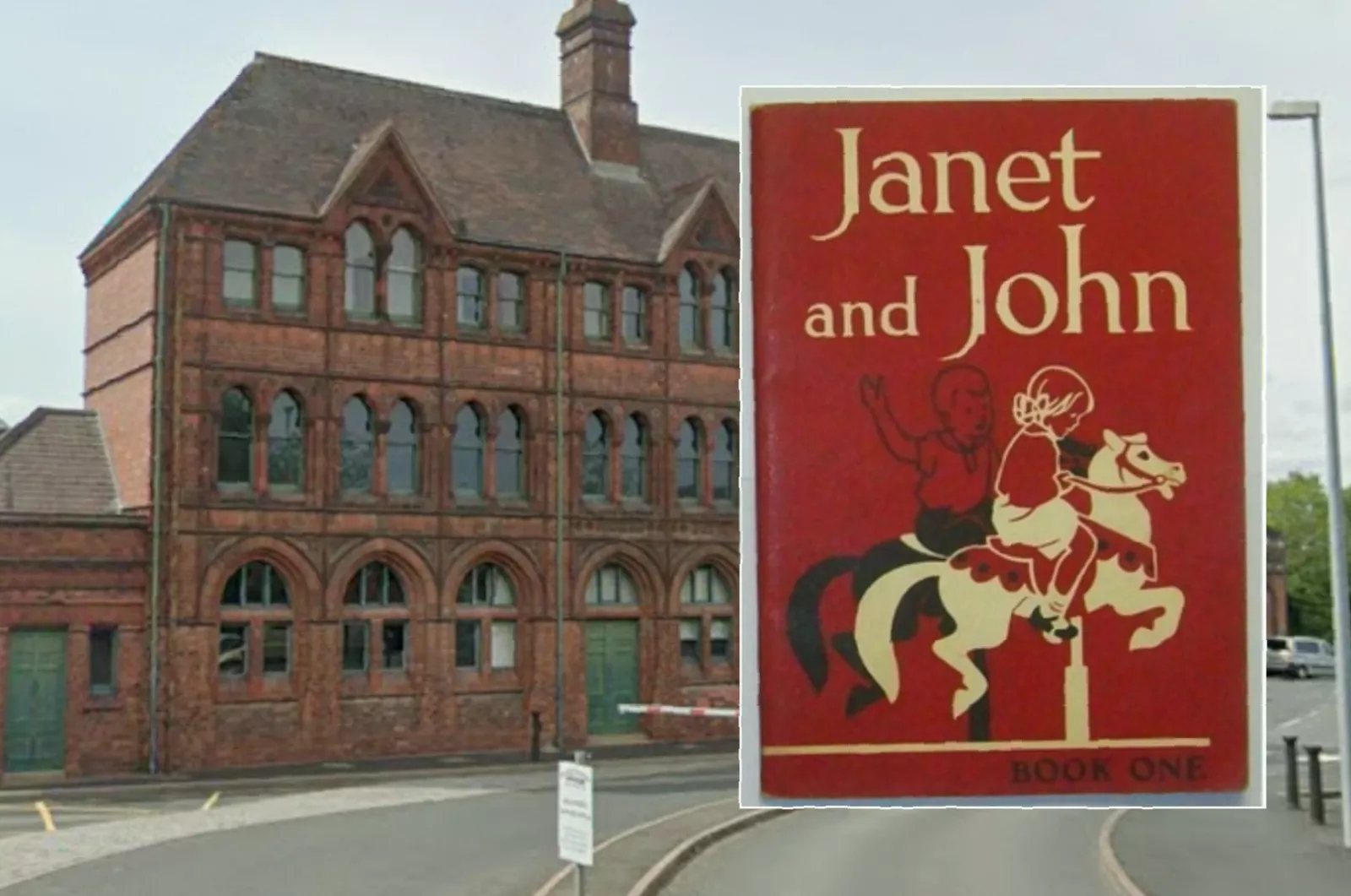
The library is part of the museum’s £30 million “Forging Ahead” development project, which extends the site’s historical scope to encompass the post-Windrush period of the 1940s to 1960s. The museum meticulously relocated and rebuilt Woodside Library, originally established in Dudley in 1894, as a centrepiece of its new 1940s-60s high street, representing the year 1963. The collection has been largely assembled through donations and is intended to reflect the range of literature available to readers during that era. Andrew Lovett, the museum’s chief executive, explained the rationale behind the expanded timeline: “We are in one of the most culturally and ethnically diverse bits of the country, and yet we would readily have admitted that the story we were telling previously wasn’t representative of the modern-day Black Country.”
Beyond children’s literature, the same advisory notice has been applied to Ian Fleming’s James Bond spy novels, which underwent sensitivity reader revisions in 2023 over concerns about racist language. Agatha Christie’s Murder at the Gallop and a short story collection by H.G. Wells have also been flagged. The museum has extended its warning system to military memoirs, including first and second world war veterans’ accounts, among them The Road to En-dor by Elias Henry Jones, which recounts the authors’ experiences as prisoners of war in Turkey and their escape plot involving spiritualist experiments.
As part of the museum’s broader historical expansion, actors portraying new characters have been introduced to reflect demographic shifts of the era, including Fitzroy Barrett, a 1950s figure who shares his Jamaican background and experiences of racism in Britain with visitors. The museum’s Community Advisory Panel, whose members provide insights from lived experiences, helped develop the wording of the advisory notices and challenged the institution to ensure inclusivity. Parsons noted that since opening this spring, Woodside Library has become one of the most popular parts of the museum, attracting strong feedback and helping tell richer stories about life in the Black Country during the 1940s, 1950s and 1960s.