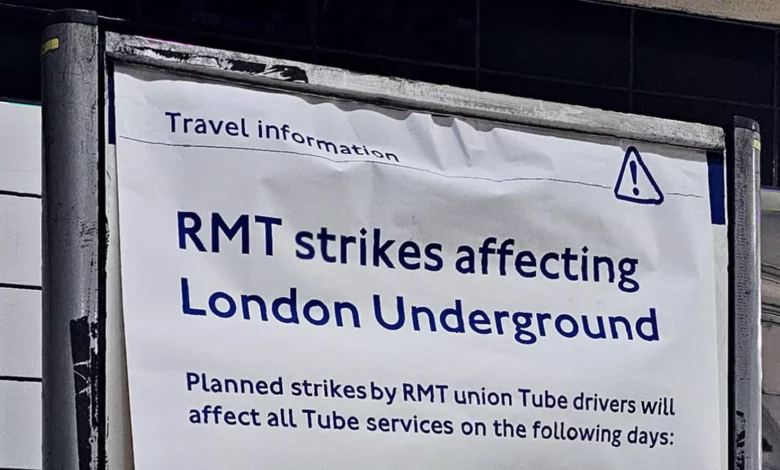
London Underground faces severe disruption next week as members of the Rail, Maritime and Transport (RMT) union stage a series of 24-hour strikes from Tuesday 19 May to Friday 22 May. Transport for London (TfL) has warned passengers to expect significant knock-on effects across the network, with service levels varying sharply on each day of industrial action.
Services are expected to begin winding down from late morning on strike days, with substantial disruption forecast from midday onwards. On the first day of action, Tuesday 19 May, normal running is anticipated until mid-morning, after which some services will be reduced ahead of the walkout. Significant disruption is then expected across all lines from around noon. The same pattern is likely to repeat on Thursday 21 May. On the days immediately following the strikes — Wednesday 20 May and Friday 22 May — severe disruption will continue through the morning, with services gradually returning to normal during the afternoon and evening. TfL has previously advised passengers to complete journeys by 8pm on strike days, and early finishes are expected on some dates.
Lines with no service
While the entire Tube network will be affected, several key lines will see no service at all. The Circle line and the Piccadilly line are both expected to be completely suspended. On the Central line, no trains will run between White City and Liverpool Street. On the Metropolitan line, the section between Baker Street and Aldgate will also be closed. Passengers relying on these routes will need to find alternative travel options throughout the week.
Other TfL services — including the Elizabeth line, the Docklands Light Railway, London Overground, buses and trams — are scheduled to run as normal. However, TfL has warned that these services are likely to be exceptionally busy because of the Tube strikes, as passengers switch to alternative modes of transport.
Resilience during previous strikes
Despite the scale of the walkout, TfL has pointed to its performance during the last round of RMT strikes in April to argue that the network can maintain reasonable service levels. During that period, the authority said that more than half of normal Tube demand was observed on every day of action. On the final day, Friday 24 April, the network saw 94 per cent of normal demand, indicating that Londoners and visitors were still able to get around the city.
The current strike is part of a larger programme of industrial action scheduled by the RMT between April and June 2026. The dispute centres on TfL’s proposal to introduce a voluntary four-day compressed working week for Tube drivers, initially as a trial on the Bakerloo line. The RMT opposes the plan, citing concerns over increased driver fatigue, longer shifts, reduced notice periods for shift changes and potential impacts on passenger safety. The union is instead calling for a 32-hour working week spread over four days on the same salary, a demand TfL has described as “unaffordable”, estimating it would cost tens of millions of pounds. TfL maintains that the four-day week is optional and designed to modernise rostering, improve service reliability and offer flexibility without additional cost.
Not all Tube drivers are taking part. The Associated Society of Locomotive Engineers and Firemen (ASLEF), which represents a significant number of drivers, has accepted TfL’s voluntary four-day week proposal. ASLEF is not participating in the RMT strikes, and during previous walkouts this has allowed most lines to run a reduced service. The RMT has a long history of industrial action over a range of issues including job cuts, pensions, pay, safety and working conditions. Separately, the union has launched an “Action Against Assaults” campaign highlighting violence and abuse directed at public transport workers, while TfL cleaners recently secured a company sick pay scheme after union pressure.
During the April strikes, alternative transport saw a sharp spike in demand. E-bike provider Lime reported a 22 per cent increase in trips, while cycling services recorded a rise of more than 50 per cent in evening rush-hour rides. Ride-hail prices surged by over 60 per cent during peak hours as commuters scrambled for options. TfL has advised passengers to plan their journeys in advance, check for updates and allow extra time for travel throughout the week of strike action.