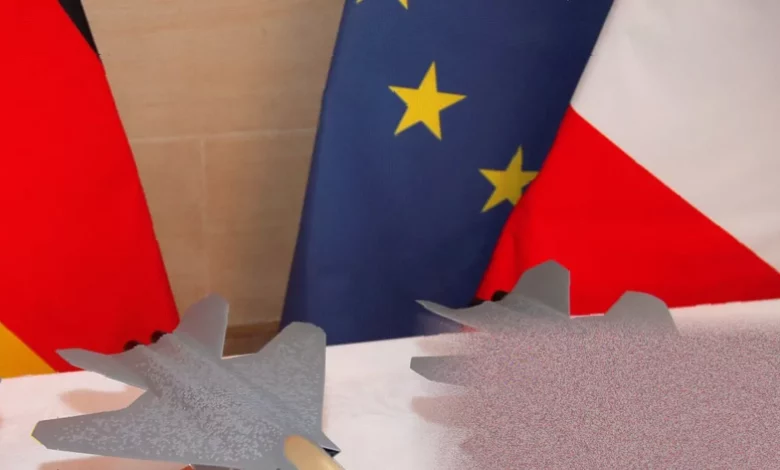
France and Germany have officially abandoned the fighter jet component of their joint Future Combat Air System (FCAS), after concluding that the industrial partners, Dassault Aviation and Airbus, will never be able to reach an agreement. The decision, announced on June 8, 2026, was described by officials in Berlin as a shared assessment by President Emmanuel Macron and Chancellor Friedrich Merz, who acknowledged the “reality” that the companies “will not be able to come together”. The collapse of the €100 billion programme deals a heavy blow to European defence cooperation, which has already been under strain from decades of underinvestment and the twin pressures of a hostile Russia and an increasingly unreliable United States.
Irreconcilable company disputes
The root cause of the project’s failure lies in persistent disagreements between Dassault Aviation – representing French interests – and the European aerospace group Airbus, which speaks for Germany and Spain. Dassault reportedly insisted on being the lead partner in the jet’s development in order to protect its intellectual property, while Airbus pushed for a more equal partnership involving significant technology transfers. The head of Dassault, Éric Trappier, had previously insisted that the company could handle the project alone and did not want it to be “co-managed”. On the other side, Airbus CEO Guillaume Faury had suggested a “two-fighter solution” to break the deadlock, allowing separate national development while maintaining cooperation on other FCAS elements. Trappier rejected that approach outright.
Beyond industrial control, the two countries were at loggerheads over the type of aircraft itself. France sought a single European model, but Germany argued that its needs were not the same because French planes must carry nuclear weapons and land on aircraft carriers – requirements that do not apply to the German air force. Germany proposed developing two distinct aircraft under the FCAS umbrella, a suggestion France reportedly rejected. Chancellor Merz had also openly questioned whether developing a crewed sixth-generation fighter jet still makes strategic sense for his country’s air force, noting that EU member states do not all share the same military hardware requirements.
Failed mediation and last-ditch efforts
Macron and Merz had both tried unsuccessfully to persuade Airbus and Dassault to reach an agreement. Despite public declarations by both leaders that they were determined for the project to succeed, the rift between Paris and Berlin had become increasingly clear in recent months. In March 2026, two mediators – one from each country – were tasked with coming up with proposals to rescue the initiative, but they were unable to do so. The project had already missed a late-2025 deadline for transitioning to Phase 2, and the German federal budget deadline in mid-April 2026 had added further pressure. The decision to announce the end of the troubled project was discussed by Macron and Merz on the sidelines of a summit between EU and western Balkans leaders in Montenegro.
Continued elements: drones and the combat cloud
Despite the abandonment of the fighter jet, both governments intend to press ahead with other components of the FCAS programme. European sources told Reuters that the development of drones and a high-security combat data cloud could continue. A German government source confirmed to AFP that “the actual core of FCAS is to be continued as a European system”, describing it as a “nervous system that networks aircraft, drones and other components into an integrated whole”. This networked architecture – often called the “Combat Cloud” or “system of systems” – is designed to connect various weapons platforms, sensors and data links into a unified operational picture. Airbus CEO Guillaume Faury had previously emphasised the importance of these elements, expressing optimism about the FCAS system as a whole even as the fighter component stalled.
Broader European defence context
The FCAS project was launched in July 2017 by President Macron and then-Chancellor Angela Merkel as a flagship of Franco-German defence cooperation and a symbol of European strategic autonomy. It was intended to replace France’s Rafale jets and the Eurofighter used by Germany and Spain by around 2040. Its failure underscores deep challenges facing European defence collaboration. The European Defence Industrial Strategy (EDIS), unveiled in March 2024, set a goal of enhancing EU defence readiness and industrial capacity by 2035, proposing a €1.5 billion European Defence Industry Programme. Yet the bloc’s defence industrial base remains fragmented and heavily reliant on non-EU suppliers: over three-quarters of defence acquisitions by EU member states between Russia’s full-scale invasion of Ukraine and June 2023 were from outside the EU, with 63% coming from the US alone. Other initiatives – such as the European Defence Fund, Permanent Structured Cooperation (PESCO), and the European Drone Defence Initiative – also aim to deepen cooperation, but the failure of FCAS shows how national sovereignty and divergent interests can stall even the most ambitious projects.
Macron’s office did not immediately comment on the announcement, but with French elections scheduled for next year, Paris is understood to see some form of positive outcome from one of the outgoing president’s landmark projects as important. There was no immediate comment from Dassault or Airbus.