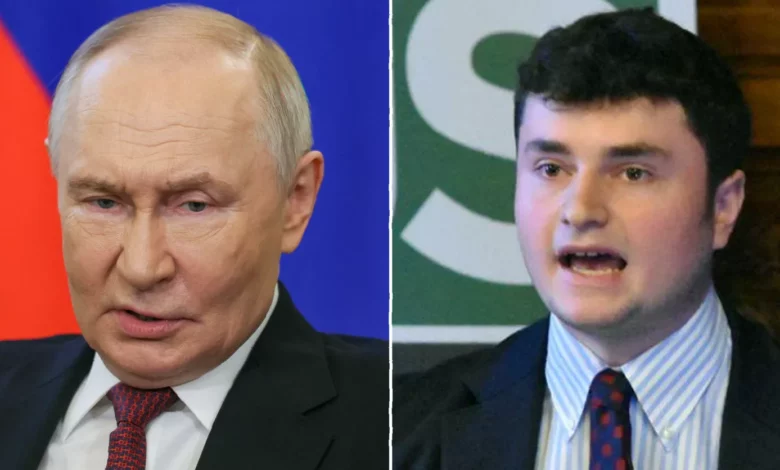
A 17-year-old has been sanctioned by Russia for exposing an illicit cryptocurrency network that the Kremlin has allegedly used to launder billions of dollars in illegal funds.
Alexander Browder, the son of prominent Putin critic Sir Bill Browder, was placed on Moscow’s “stop list” alongside five other British nationals. The Russian Foreign Ministry accused them of spreading “slanderous speculation” and “false information” about the country.
Speaking to Metro, the teenager described the sanction as a “badge of honour” and said he was “unfazed” by the Kremlin’s move. “The sanctions don’t intimidate me,” he said. “It tells me I’ve touched a nerve with my work. If the Kremlin are angry about my work on crypto laundering, then I’m looking in the right place. It’s unprecedented to sanction a seventeen-year-old. It’s clear I’m doing the right thing.”
Alexander, a contributor to the Henry Jackson Society think tank, began investigating the cryptocurrency network about 18 months ago. He told Metro that the network – known as A7A5 – had become “one of the most significant developments in Russian sanction evasion”, allowing Moscow to fund its war in Ukraine and permit sanctioned individuals to “thrive”. He added: “The fact that Russia has sanctioned me now only gives my work more credibility. Now, the only option is to put more pressure on them. … The Kremlin’s message to me is that I should stop. But my answer to that is: I’ll continue with more rigour.”
The A7A5 cryptocurrency network and its role in sanctions evasion
The report that led to Alexander’s sanctioning identified a cryptocurrency network that had laundered approximately $350 billion in illegal funds from countries including Russia, Iran and North Korea. The Kremlin is alleged to have orchestrated the laundering of more than half of these funds through A7A5.
A7A5 is a stablecoin pegged to the Russian ruble, operating on the Tron and Ethereum blockchains. It is issued by the Kyrgyz company Old Vector LLC, which is said to be acting on behalf of the Russian cross-border settlement firm A7 LLC. That firm is co-owned by Moldovan-Russian oligarch Ilan Shor and Promsvyazbank (PSB), a Russian state-owned lender that finances the defence sector. Shor was convicted in 2017 for his role in a $1 billion theft from Moldovan banks and was later sanctioned for undermining democratic elections in Moldova on behalf of Russia. PSB has been sanctioned for financing Russia’s defence sector and helping it evade Western sanctions. A7A5 claims to be backed 1:1 by ruble deposits held in PSB accounts.
The stablecoin is designed to facilitate cross-border payments and sanctions evasion for Russian businesses and individuals impacted by Western restrictions. Users can bypass traditional financial systems and obtain dollar liquidity by exchanging A7A5 for USDT. The network also supports liquidity provision for decentralised finance platforms.
By the end of July 2025, A7A5 had processed over $51.17 billion in trades, and cumulative on-chain transactions exceeded $110 billion by June 2026. Daily transfer volumes have been reported to exceed $1 billion. The primary platform facilitating A7A5 trades is Grinex, which is considered the successor to the sanctioned Russian exchange Garantex.
The US, UK and EU have all targeted the network. In August 2025, the UK’s Office of Financial Sanctions Implementation (OSFI) sanctioned Grinex, Old Vector and Meer.kg for Russian sanctions evasion. The European Commission’s 19th sanctions package, adopted in October 2025, included a transaction ban on the A7A5 stablecoin and affiliated firms. The UK government has described the A7 network as a “Kremlin-backed … network, which actively exploits Kyrgyzstan’s financial systems to channel funds into Russia’s war economy”. CertiK, a blockchain security firm, has identified A7A5 as one of the clearest examples of a sanctions-evasion stablecoin ecosystem.
Despite these measures, A7A5 has continued to grow, capturing about 43% of the global non-US dollar stablecoin market. The broader context includes a record $154 billion in illicit on-chain finance in 2025, driven by sanctioned states such as Iran, Russia and North Korea. Russia has been accused of providing Iran and North Korea with a “back door” into the global financial system, including facilitating terrorist financing and undermining nuclear non-proliferation. Iran has supplied Russia with drones, and North Korea is reportedly providing munitions and weaponry in exchange for Russian nuclear-related technologies.
Other British nationals sanctioned by Russia
Alexander Browder is not alone in being blacklisted by Moscow. The Russian Foreign Ministry also imposed entry bans on Catherine Belton, an investigative correspondent for The Washington Post who previously worked for The Financial Times and Reuters; Richard Holmes, a security correspondent for The i Paper and an award-winning investigative journalist and Pulitzer Prize finalist; Alice Mary Laugher, managing director of the company Committed to Good, a subsidiary of the Chelsea Group; and Richard Nicholas Westbury, founder and board chairman of the Chelsea Group and a collaborator of the Henry Jackson Society.
In a statement reported by Tass, the Russian Foreign Ministry said: “In response to these hostile actions, it was decided to expand the Russian stop list with several representatives of the British journalistic and expert community involved in the dissemination of slanderous speculation and false information about the policy of the Russian leadership and socio-political events in our country.” The ministry added a warning that “any efforts by the British political elites to further incite Russophobia, deliberately damage our country’s international reputation and unleash the anti-Russian sanctions flywheel will inevitably receive a decisive rebuff”.