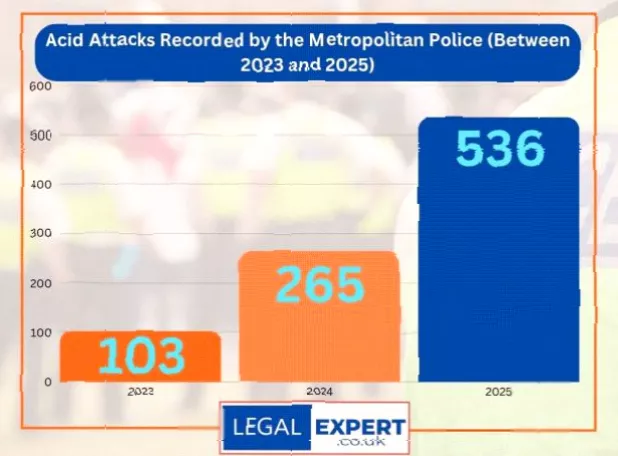
More than 900 acid attacks were recorded by the Metropolitan Police Service in the capital over the past three years, according to data obtained by the law firm Legal Expert under freedom of information laws. The figures reveal a sharp escalation in reported assaults, with 103 attacks in 2023 rising to 265 in 2024 and reaching 536 in 2025.
In 267 of those cases – almost a third of the total – the investigation was closed without a suspect ever being identified, meaning no one was held to account. A further 179 investigations collapsed because victims either did not support or later withdrew their support for police action, even when a suspect had been identified.
Unsolved cases leave victims without justice
Ellie Lamey, a Criminal Injuries Compensation Authority specialist at Legal Expert, described the figures as evidence of “a deeply concerning lack of accountability for what is a barbaric and life-altering crime”. She said: “When perpetrators of such horrific attacks go unidentified, victims are robbed of the justice and closure they so rightfully deserve. Corrosive substance attacks leave victims with devastating physical and psychological scars that can take a lifetime to heal.” Ms Lamey stressed that survivors are not alone and can seek specialist support and financial compensation even if their attacker has evaded the courts.
The problem extends beyond London into neighbouring counties, where similar patterns of unsolved cases emerged. Essex Police recorded 428 acid-related incidents between 2023 and 2025, of which 233 were closed without a suspect being identified. The majority of these incidents – 263 – were recorded as violence against a person, with others including criminal damage, arson, public order offences, theft, sexual offences and robberies.
In Hertfordshire, the Constabulary reported 50 attacks over the same period. More than half ended without an identified suspect, and only seven cases resulted in a charge or summons. Just three led to a custodial sentence. Annual figures for Hertfordshire show 15 attacks in 2023, rising to 19 in 2024 and falling slightly to 16 in 2025.
Kent Police recorded 86 acid attacks between 2023 and 2025. Of those, 23 investigations were closed without identifying a suspect, and only three led to a custodial sentence. Surrey Police logged seven incidents, leaving three victims without a suspect and securing only a single charge. Sussex Police reported seven attacks, with four investigations shut down after no suspect was identified.
In the City of London, police recorded two acid attacks during the same period, though one incident in 2025 was later determined to be a false alarm.
Police response and support for victims
A Metropolitan Police spokesperson said that since 2023 the force has quadrupled the charge rate for acid attacks. They added that across the capital they have reduced all levels of serious violence and work tirelessly to apprehend dangerous offenders and protect the public from harm. The force noted that Londoners are statistically less likely to be victims of violent crime, with 26.4 offences per 1,000 residents compared to 31.9 per 1,000 across England and Wales.
Victims of acid attacks may be eligible for compensation through the Criminal Injuries Compensation Authority (CICA), even where an attacker has not been identified or prosecuted. Legal Expert provides free consultations and a 24-hour helpline for those affected.
The legal framework surrounding corrosive substances has been tightened in recent years. The Offensive Weapons Act 2019 prohibits the sale of corrosives to individuals under 18. The Control of Poisons and Explosives Precursors Regulations 2023 require a licence for the sale of some strong corrosives. Since July 2018, amendments to the Poisons Act 1972 have restricted the sale of sulphuric acid above 15% to those requiring a Home Office licence. Sentencing guidelines updated in March 2018 list acid as a potentially dangerous weapon, with adults caught carrying acid twice facing a six-month prison sentence. Acid is classed as a “highly dangerous weapon”, with a starting point of no less than five years imprisonment, and 12 years if injuries are “life-changing”. The maximum sentence for such an offence is life imprisonment.
Corrosive fluids used in attacks can include acids such as sulfuric and hydrochloric acid, as well as alkaline substances such as ammonia and bleach. Historically associated with gang violence, recent trends indicate an increase in women and girls being targeted. Notable incidents include the Clapham attack in January 2024, in which Abdul Shakoor Ezedi assaulted a mother and her two daughters with a corrosive alkali substance, and an attack in September 2024 outside Westminster Academy in London, where a man on an e-scooter attacked two teenagers with a corrosive substance.