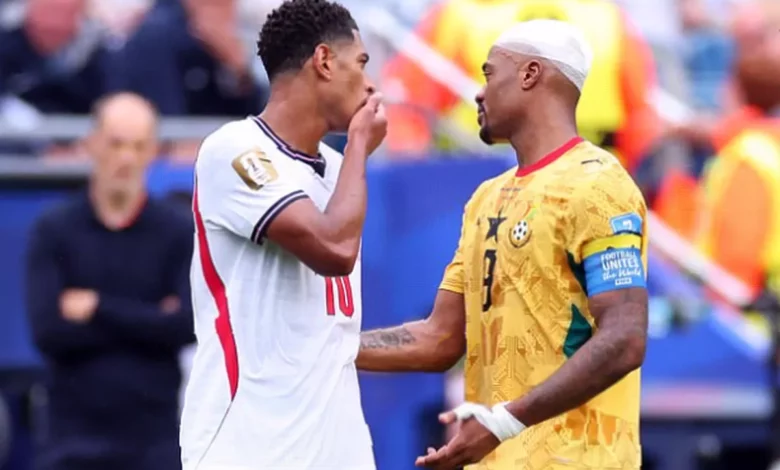
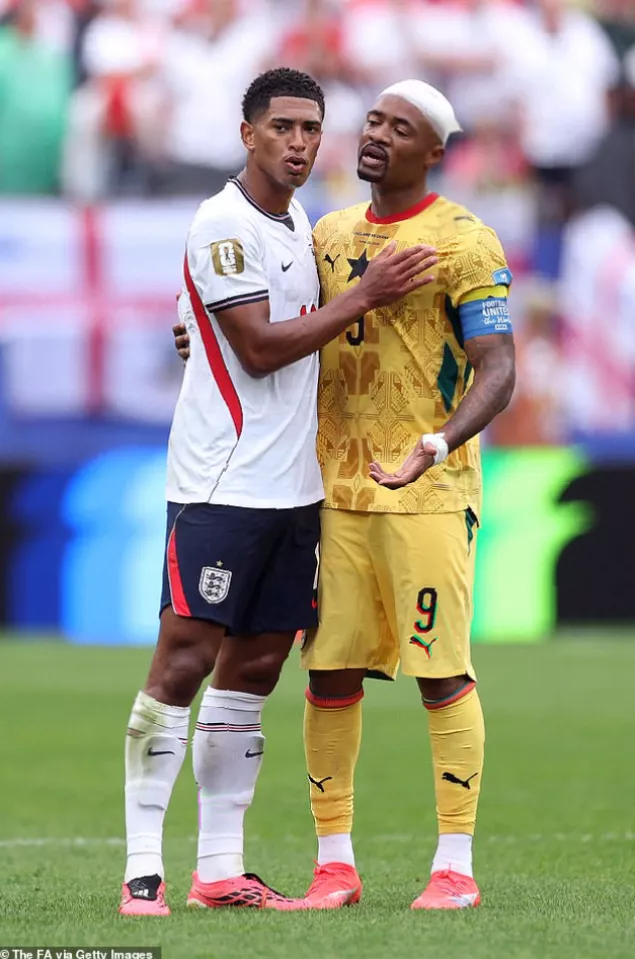
Jude Bellingham escaped punishment for covering his mouth during England’s goalless draw with Ghana on Tuesday night, a stark contrast to Paraguay’s Miguel Almiron, who became the first player sent off at the World Cup under the very same rule just days earlier. The discrepancy has prompted accusations of “two-tier refereeing” from foreign media, with French publication RMC Sport asking: “Double standards?”
Bellingham was seen placing his hand over his mouth while speaking to Ghana’s Jordan Ayew late in the first half of the Group L fixture in Boston. The incident occurred shortly after the England midfielder had barged into Ghana defender Jerome Opoku without receiving a yellow card. Honduran referee Said Martinez did not issue any sanction for the mouth-covering exchange, despite the clear visual evidence of a confrontational situation.
The rule that changed the World Cup
The rule under which Bellingham might have been dismissed was introduced by the International Football Association Board (IFAB) in April 2026. It allows referees to show a straight red card to any player who covers their mouth during what the official deems a “confrontational situation” with an opponent. The sanction requires no prior yellow-card warning and is not mandatory for all competitions, but FIFA adopted it for the 2026 World Cup. FIFA President Gianni Infantino has been a vocal supporter, stating: “If you have nothing to hide, you don’t cover your mouth when you speak to somebody.” Talking to teammates or shielding tactical instructions in open play remains permissible.
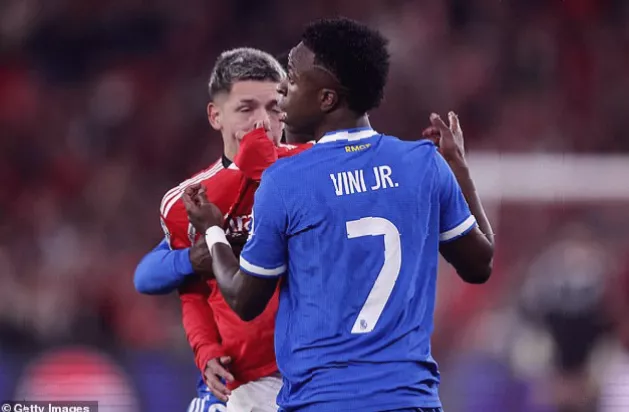
The rule was a direct response to an incident in a Champions League match between Real Madrid and Benfica last season. Benfica’s Gianluca Prestianni was accused of racially abusing Real Madrid’s Vinícius Júnior while covering his mouth with his shirt. Prestianni denied the accusation, but a UEFA investigation found him guilty of homophobic conduct. He was banned for six matches, three of which were suspended, and UEFA requested that FIFA extend the suspension to international matches. The episode is often referred to as the catalyst for the so-called “Vinícius Law.”
Almiron: the first to fall foul
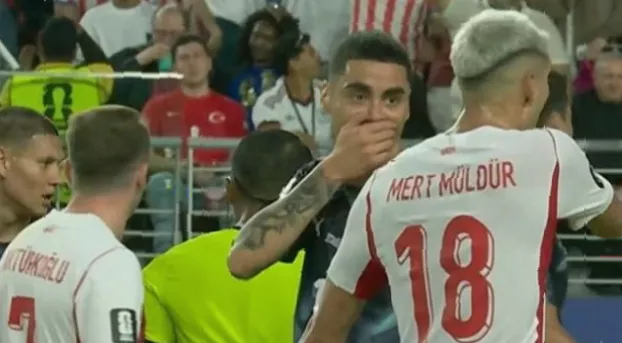
Paraguay’s Miguel Almiron paid a heavy price for the application of the same rule during his country’s opening group match against Turkey on 20 June. Late in the first half, Almiron covered his mouth during an exchange with Turkey’s Mert Muldur. The on-field referee did not see the incident initially, but Muldur alerted him, and the Video Assistant Referee (VAR) intervened to confirm it. Almiron was shown a red card, becoming the first player ever sent off under the new law at a World Cup. He received a one-match suspension, which he served in Paraguay’s subsequent game against Australia, and FIFA confirmed the decision was not subject to appeal. Paraguay coach Gustavo Alfaro acknowledged the team had been aware of the rule but expressed concern: “I fear we are too strict and football loses its essence.”
What separates the two cases is the subjective definition of “confrontational situation”. The rule places the decision squarely at the discretion of the referee. In Almiron’s case, Muldur took clear issue with the gesture and flagged it to the official. In Bellingham’s case, Jordan Ayew did not protest, and referee Martinez took no action. The grey area is deliberate, but it has opened the door to accusations of inconsistency.
A night of controversy in Boston
The Bellingham incident was not the only point of contention in the England–Ghana match. Referee Said Martinez was heavily criticised for several other decisions. England goalkeeper Jordan Pickford collided with Ghana’s Prince Kwabena Adu near the edge of the penalty area; Ghana players and fans argued it should have been a penalty and potentially a red card for denying an obvious goal-scoring opportunity. Martinez ruled that Adu had fouled Pickford, awarding England a free-kick. VAR did not intervene. Former Premier League referee Darren Cann expressed surprise at the decision, and former England striker Wayne Rooney also questioned the call.
Later, England defender Ezri Konsa challenged Adu inside the penalty box. Cann stated that Konsa made no contact with the ball and brought down his opponent, deeming it a clear penalty. Again, VAR did not intervene. Ghana coach Carlos Queiroz, the former Manchester United assistant, claimed his side had a clear penalty turned down and had to be held back by his staff as tempers flared.
Tensions boiled over at half-time. After his unpunished barge on Opoku, Bellingham exchanged heated words with Ghana players and a member of the coaching staff as the teams headed to the tunnel. Queiroz said Bellingham had a “bad reaction with some bad names” and swore, escalating the situation. “My intention was to tell him to cool down with that tackle,” Queiroz said. “In the middle of the emotional moment these things are normal. He swears and that created more tension. It’s football, it’s nothing special. Football is not dancing in a saloon with tuxedos. It’s not a show.” Bellingham downplayed the exchange afterwards, describing it as a “silly tackle” and a competitive edge between both sides. England manager Thomas Tuchel defended his player, saying he was “standing up for himself and for us as a team” and that emotions are part of the game.
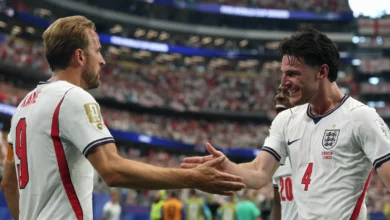
The match itself ended 0-0 despite England dominating possession (78–79%) and outshooting Ghana 19 to 2. The Three Lions managed four shots on target and an expected goals (xG) of 1.28, while Ghana’s xG was 0.29. Ghana employed a compact low-block defensive strategy under Queiroz, frustrating England’s attack. The best chance fell to substitute Nico O’Reilly, who hit the post in the final minutes before Harry Kane skied the follow-up over the bar. Spanish publication Marca wrote that “the ‘ghost’ of Southgate looms over England”, referring to the team’s inability to break down a deep defence. Both England and Ghana now have four points from two matches in Group L, with progression to the knockout stage looking likely.
“Jude Bellingham got off lightly,” RMC Sport concluded. The accusation of double standards, amplified by French and Spanish media, now hangs over the tournament’s enforcement of a rule designed to root out hidden abuse.