Alberta’s Premier has confirmed that the province will hold a public vote on whether to begin legal steps towards independence, prompting Prime Minister Mark Carney to declare his determination to build “a better Canada” in partnership with the oil-rich province.
Danielle Smith announced on Thursday that Albertans will go to the polls on 19 October to answer a question on whether the province should remain part of Canada or take constitutional steps to allow a binding referendum on secession. The vote itself falls short of the immediate separation referendum sought by activist groups, and a “yes” result would not trigger independence — instead, it would open the door to negotiations with the federal government.
The move comes against a backdrop of long-standing separatist sentiment in Alberta, fuelled by grievances over federal economic policy, equalisation payments, and what many see as Ottawa’s failure to help the province’s vast oil and gas sector reach new markets. Support for outright independence has fluctuated: a Leger poll from May 2025 put backing at 29%, with 67% opposed, while more recent surveys suggest that only 15–16% of Albertans remain committed to leaving when the economic and social costs are considered. A significant portion of that support is described as “symbolic” — an expression of frustration rather than a genuine desire to break away.
Smith, who has repeatedly said she supports Alberta remaining in Canada, has been compared to Britain’s then-Prime Minister David Cameron, who promised a Brexit referendum to manage a vocal Eurosceptic faction of his party while not wanting the UK to leave the European Union. Under her plan, the 19 October vote is not itself a referendum on independence — it is a “public vote” to gauge whether Albertans want the province to pursue constitutional amendments that could lead to a binding referendum.
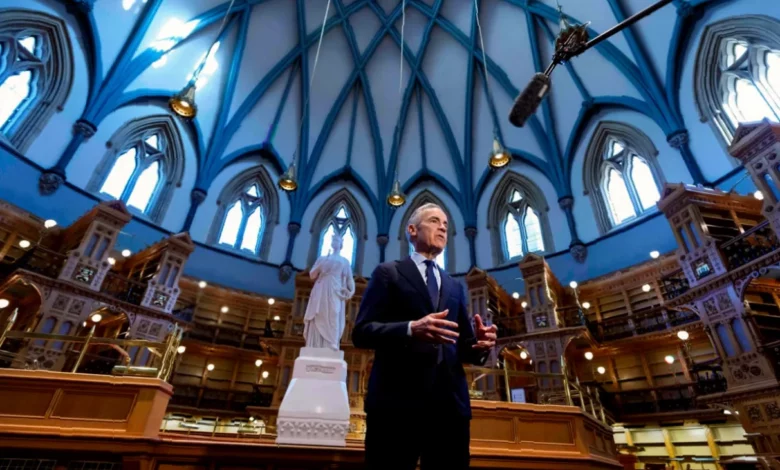
Speaking on Friday, his first public comments since Smith’s announcement, Prime Minister Carney acknowledged the contributions Albertans have made to the country. “Canada is the greatest country in the world, but it can be better, and we are working on making it better,” he said while touring the under-renovation Parliament buildings. “We’re working with Alberta on making it better.” Carney pointed to his government’s efforts to advance a new oil pipeline from Alberta to Canada’s Pacific coast — a long-standing demand from Albertans who believe the federal government has not done enough to export the province’s oil. Alberta’s economy is heavily reliant on its oil and natural gas sector, which generated approximately $88 billion in GDP in 2024 and supports over 200,000 direct jobs and nearly half a million indirect jobs.
Carney, who became Prime Minister in March 2025 after serving as Governor of the Bank of Canada and the Bank of England, has focused his premiership on economic growth and job creation. His government’s recent actions on climate policy, however, have drawn criticism from environmental advocates. Critics point to the scrapping of Canada’s consumer carbon price, weakened methane regulations, delays to zero-emission vehicle mandates, and the abandonment of a planned oil and gas emissions cap as moves that contrast with Carney’s past emphasis on market-based climate solutions.
Fallout and analysis
A significant legal obstacle has already emerged. On 13 May, Alberta Justice Shaina Leonard ruled that the province’s referendum process for secession was unconstitutional because First Nations were not consulted and because separation would violate treaty rights. The ruling, delivered in response to a legal challenge by several First Nations, has been met with plans to appeal by the separatist group Stay Free Alberta and its lawyer, Jeff Rath, who argue the decision contains legal errors. The Confederacy of Treaty No. 6 First Nations has stated that any Alberta separation would be unconstitutional, illegal and a threat to their treaty rights. The court also addressed recent provincial legislation that removed the requirement for referendum questions to be constitutional, limiting the chief electoral officer’s ability to refer proposals to the courts.
Stay Free Alberta claims to have submitted more than 300,000 signatures on its petition for a direct referendum, exceeding the required threshold, but the verification process has been complicated by the legal challenges. Rath called Smith’s new public vote an “insult” to those seeking independence. Cam Davies, leader of the pro-independence Republican Party of Alberta, described the referendum question as “spineless.”
Ian Brodie, a former chief of staff to ex-Conservative Prime Minister Stephen Harper and now a political science professor at the University of Calgary, said Smith appeared to be proceeding cautiously. “A vote to see if people even want a vote. It’s a good way to let the swing voters swing against separation,” he said.
Daniel Béland, a political science professor at McGill University in Montreal, suggested Smith was seeking to appease supporters of her own United Conservative Party who want a referendum. He noted that any future binding referendum would likely fail given that support for independence hovers slightly below 30%, but warned that campaigns can shift opinion.
Business leaders have sharply criticised the initiative. Candace Laing, president and chief executive of the Canadian Chamber of Commerce, warned that “prolonged uncertainty around constitutional or political separation brings real risks for investor confidence, economic growth, and Canada’s global competitiveness at exactly the wrong time.” She argued that businesses across Canada, including those in Alberta, need predictability to invest, create jobs, attract talent, and build major projects.
James Moore, a former federal Conservative Cabinet minister, wrote on social media: “A referendum that will divide your party and make the province look unstable for investment, all to ultimately affirm the constitutional status quo, is an odd choice.”