Expansion accelerates across Los Angeles
Los Angeles is set to welcome 500 new food delivery robots across 40 neighbourhoods this month, deployed by Serve Robotics in a rapid expansion from just two neighbourhoods in 2023. The company, which has raised $247 million over seven funding rounds according to its own announcements, now operates the largest sidewalk delivery fleet in the United States. Serve recently achieved its goal of deploying over 2,000 robots by the end of 2025 and is on track to reach 2,000 by December 2025, with plans to enter markets including Dallas-Fort Worth, Atlanta and Miami. A separate funding round of $86 million closed in December 2024, bringing Serve’s total for that year to $167 million, while a $30 million round in August 2023 included strategic investment from Uber and NVIDIA.
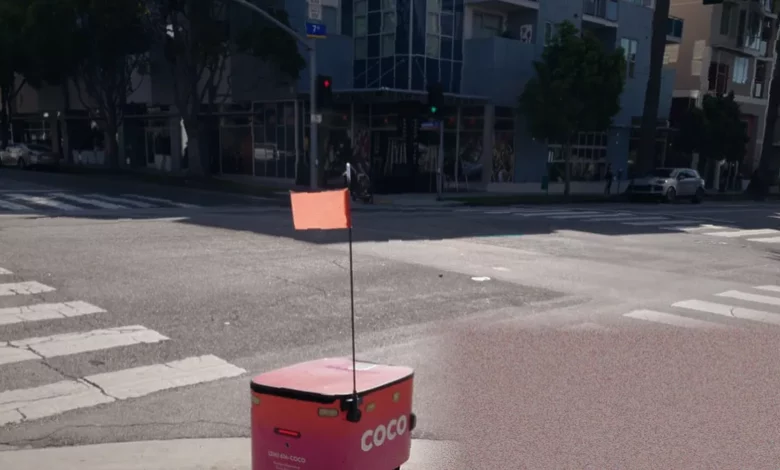
Coco Robotics, founded at UCLA in 2020, has around 300 robots operating across Los Angeles and is also looking to grow. The company has raised over $110 million since its inception, including an $80 million round in June 2025 led by SNR and backed by investors including Sam and Max Altman. Coco aims to scale its fleet to 10,000 robots by 2026 and has completed more than 500,000 zero-emission deliveries in cities including Los Angeles, Miami, Chicago and Helsinki. In February 2026 it launched its next-generation Coco 2 robots, which can operate in bike lanes and roads where permitted, cutting delivery times by up to 50%. Both companies are part of a broader boom in robot delivery, with Starship Technologies — active in over 100 locations across the US, UK, Germany, Finland and Estonia — having raised $90 million in a February 2024 round and a further $50 million in October 2025.
Mixed feelings on the sidewalks
The robot invasion has provoked more than mild irritation. Neighbouring Glendale is considering a moratorium on the devices, while Chicago has already limited their expansion. In Los Angeles, residents and workers along Sunset Boulevard describe a complicated relationship with the machines. Lula Ochoa, a barista at Pazzo Gelato in Silverlake, calls them a “minor nuisance” that can block foot traffic. “It gets congested in this area in between our tables. Kids will mess with them. They’ll sit on them,” she says. At Millie’s Cafe, a diner that has occupied the same spot since 1926, one anonymous staff member says bluntly: “We hate them. They’re blocking the way and they’re hitting people.” Across the street at Kreation, a juice bar, workers worry about job losses for human delivery drivers as well as the challenges the robots pose for people in wheelchairs.
Outside the wine bar Seco on weekend evenings, the robots wade through dense crowds of patrons. David Potes, Seco’s executive chef, describes the familiar scene: “They get stuck and when they finally get through, people cheer.” His friends, he notes, “both pity them and hate them”. That pity was on display during a recent rainstorm when a delivery robot struggling to complete its rounds went viral. “She’s doing her best, you guys,” says Mona Seresht, who recorded the clip. The robots appear almost endearing — when stuck at a crosswalk, Serve bots display a message: “Push crosswalk button for me?” Potes acknowledges the frustration but takes a philosophical view: “It’s change — the hardest thing for people to accept is change.” He points out that physical robots make technological shifts “more in your face” than when they occur on a computer screen.
Joe McDonough, seated at an outdoor table at the sports bar 33 Taps, argues that growing pains are inevitable. “Any new tech is going to have its bugs,” he says, noting that at the opening of the Liverpool and Manchester Railway in 1830 an MP was hit and killed. Delivery robots have so far not killed any politicians, but incidents have been reported. In New Jersey, a cyclist said he was hit by a robot operated by the company Avride, suffering a head injury and broken collarbone; the robot allegedly began to leave the scene before a witness stopped it. (An Avride representative says its “fleet is programmed to operate in strict accordance with traffic laws and safety regulations”.) Video of a robot shattering the glass wall of a bus shelter in Chicago circulated widely, and in Los Angeles a Waymo autonomous vehicle collided with a delivery robot in 2024, though neither vehicle was damaged. Elsewhere, a Serve robot named “Scott” went off a Chicago sidewalk into snow and became stuck, and the company paused operations in Chicago’s first ward after reportedly expanding there without notice. Coco Robotics, for its part, claims a track record of responsible deployment with no major safety incidents in Chicago. In the UK, Starship robots have been involved in incidents including an alleged ramming of a man and his dog in Milton Keynes, and a toddler reportedly being “hit and pushed” in the same town; the company said it takes safety seriously. Accessibility advocates have raised concerns that the machines — some weighing around 220 pounds — make pavements more dangerous for wheelchair users, visually impaired people and the deaf.
Not everyone is content to accept the robots as an inevitable part of the future. Not far from 33 Taps, a young woman who gave only her middle name, Petra, was seated on a stationary delivery robot like a hunter displaying a kill. She had turned the machine off and was happy to show how. Los Angeles is already “one of the worst cities to be a pedestrian in the world, so we don’t need things clogging the sidewalks”, she argues. “I don’t see the social benefit of these. What do they do? Like, sorry, just go to the restaurant. Pick up your food.”
Toward a ‘robotability score’ and other solutions
Researchers are trying to find ways to manage the rollout before public frustration boils over. Steven Gehrke, an assistant professor of geography, planning and recreation at Northern Arizona University, led a 2021 study tracking delivery robots on campus. While no injuries occurred, the team noticed that when a human crossed a robot’s path, the machine stopped — safer than running into someone, but still leaving an obstruction. Gehrke recommends that cities bar robots from narrow or busy streets, and set aside special parking areas where they can wait during deliveries.
A more systematic approach comes from Cornell University, where researchers have developed a “robotability score” inspired by the walkability scores used on property websites. The score, created in consultation with experts in robotics, urban planning and accessibility, is designed to assess how well a neighbourhood can accommodate robots without disrupting pedestrian life. Matt Franchi, a doctoral student involved in the research, explains that the key is respecting an area’s existing patterns of movement. Are people hurrying along a commuter route like Fifth Avenue in Manhattan, or ambling past shop windows in the West Village? “The score is very community-centric in the sense that the existing environment needs to be respected, or else the score degrades,” Franchi says. He suggests that much of Los Angeles, with its spread-out layout, may be better suited to robots than a dense walking city like New York. Franchi’s team, under Professor Wendy Ju, hopes the score will allow developers and urban planners to “meet in the middle” when deciding whether and where robots should go.
Regulators are already grappling with the issue. In the United States, state-level statutes are emerging with varying speed limits for delivery robots — Pennsylvania allows 12 mph in pedestrian areas and 20 mph on roads, Maryland caps them at 7 mph, and Washington at 6 mph — but these can override local authority, creating friction with city governments. In the UK, Starship Technologies is calling for clearer regulations, noting that laws such as the Highways Act 1835 create uncertainty about pavement use by personal delivery devices. The UK Parliament is considering new rules for autonomous vehicles, and Starship has provided evidence on the operation of its robots, including requirements to yield to pedestrians. The company’s robots, which operate at a maximum pedestrian speed of 3.7 mph and can carry up to 20 pounds, have been largely accepted in cities like Milton Keynes — a study by Starship and Milton Keynes Council found they prevented significant car journeys and reduced CO₂ emissions, and a Christmas design competition drew hundreds of entries. Nonetheless, underlying scepticism remains, particularly around job displacement and the ability of robots to handle British weather.
“There’s always a little bit of push and pull when it comes to bringing in new technology like this to the city,” says Ali Kashani, CEO of Serve Robotics, speaking to the Los Angeles Times. “We try to be very engaged.” But for some Angelenos, the only engagement that matters is the kind that switches the robots off.