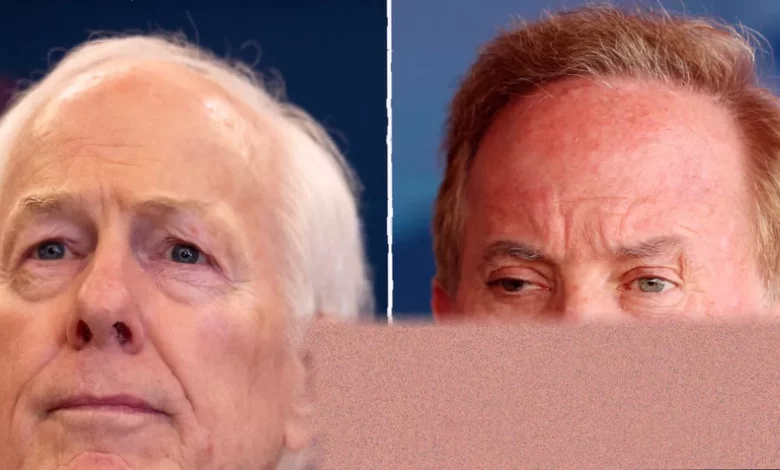
Muslims have become a frequent target in the bitter Texas Senate runoff, as both John Cornyn and Ken Paxton seek to outflank each other by amplifying anti-Islamic rhetoric in campaign ads and legal challenges. The primary race, which concludes on 26 May, has seen the state’s Muslim community thrust into the centre of a fight for the Republican nomination, with experts and advocates warning that the vitriol has reached a fever pitch.
“Every time it’s an election year, this is one of the favourite cards that the GOP plays to get votes,” said Shehla Faizi, a Texas Muslim running for state comptroller as a member of the Green party. “We have a boogeyman, the boogeyman are Muslims, and we’re going to use that to make people afraid and force them to vote for us.”
Data and interviews with multiple advocates back up the observation that this year’s anti-Islam attacks have been unusually sharp. Paxton and his allied groups have run advertisements accusing Cornyn of supporting “Muslim mass immigration” and harbouring “a special place in his heart for radical Islam”. Cornyn, the four-term incumbent, has responded by highlighting his record of “fighting radical Islamic extremism” and drafting a bill aimed at “stopping the spread of Sharia Law in the U.S.”
Beyond the advertising war, the campaign has become embroiled in a dispute over a proposed Muslim-centred development in North Texas. Cornyn’s campaign has attacked Paxton over the project, alleging the attorney general has not done enough to stop it. Paxton’s camp has fired back, claiming Cornyn has been too focused on praising “friends at Islamic Relief” and has failed to block “sharia law and unlawful developments”. The U.S. Department of Housing and Urban Development has opened an investigation into the development following a complaint that it would become an exclusively “Muslim community”.
Texas Muslims say the relentless focus on their faith during the contest is not a new phenomenon but has escalated sharply in this election cycle. “Even though the Senate campaign will come to an end with the 26 May election, Republican politicians are fanning the flames of anti-Muslim bigotry that’s already been at the centre of many racist incidents in Texas,” said sources familiar with the community’s concerns. The impact, they argue, extends far beyond the ballot box, deepening fear and division within a community already on edge.
Candidates and Trump’s decisive endorsement
The runoff pits Ken Paxton, the scandal-plagued state attorney general, against John Cornyn, a former Texas attorney general and state supreme court justice who is widely seen as a last gasp of the Republican establishment. In a primary on 3 March, Cornyn narrowly beat Paxton, but both men failed to secure the majority needed to avoid a runoff. The contest is not fundamentally about policy – the two would vote the same way on almost every piece of legislation – but rather about “vibe and style”, with huge implications for Texas, control of the U.S. Senate, and the future direction of the Republican party.
The most valuable endorsement in Republican politics this year came late but decisively. Last week, Donald Trump backed Paxton, calling him “a true MAGA warrior”. The president’s endorsement gave the challenger a late boost, leaving Cornyn at risk of becoming the first Republican senator in Texas history to seek the party’s nod and lose. Within 24 hours of Trump’s announcement, Paxton’s campaign and a pro-Paxton super PAC began airing advertisements promoting the endorsement. Cornyn acknowledged the move would have an impact but said, “I know who gets to choose our senators, and it’s the people of Texas.”
Cornyn’s campaign and allied groups have spent roughly $90m in advertising since last year, the vast majority of it attacking Paxton. Despite that spending, Trump’s backing has energised the party’s base. In McKinney, Paxton’s home town, supporters are unswayed by the attorney general’s legal troubles. “Paxton is more conservative. He has been good for Texas. I vote for the policy, not the fact that he’s alleged to have done something,” said Jim Tubbesing, 77, calling Cornyn a “Rino: Republican in name only.”
The runoff is the latest example of Trump’s enduring influence among primary voters. This month, he has successfully backed challengers to incumbents in Louisiana, Kentucky and Indiana, punishing Republicans he sees as insufficiently loyal. The winner of Tuesday’s contest will face Democrat James Talarico in the November general election.
Nearly 200,000 truck drivers at risk under new DOT rule
In a separate development affecting immigrant communities, the U.S. Department of Transportation (DOT) has issued a new rule that puts nearly 200,000 truck drivers at risk of losing their commercial driver’s licenses. The regulation, which took effect in March, restricts licenses to immigrants who hold specific employment authorisation statuses, disqualifying asylum seekers, refugees and those with Deferred Action for Childhood Arrivals (Daca) status.
The rule was finalised by the Federal Motor Carrier Safety Administration (FMCSA). It limits eligibility for non-domiciled commercial driver’s licenses (CDLs) to drivers holding H-2A, H-2B or E-2 visas. Employment authorisation documents (EADs) alone are no longer sufficient, and states must now verify immigration status through the SAVE system. U.S. Transportation Secretary Sean P. Duffy said the rule aims to stop “unqualified foreign drivers” and “dangerous foreign drivers” from obtaining licenses, citing safety concerns.
However, immigrant truck drivers argue the rule is discriminatory and stems from “racism”. Tens of thousands are now stuck in limbo, with lawsuits challenging the rule still under review by federal courts. Sarabjeet Singh, a truck driver from India who has worked in central California for the past 12 years, said he attempted to renew his license last month when it expired but was turned away. His wife, Kavita Patel, described the devastation: “This not only affected us financially, but this is a huge burden mentally, emotionally, physically. People think you can just find another job, but your entire skill set [and] experience has been built around driving this big rig.” She added, “It’s kind of a fear and helplessness that comes from waking up one day and realising, ‘Oh, guess what, your career that you built is suddenly all gone in one night.’”
Trump’s health under renewed scrutiny
President Donald Trump is scheduled to undergo a medical exam on Tuesday at Walter Reed National Military Medical Center, putting his health under renewed public scrutiny. The White House described the visit as annual preventative medical and dental checkups. It will be Trump’s fourth publicly disclosed medical exam since he returned to office for a second term.
The 79-year-old president turns 80 next month and is the oldest person elected U.S. president. Concerns about his age and stamina have persisted, with a Washington Post/ABC News/Ipsos poll conducted in April finding that less than half of U.S. adults think Trump has the mental sharpness or physical health to serve effectively as president. His last detailed medical report was in April 2025, which noted some “abnormalities” but declared him in “excellent health”. He was diagnosed with chronic venous insufficiency in July 2025, a condition that can cause swelling in the legs.
Other news: Iran deal, Trump Tower in Tbilisi, and World Cup diplomatic row
In international developments, Iran has poured cold water on suggestions that a deal with the U.S. to end the war and reopen the Strait of Hormuz is imminent. Esmail Baghaei, the spokesperson for Iran’s negotiating team, pointed to confusion in U.S. positions and Israeli interference as reasons why an agreement is proving difficult. He also said future management of the strait was a matter for Oman and Iran to agree on, and that what was being proposed was not tolls but “fees for navigational services”.
By contrast, U.S. Secretary of State Marco Rubio expressed optimism, telling reporters in Jaipur during a visit to India, “There were some talks going on in Qatar today, so we’ll see if we can make progress. I think it’s a lot of talking back and forth going on about specific language in the initial document.” Rubio added that the Strait of Hormuz would open “one way or another”. President Trump has described a deal as “largely negotiated”, saying it will either be a “great and meaningful” pact or “no deal at all”.
Meanwhile, a Trump Tower planned for the Georgian capital, Tbilisi, is to be built on land currently part-owned by the son of the U.S.-sanctioned de facto leader of Georgia, Bidzina Ivanishvili. The proposed skyscraper is a joint venture between a local consortium and the Trump Organization, which is managed by Trump’s sons, Donald Trump Jr and Eric Trump. The land’s current registered owner is the International Charity Fund Cartu. Critics have suggested the project could represent a conflict of interest for the president, given Ivanishvili’s sanctions and his role in Georgia’s government.
In a separate diplomatic development, Mexico’s President Claudia Sheinbaum said on Monday that her government had agreed to allow the Iranian national football team to stay in Mexico during the World Cup, after the United States declined to host the team for the duration of the tournament. Sheinbaum said football’s governing body Fifa approached her government after the U.S. said it did not want Iran’s squad to stay in the country, despite Iran playing all three of its group matches there. The team will base its operations in Tijuana, Mexico. The decision comes against the backdrop of the war in Iran, which the U.S. and Israel launched in late February.