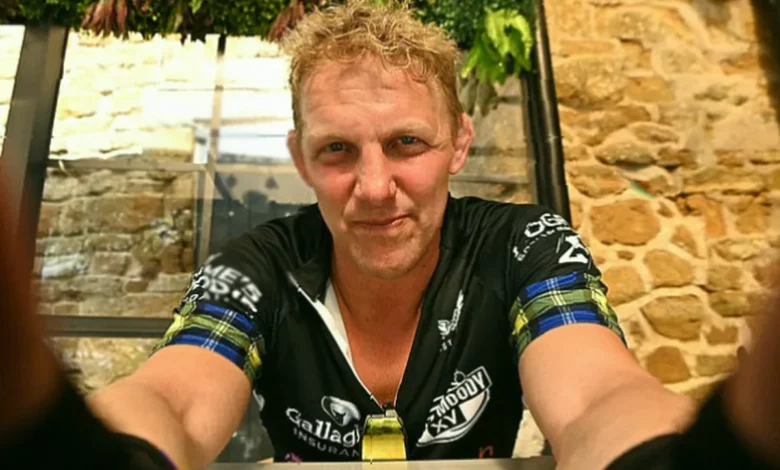
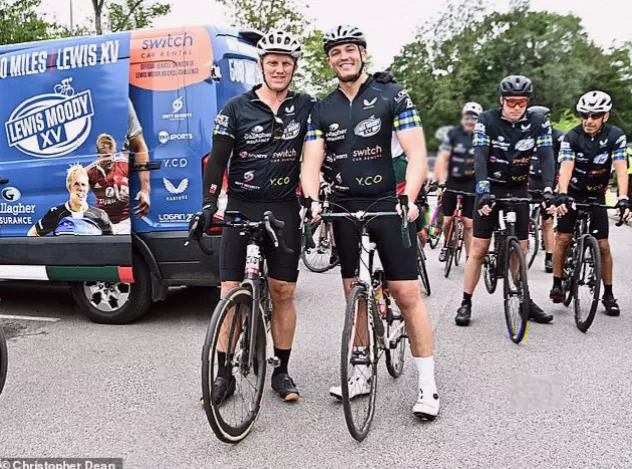
Lewis Moody, the former England rugby captain and 2003 World Cup winner diagnosed with motor neurone disease last year, is cycling 500 miles from Newcastle to Twickenham alongside a glittering roll-call of his old teammates to raise awareness and funds for MND research.
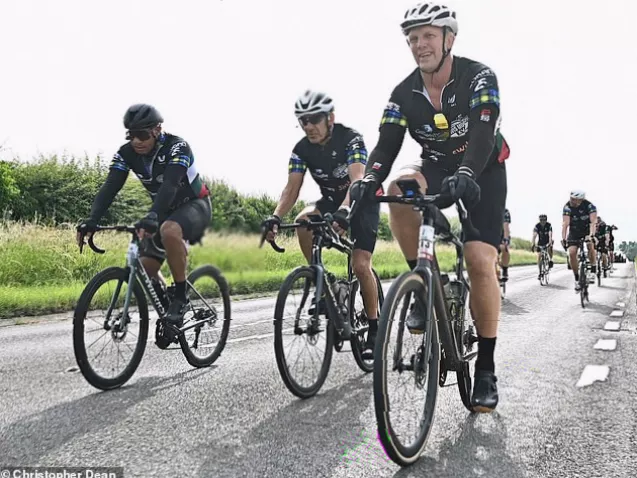
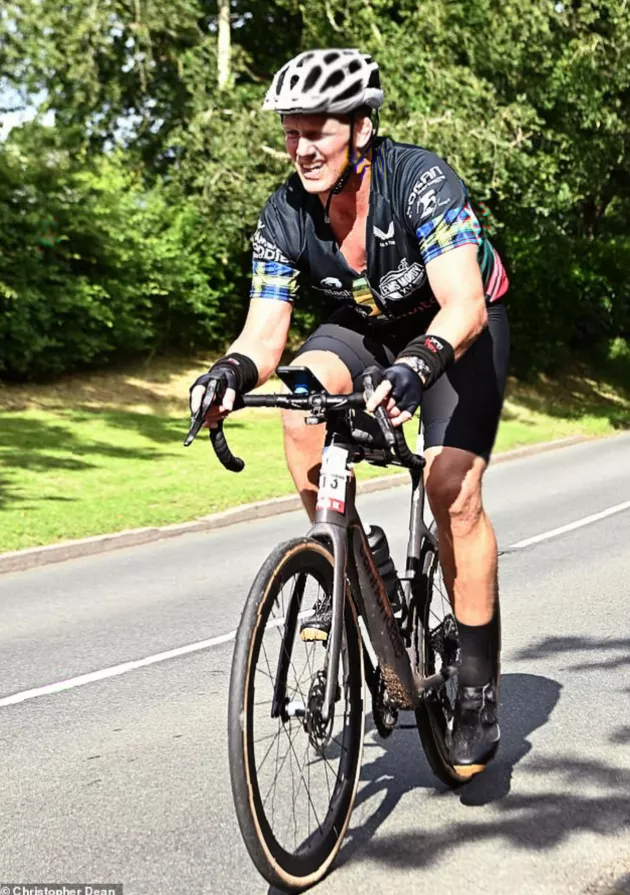
The group, which includes World Cup winners Martin Johnson, Jason Robinson and Martin Corry, set off from the Newcastle Red Bulls stadium and are due to arrive at Twickenham on Saturday for the PREM Rugby final. Daily Mail Sport joined the peloton on day three of the ride, an 86‑mile leg from Worksop to Leicester’s Welford Road — once Moody’s home ground.
The atmosphere was characteristically sardonic. Corry ribbed Robinson about his size on a bike. Johnson, now 56 and still competitive, led from the front. When the pack stopped at a red light in rural Leicestershire, Robinson broke into a dance to Olivia Dean’s “Man I Need” blaring from a support vehicle. The speaker was held by Moody’s wife, Annie.
“This event is about supporting each other and getting through,” Robinson said. “It’s what the rugby family does. There are some very good people in this sport, but Lewis is one of the best. I went into battle with him a few times and he looked after me big time. He has a reputation for being tough and for putting his body on the line for everyone else, so now it’s our turn to do the same for him at what is a tough time.”
Moody, 46, announced his diagnosis in October 2025, a month after doctors confirmed he had MND — also known as amyotrophic lateral sclerosis (ALS). He has described the news as “incredibly hard to process” and a “huge shock” for his family. At this stage he is living with “minor symptoms” that include “a bit of muscle wasting in the hand and the shoulder”. He receives regular treatment from former England physio Phil Pask, who massages the shoulder where the weakness has appeared.
“I feel fit and well in myself,” Moody said at one of the day’s pitstops. “I’m focused on staying positive, living life and dealing with the changes I will experience as they come.” He noted that the disease is “moving slowly” but that he must “manage energy because, if you get depleted, it drops away quickly”, meaning he needs more sleep. “This is like a constant wave of emotions punching me repeatedly,” he added. “I feel privileged to be in this space. It’s a strange word, but I use it often. I get to be really focused on using my platform for good.”
The disease and the fight for a cure
Motor neurone disease is a progressive condition that attacks the motor neurons controlling voluntary muscles, leading to weakness, stiffness and eventually paralysis. It affects a person’s ability to walk, talk, swallow and breathe. There is currently no cure, though treatments can help manage symptoms and slow progression. In the UK, six people are told they have MND every day — roughly 1,100 each year — and most die within two to five years of symptom onset.
Recent research suggests MND may involve biological changes across the whole body, not just the central nervous system. Scientists are also exploring a possible link between strenuous physical activity and the disease, though it is not considered the sole cause. Promising developments include a drug called M102, developed by the University of Sheffield and Aclipse Therapeutics, which has shown the ability to protect nerve cells and slow progression in mice; human trials are being considered. Another drug, Ellorarxine, developed by Nevrargenics Ltd, has demonstrated antioxidant and anti-inflammatory effects in MND models, and its human trials have been approved by the Medicines and Healthcare products Regulatory Agency.
Moody and his family are supporting the My Name’5 Doddie Foundation, the charity set up by the late Scotland and British & Irish Lions lock Doddie Weir, who died in November 2022 aged 52. The foundation’s vision is “a world free of MND”. By the time of Weir’s death it had raised £8 million for research, including into the role of strenuous physical activity. In 2021, the #United2EndMND campaign — a collaboration involving people with MND, the My Name’5 Doddie Foundation, the MND Association, MND Scotland and neurologists — persuaded the UK government to commit £50 million over five years to targeted MND research.
Moody is the latest in a string of rugby players diagnosed with MND. Joost van der Westhuizen, the former South Africa captain, died in 2017 aged 45. Doddie Weir was diagnosed in 2017 and died in 2022. Rob Burrow, the Leeds Rhinos and England rugby league star, was diagnosed in December 2019 and died in June 2024 aged 41; his fundraising with Kevin Sinfield raised more than £15 million for MND and he was awarded a CBE in the 2024 New Year Honours. Ed Slater, a former Leicester Tigers and Gloucester lock, was diagnosed in 2022 and has launched the “4Ed campaign”, receiving an Honorary Fellowship from the University of Gloucestershire. A charity match known as the “745 Game” has been held in honour of Slater, Burrow and Weir.
“This is proper serious stuff at the moment, so all the boys are here,” said Johnson, still an iconic leader 23 years after lifting the World Cup. “Lewis was like our little kid brother with our generation because he turned up full of schoolboy enthusiasm, naivety and joy. It was fun to watch him and he developed into a world-class player. He’s universally loved and a guy who is easy to rally around. MND has been a bit underfunded over the years. Unfortunately, it always takes a tragedy to get something going. We’ve seen that with Doddie and Rob. If your mate is going through something and asks you to help out, then of course you do.”
Kenny Logan, the former Scotland wing who is completing the entire ride, has been a long‑term MND fundraiser. “When Doddie was diagnosed, he was told he may as well go into a room and say his goodbyes,” Logan said. “Lewis was told there’s hope. The challenge is to make that hope bigger and better. The funding is key to that. The fact Lewis is doing this challenge is quite incredible. A lot of people with MND don’t have a voice. The disease takes that away and sometimes, the symptoms mean they withdraw in life. We want to give those people a voice.”
Emotional homecoming
The ride reached Oakham School, Moody’s alma mater, where a group of current pupils gathered to hear speeches from Moody and his former school coach Ian “Dosser” Smith. The school announced that its first-team rugby pitch would be renamed in Moody’s honour — a reference to Oakham’s Latin motto, which speaks of passing on “the torch of life”.
“This is going to be hard for me and my family,” Moody said, his voice cracking as he paused. “But with love and support, it’s going to be easier. Please continue with us on this journey. You’ll see it for what it is. I hope in my lifetime, we can make a difference.” After speaking, he collapsed into the arms of his close friend and former Leicester teammate Leon Lloyd. Around him, Annie, the couple’s two sons Dylan and Ethan, and his mother were in floods of tears. Geordan Murphy, another Leicester legend, was also struggling to hold back the emotion. “It’s a tidal wave of emotion,” Moody said later. “It’s a little bit like being at your own wake. That sounds a bit solemn, but I think that’s something more people should experience — hearing the love and support that’s there for you.”
The impact of Moody’s efforts was already tangible. At Worksop RFC, the finish point for day two, Moody met Rick, a Leicester fan who had received his own MND diagnosis and had not left his house in more than 12 months. He had come out specifically to tell Moody how inspiring his fundraising had been. “Everyone has mates,” Moody said, his voice cracking again. “But team‑mates are a different breed. Team‑mates stand up for you when times are hard. I feel incredibly grateful to have such an amazing group of humans around me on this ride. They’re there to support me but also to help carry on this baton from Doddie and Rob. You’re part of this now too. We need to find better treatments. A cure might be a bit further off but there’s no reason why we can’t make living with MND longer and easier.”
By the time the pack rolled into Welford Road, the journalist who had attempted to keep up was spent, having had to sit out part of the afternoon’s riding. Moody, despite his illness and the weakness in his shoulder, had completed every mile — and still had several hundred more to cover to Twickenham. The overriding thought was that the superhero who is Lewis Moody is just built differently to the rest of us mere mortals.