Cape Verde’s disciplined defence frustrated Spain for a half, producing a first 45 minutes that left the European champions searching for answers. Playing in their debut World Cup campaign, the Blue Sharks demonstrated why they stunned Cameroon to secure qualification, soaking up pressure with a composure that belied their status as tournament minnows.
Cape Verde’s Defensive Masterclass
Under manager Pedro Leitão Brito, known as Bubista—named CAF Coach of the Year for 2025—Cape Verde set up to deny space, refuse tackles and crowd second balls. The approach was remarkably effective. “Usually in a game such as this one, you’d expect a smorgasbord of last-ditch blocks and penalty-area pinball,” one observer noted, “but what stands out here is Cape Verde’s discipline and composure.” They did not dive in, instead holding their shape and forcing Spain into sideways passes.
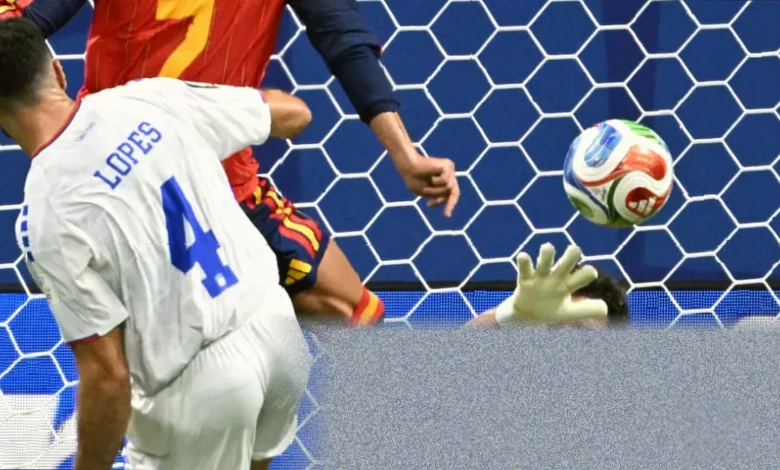
Central to that resistance was goalkeeper Vozinha, the 40-year-old who plays for Desportivo de Chaves in Portugal’s second division. He made a string of saves, tipping a Laporte header round the post with his fingertips, and flying to his right to deny Pedri. His authority in the box allowed him to collect crosses under pressure. “Vozinha has been great, so too his teammates,” a half-time email noted. His performance earned the man-of-the-match chatter even before the break.
Cape Verde’s historic qualification—topping their CAF group ahead of Cameroon with 23 points from ten matches—had built a squad used to high-pressure encounters. Players such as Sidny Cabral (Trabzonspor), Laros Duarte and Livramento were part of a unit that had conceded only eight goals across their qualifying campaign. That defensive foundation travelled to Atlanta’s climate-controlled indoor stadium.
The first half also featured a hydration break at the 23-minute mark—a scheduled pause that drew criticism from fans, who saw it as a concession to advertising. But Cape Verde used the interval to regroup, and Spain could not capitalise.
Spain’s Creative Void
Spain, managed by Luis de la Fuente—who led the side to victory in Euro 2024 and the UEFA Nations League in 2023—arrived with a perfect qualifying record. Yet they looked ill-prepared for the task. “What I’m finding odd about this game is that Spain will have known how Cape Verde were going to play, yet look like it’s come as a total shock,” the match commentary observed. “There’s no tempo or snap to their passing and movement about the box, nor are they overloading it with men; I’m not really sure what kind of goal they’re trying to score.”
Spain’s quick interchanges, which had picked apart defences during qualifying, were almost totally absent. The clipped passes out wide that had worked before the interval vanished after the restart. “I’m not sure what they were told at half-time, but I doubt it was ‘more of the same please lads’—yet that’s pretty much what we’re seeing,” one commentator wrote. Pedri looked likeliest to make something happen, gliding balls into the middle, but Fabian Ruiz headed straight at Vozinha and Oyarzabal’s header was blocked. Gavi missed a connection at the near post, and Ferran Torres could not guide his low shot past the goalkeeper.
Rodri, the captain and defensive midfielder, attempted to switch play with cross-kicks, but left-back Cucurella was often the target. A fine Rodri delivery found Cucurella, who headed back for Ferran—only for the forward to hammer against the crossbar. The rebound fell to Oyarzabal, whose looping header forced another tip over from Vozinha, only for an offside flag to negate the effort. “Spain are starting to feel the pressure,” the match report noted as Laporte flung himself into a speculative long-range shot that flew over.
The lack of game intelligence drew sharp criticism. “I never thought I’d criticise a Spain team, never mind one run by Rodri and Pedri, of a lack of game intelligence,” one analyst said. “But that’s exactly what we’re seeing.”
Substitutions Fail to Break the Deadlock
As the second half wore on, both managers turned to their benches. Cape Verde made a triple change on the hour mark: Jovane Cabral, Laros Duarte and Livramento made way for Deroy Duarte (brother of Laros), Da Costa and Willy Semedo. The switch added fresh legs but did little to alter the defensive structure.
Spain’s response was more direct. At 71 minutes, Luis de la Fuente introduced Lamine Yamal and Mikel Merino in place of Gavi and Fabian Ruiz. The teenage Barcelona starlet generated an immediate buzz whenever he received the ball. “A buzz flows around the ground the second Lamine gets the ball,” the match report noted. In the 73rd minute, Lamine beat his man on the outside and cut back for Llorente, who squared to Merino near the penalty spot. The Arsenal midfielder, noted for his aerial prowess, scuffed his shot and Vozinha fielded easily.
Minutes later, Sidny Cabral—already on a yellow card after hauling back Llorente in the first half—was withdrawn for João Paulo of FCSB. The substitution was sensible, as Cabral had been tasked with marking Lamine. Yet even with the extra threat, Spain could not find a breakthrough. “I feel like I’m watching Groundhog Day,” one fan emailed. “Spain have ball, Spain attack, Cape Verde defend well, Spain’s attack comes to nothing. Repeat. Repeat. Repeat.”
Cape Verde had their own rare moments on the counter. Ryan Mendes lifted the ball over Gavi’s head before firing into Cucurella’s midriff. A free-kick was wasted when Jovane Cabral shot over. And when Spain countered through Ferran, full-back Borges did a remarkable job of shackling him at the cost of a corner—which came to nothing. The European champions finished the half with possession and pressure, but lacked the incision to break down a team that had made defending an art form.