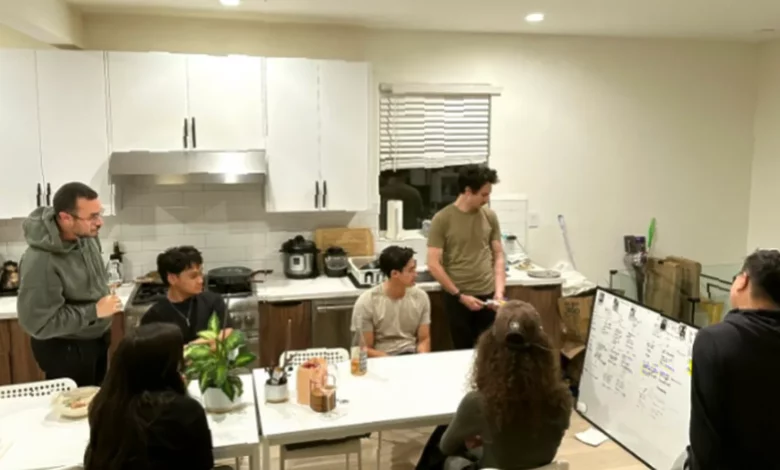
On a cool October evening during San Francisco Tech Week, a crowd gathered outside the wrought-iron gates of a Pacific Heights mansion. Two burning braziers flanked a red carpet leading up the steps of what was once an art school building — a setting whose revivalist architecture felt a world away from the sterile offices and corporate venues that dominate most Tech Week events. Inside, the guests looked equally out of place by San Francisco standards: structured jackets, silk neck scarves, tailored skirts, and barely a hoodie in sight. This was Fashion X Tech, an event devoted to a topic many people no longer associate with the Bay Area: style.
The evening was hosted in one of The Residency’s houses — a detail that would prove telling. The turnout was oversubscribed, a signal, according to those who attended, that even in a city better known for SaaS and enterprise software, there is an appetite for consumer culture and creator-driven commerce. For Max Hui, founder and CEO of Lookbook, the event was both a proof of concept and a homecoming. “I heard someone say this was the best-dressed room in SF,” he joked. “They’re not wrong.”
Building a fashion startup in the worst-dressed city
Lookbook is a consumer app that curates personalised outfit inspiration for Gen Z — a demographic that, according to industry data, finds 92% of its fashion inspiration online. On the surface, the startup is an awkward fit for San Francisco, a city routinely described as one of the worst-dressed in the country thanks to its inescapable tech scene, where hybrid and remote work are prevalent and in-office dress codes, where they exist, tend to be relaxed. Yet a growing number of fashion founders have decided to make San Francisco their home base. For Hui, the logic is straightforward: the city may not be Lookbook’s market, but it remains one of the best places in the world to build a company.
“One thing that’s really hard to substitute is the startup environment. It’s undoubtedly the best place to build,” Hui told Tech Funding News. “You’re surrounded by people who are doing the same thing, and it helps you find your bearings.” He argues that the infrastructure needed to get a company off the ground is unparalleled in San Francisco — from access to capital and engineering talent to a dense network of incubators and accelerators. The city’s Fashion Tech sector alone comprises a significant number of companies and has raised substantial venture capital, with notable names such as Everlane, ThirdLove, Allbirds, unspun, and Archive all calling the Bay Area home.
San Francisco’s fashion identity is more complex than the hoodie stereotype suggests. The city has deep roots in counterculture and artistic expression, with a tradition of supporting boundary-pushing designers. Historical brands such as Levi’s, Gap, and Esprit originated here, and recent years have seen a resurgence in fashion innovation fused with technology — focused on how clothing is made, from materials to manufacturing processes, rather than high fashion itself. The local style is a blend of workwear, smart casual, and athleisure, which means traditional fashion rules often don’t apply, fostering an environment for experimentation. Yet the city lacks a prominent fashion magazine to document its evolving sartorial identity, leaving its fashion discourse largely drowned out by tech-driven platforms.
The hacker house effect
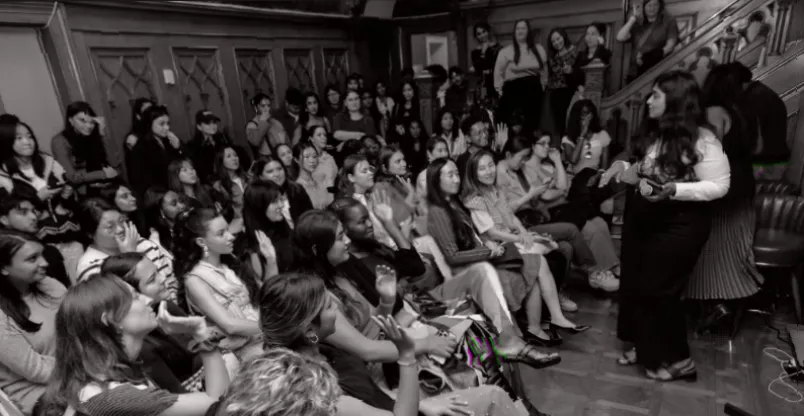
One part of the startup ecosystem that has seen a post-pandemic resurgence is the network of “hacker houses” and in-person founder communities in the Bay Area. These living-and-working spaces aim to compress months of introductions, feedback, and momentum into a much shorter window for early-stage founders. The Residency is among the most prominent, positioning itself as an alternative to the traditional path of higher education. It is no less selective: according to its social media, one recent cohort received about 3,000 applications, of which just 3% were given a place in one of its six Bay Area houses.
“A big part of kickstarting my journey was living at one of the houses in The Residency,” Hui recalled. “It put me in touch with the right people and a group of people working towards the same goals.” He credits that environment with helping Lookbook raise $150,000 in initial capital from both angel and institutional investors. “It’s allowed us to go and validate our theses with the market,” he said. But the value, he argues, extends beyond funding. “Intimate dinners, parties, panels, summits — they all put you in touch with different people that matter to your journey.”
The Bay Area hosts a diverse range of such programmes. SF Parc focuses on creative technologists and artistic creativity; Foundry Coliving offers residencies for startup founders with community dinners and demo days; Calculus House is a research residency for high-agency researchers in AI and robotics; and AGI House, backed by figures such as Eric Schmidt and Andreessen Horowitz, concentrates on AI founders. Despite the demand for these living communities, sentiment surrounding them can be mixed. It is difficult to separate the culture fuelling hacker houses from the new-age AI hustle culture that some describe as “grifty,” “cringe,” or “weirdly ascetic.” Nonetheless, for early founders like Hui, the compressed access to networks and feedback can be transformative.
Hui has become a connector in his own right, helping bring the Fashion X Tech event to The Residency’s Pacific Heights mansion. The oversubscribed turnout suggests to him that, even in a city not typically associated with fashion, there is appetite for consumer and culture-focused technology.
Separating the place where culture is observed from where companies are built
Yet Hui is careful not to confuse San Francisco’s strengths with a perfect proxy for Lookbook’s users. “I always get told I should be in New York instead,” he said. “Don’t get me wrong. Being close to the consumer is probably the number one most important thing to do.” He just does not believe that closeness has to mean physical proximity. Instead, his team uses their millions-strong viewership on social media to reach users elsewhere: New York, Los Angeles, and on college campuses across the country.
“In the age of social media and algorithms, content that we post might naturally find our target users in places like LA, New York, maybe even more easily than it might find someone physically closer to us,” he said. To put that hypothesis to the test, Lookbook started posting to TikTok before they had even built the app. A few weeks in, one video went viral, reaching hundreds of thousands of viewers. Since then, the team has accrued millions of views across platforms and expanded to involve multiple creators and freelancers. In addition to building brand awareness, these social campaigns have helped the team understand which ideas, features, and pain points resonate with real users outside the San Francisco bubble. “It becomes a bit of a two-way conversation with our target audience,” Hui said.
That online dialogue matters, he says, because consumer startups can be vulnerable to misleading feedback — especially in San Francisco, whose startup scene has no shortage of opinions on any product or idea. “Too much of [it] can get noisy,” he said of the Bay Area’s startup culture. “There’s a lot of hype that sometimes you have to ignore, and opinions that you have to… well, have opinions on. Opinions on opinions.” Past criticisms of the city’s startup ecosystem include an echo-chamber effect where ideas get reinforced, a gold-rush mentality, and a homogeneity that can be cutthroat. Hui acknowledges the noise but filters it.
Ultimately, his case for San Francisco is not about whether the product is a fit for the city. If anything, it is a case for separating the place where culture is observed from the place where companies are built. Lookbook can learn from users online, test its branding on TikTok, watch behaviour on Instagram, and find users far beyond the Bay Area. What San Francisco offers is a different set of tools: capital, density, urgency, and a high tolerance for early, unfinished ideas. For Lookbook, and for Hui, that is enough reason to call San Francisco home base.