It was a letter delivered by a motorcycle messenger from Kent to Hampshire, typed on two sheets marked A and B, that settled the most consequential decision of Juliet Nicolson’s life. Her father, a thrifty man who rarely wasted a penny, had hired the courier at what must have been considerable expense because he understood the urgency. On Boxing Day 1972, Nicolson had telephoned him with news that should have been triumphant – she had been offered a place to read English Literature at St Hugh’s College, Oxford, starting in autumn 1973 – and then confessed she intended to turn it down. She was planning, instead, to travel to Iran with her DJ boyfriend and work as his assistant in the disco at the Tehran Hilton. Her father said nothing. The next day, the letter arrived. It changed everything.
To understand the forces pulling Nicolson in the other direction, one must first understand her mother’s expectations. Born in Britain between the two world wars, when a scarcity of men had made them precious commodities, Mrs Nicolson had left school at 14. She belonged to a generation often brought up to believe that matrimony was the only guarantee of a secure social and financial future. While romance and love were bonuses, the unwritten clause in a marital contract stipulated that a wife must play her supportive part at home while the husband went out to work. Without the necessary qualifications for the role, the entire agreement risked failure. In post-war Britain, this was the lived reality for many women. Higher education was not the norm, especially for working-class girls. For those in middle- and upper-class families, education often ended with “finishing schools” that taught cooking, etiquette and household management – skills designed to enhance spousal eligibility. The so-called “marriage bar”, which forced women to resign from professional jobs upon marriage, was still casting a long shadow, though the 1944 Education Act had begun to dismantle it. Even as late as the 1970s, informal barriers persisted in certain professions.
In 1972, Nicolson was at college studying for her A-levels, but during the holidays her mother enlisted her on various finishing courses. The intention was that she acquire the domestic skills to improve her chances of landing a suitable husband – a nice gentry farmer, perhaps. Courses included how to cook, carve a roast and drive a Jeep to the shops. Her mother did not see anything wrong with this. Only now, almost 40 years after her death, does Nicolson realise how much her mother regretted the lack of educational and career opportunities open to her, and only now does she sympathise with the subconscious envy when those opportunities were offered to her daughter.
While allowing her mother to manoeuvre her towards a well-cushioned altar, Nicolson’s own ideas of future independence were forming. Tentatively, she mentioned the university option to her mother, who managed a tone of considered scepticism before concluding with a firm “out of the question”. Her divorced parents exchanged tense letters. “Juliet is not university material,” her mother wrote. Her father replied that it would be “spine-strengthening” for her to have a go, even if she failed. He had recognised his daughter’s incubating passion for reading, poetry, theatre and writing. So had her English teacher, Mrs Fitzgerald – a woman with a falling-down half-bun, chewed red biros and battered brogues, who secretly hoped to make enough money to leave teaching and become a novelist. Her encouragement was inspirational. Nicolson sat the Oxbridge exam.
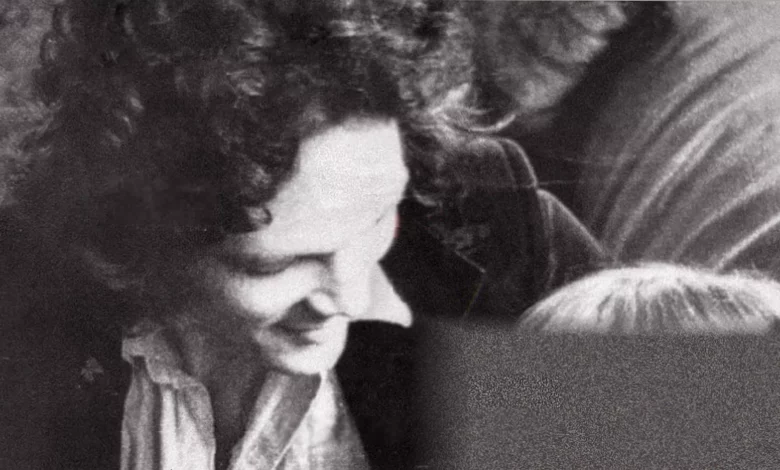
Around that time she met James, a clever, arty, curly-headed charmer working for a travelling discotheque company as their star DJ until he found his professional calling. Her mother was dismayed by the choice of boyfriend. Her father said he looked like the young Byron. Lord Byron, the Romantic poet, was renowned for his charisma, dark curly hair, intense eyes and scandalous reputation – a “mad, bad and dangerous to know” figure who cultivated a dramatic public image. The Byronic hero archetype – moody, passionate, rebellious – clearly appealed. Nicolson was smitten. James lived in a tiny mews flat in London above a stable; the musty, horsey scent permeated the sitting room. On their first date, he played Here Comes the Sun at top volume on his tiny portable record player, and life began to glow.
One rainy December evening, Nicolson was on her way to a Christmas party when a damp brown envelope marked “Telegram” flopped through her letterbox. She read the pasted-on typewritten words at one glance: “Vacancy offered you to read English Literature, autumn 1973. St Hugh’s College Oxford.” By the early 1970s, telegram usage in the UK was in decline due to the rise of domestic telephones, but the medium still carried a sense of urgency and gravity, often associated with significant news – a death or a lottery win. Shoving the telegram in her pocket, Nicolson went to the party and told no one. Not even James. The next day, a second telegram arrived: the university would offer the place to the first person on the waiting list if they did not receive an acceptance by 27 December.
On Boxing Day, she rang her father and told him the news. He was momentarily silent until his delayed shock was so great that he dropped his favourite coffee cup and she heard it smash. Then she told him she was turning the offer down. James had proposed they go to Iran, where he would work as a DJ at the Tehran Hilton, and she would be his assistant. Tehran in the 1970s had a vibrant disco scene, blending Eastern and Western influences – a cosmopolitan atmosphere that the Tehran Hilton (now the Parsian Esteghlal Hotel) symbolised. It was a period of cultural mixing before the 1979 Islamic Revolution suppressed such public entertainments. Her father said nothing.
The next day, the motorcycle messenger arrived with two typewritten sheets, marked A and B. Sheet A was headed “Why I should go to work in a discotheque in Tehran” and itemised the virtues and advantages: a wonderfully rich culture to explore, financial rewards, lovely music, romance. There were not many points, but they were plausible pluses. Sheet B was headed “Why I should be the first woman in our family to go to university” and argued the case with such fluency, persuasion and irresistible seduction that the decision suddenly became a no-brainer. St Hugh’s College, founded in 1886 by Elizabeth Wordsworth as a women’s college, was at that time still single-sex – it would not admit male undergraduates until 1986. The significance of becoming the first woman in her family to attend university was not lost on her father, nor on Nicolson.
The letter, as she later reflected, changed the way she approached big decisions thereafter, weighing up the pros and cons with equal care. It gave her a new confidence to just have a go, even if almost everyone tells you not to. For her father’s next birthday, she presented him with the glued-together coffee cup.
James never went to Tehran. He stayed behind in London, and eventually she married him. In 1979, her English teacher’s novel, Offshore, won the Booker Prize. Penelope Fitzgerald, the teacher in question, had drawn the novel from her own experiences living on a Thames sailing barge; its win was considered a surprise, partly because at 132 pages it was the shortest novel to have won the prize up to that point. She is now recognised as a significant British writer, listed among the 50 greatest British writers since 1945. Nicolson, who went on to become a writer and journalist herself, remains, by her own admission, useless at cooking.