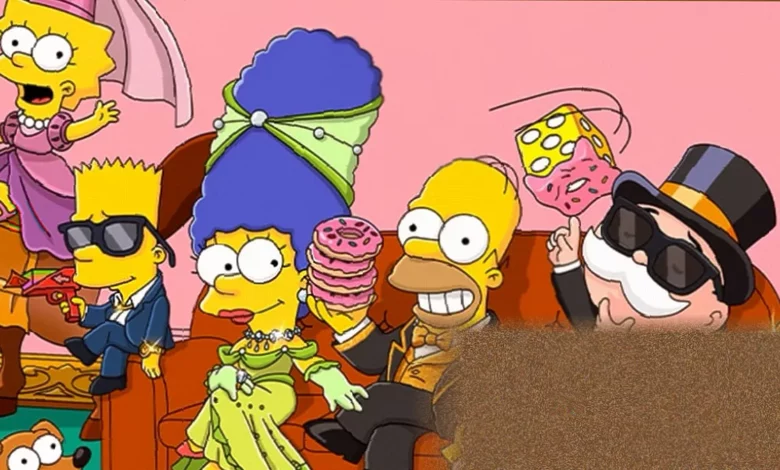
The Simpsons is now a permanent fixture in Monopoly Go!. The mobile gaming phenomenon, developed by Scopely in conjunction with Hasbro, has welcomed Springfield for a two-month takeover that runs from June 3 to July 29, 2026 — one of the most comprehensive collaborations the game has ever undertaken. This is not a simple licence-and-paint job; it is a full-blown creative partnership involving the show’s writers, animators and voice talent, plus an original animated short pitting Mr. Monopoly against Mr. Burns, voiced by Will Ferrell and Harry Shearer.
Springfield lands in Monopoly Go!
The event transforms the board game’s digital world into a playground of iconic Simpsons locations — Evergreen Terrace, the Nuclear Power Plant, Krustyland, Moe’s Tavern and the Kwik-E-Mart — all reimagined in Monopoly Go!’s art style. New gameplay mechanics have been woven in: “The Simpsons Run” turns Free Parking into a path-based mini-game; “Bribe Wiggum” offers a twist on the “Go to Jail” mechanic, letting players attempt to bribe Chief Wiggum for rewards or penalties; and themed Shutdown and Heist events feature elements such as the Springfield Monorail. Players can also collect new “Episode Sticker Sets” that rotate every two weeks, with 189 stickers across 21 sets. Completing the main album rewards participants with dice, a “The Simpsons Board Token”, and in-game cash.
The collaboration goes far deeper than most licensed tie-ins. Rather than simply borrowing characters and applying a yellow coat of paint, Scopely worked directly with The Simpsons creative team for months. “We weren’t just providing a homage,” said Joe Zanetti, vice-president of operations at Scopely. The company brought in Loni Steele Sosthand, a co-executive producer and writer now in her sixth season on the show, to help shape original storylines that unfold across seasonal maps. Veteran animator Eric Keyes, who has worked on the series since its beginning, acted as an unofficial quality controller. “He can just glance at something and see if there’s not the right number of eyelashes,” Sosthand said.
Zanetti traced his own Simpsons gaming nostalgia back to Konami’s 1991 arcade brawler, The Simpsons Arcade Game. “That’s the one that made such an impression on me,” he said. The experience of creating the Monopoly Go! event, he added, was less about licensing and more about borrowing Simpsons writers. “We were trying to come up with a joke for every mechanic. That one really felt very writers’ roomy.” Among the deep-cut characters included are Rich Texan, Homer’s pet pig Plopper, and Cowboy Carl — a nod to Sosthand’s Writers Guild award-winning episode Carl Carlson Rides Again, which explored the character’s Black cowboy heritage.
Sosthand, who is currently working on the show’s 2027 Treehouse of Horror episodes from the Fox lot in Los Angeles, said the collaboration gave her a new perspective. “I’ve been impressed with the richness of this world we’re creating,” she said. “I have a newfound respect for games.” The show’s showrunner and executive producer, Matt Selman, emphasised the importance of partners who truly understand the show’s humour and spirit. For Scopely, the feeling was mutual. “It’s not: ‘This is our box,’” said Zanetti. “It’s more: ‘How can we break the box?’”
A history of Simpsons in games
The Simpsons has been a fixture in video games since the arcade era. The first adaptation, The Simpsons Arcade Game, was developed by Konami in 1991 — the same year the franchise expanded to home consoles with Bart vs. the Space Mutants. Since then, the family has appeared in beat-’em-ups, platformers, racing games, sports titles, and open-world adventures, most notably The Simpsons: Hit & Run (2003) and the more ambitious The Simpsons Game (2007). As of October 2020, 27 Simpsons video games had been released. The Monopoly Go! collaboration marks the franchise’s first dedicated mobile game experience in over a decade — 13 years since its last appearance in the format.
Unlike many sitcoms adapted into games, The Simpsons has always felt unusually well-suited to the medium. Springfield is not just a setting but an entire densely populated world with hundreds of characters, dozens of recognisable locations and decades of running jokes — from the Stonecutters to Mr. Sparkle — waiting to be explored. That flexibility has allowed the franchise to move effortlessly between genres. As Zanetti put it, “It’s the one that made such an impression on me.”
The enduring appeal of Springfield
What makes The Simpsons so adaptable across generations of gaming? Sosthand believes the reason is straightforward. “At heart it’s a family show,” she said. But it is also a show that has always thrived on mischief, giving creators permission to be naughty themselves. Over nearly four decades, the series has survived broadcast television, DVDs, streaming and social media. Most franchises eventually become trapped by nostalgia; The Simpsons seems to dump it straight back into the Springfield nuclear power plant and convert it into fresh fuel.
The numbers bear out its sustained relevance. Since its debut in 1989, The Simpsons has become the longest-running animated sitcom in history, with more than 790 episodes and a feature film. It continues to generate significant demand, often competing with new releases. The show has been awarded 31 Primetime Emmy Awards, and Time magazine named it the best television series of the 20th century in 1999. Its commercial reach is vast: the franchise has generated billions in merchandise revenue, with catchphrases and characters becoming ingrained in global popular culture. It also paved the way for other adult animated series such as Family Guy, American Dad and Futurama, and influenced a style of self-aware, hyper-referential comedy.
Live-service games such as Monopoly Go! offer a new kind of longevity. They are places where audiences spend years rather than hours, and for a franchise as established as The Simpsons, they provide something television increasingly struggles to deliver: an endlessly expandable world. Sosthand said the process of creating the in-game content felt like making “a true Simpsons little episode.” For Zanetti, the showdown between Mr. Burns and Mr. Monopoly felt oddly natural because both characters occupy “a really important place in the zeitgeist.”
Monopoly Go! itself has proved a phenomenon. Since its launch in April 2023, the Scopely title has surpassed $6 billion in lifetime in-app purchase revenue, making it the fastest mobile game in history to reach that milestone. It maintains high player engagement, with 70% of players returning daily. The Simpsons takeover is the latest in a string of major collaborations for the game, following previous Hasbro partnerships on Yahtzee With Buddies and Scrabble Go.
More than three decades after Homer first walked into Moe’s Tavern, Springfield remains woven into the fabric of popular culture. And if the journey from arcade cabinets to Monopoly Go! proves anything, it’s that The Simpsons’ greatest trick was never predicting the future. It was finding new ways to belong in it.