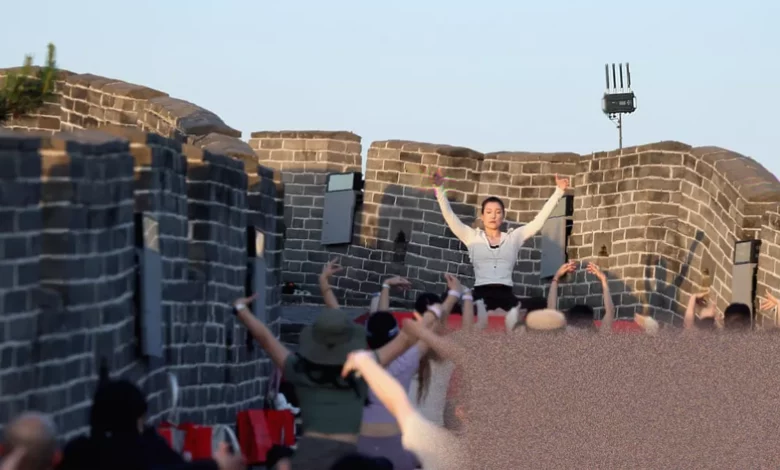
Lululemon has issued an apology after a promotional yoga festival held on the Great Wall of China sparked fury when a drumming performance appeared to feature a Japanese taiko instrument instead of a traditional Chinese dagu drum, with social media users calling the choice deeply inappropriate and insulting given the historical and symbolic weight of the location.
Drum controversy erupts on social media
The Canadian athleisure brand, which is expanding rapidly in China and views the market as crucial to its growth, held the event on 30 May on a section of the Great Wall near Beijing to mark its 10th anniversary in mainland China. More than 2,000 people were invited to the yoga festival, which was advertised as a celebration of Chinese culture and wellness, according to the state-run tabloid Global Times. The well-known Chinese actor Zhu Yilong, a Lululemon brand ambassador, was booked to perform.
Zhu joined a drumming group on the Wall and posted a picture of himself in front of one of the instruments, bearing the Lululemon logo, on his Weibo account. Almost immediately, users of the social media platform accused the troupe of using a Japanese taiko drum rather than a Chinese dagu drum. The distinction was considered far from trivial: the instrument’s barrel shape, red cross-rope tension system and angled stand were identified by users as characteristic of taiko, a Japanese performance tradition that, while historically influenced by Chinese instruments, has evolved into a distinct art form linked to Shinto worship and the Bushido spirit.
Percussionist Xu Yang provided a detailed analysis online, noting that the drum’s structure, performance style and artistic concept aligned more closely with Japanese taiko traditions than with Chinese drumming. The choice was particularly sensitive because the Great Wall is a potent national symbol, and the use of a Japanese instrument there evoked memories of Japan’s occupation of China and wartime atrocities. Some users drew direct connections to Japanese imperial aggression. By Monday, discussions about the drum had gathered more than 50 million views on Weibo. Zhu Yilong’s studio called on Lululemon to respond and urged the brand to verify its planning process, affirming the studio’s own commitment to promoting traditional Chinese culture.
Event details and backlash
The event was held at the Huanghuacheng Water Great Wall in Huairou District, Beijing, and was part of Lululemon’s 2026 yoga festival series. Despite being promoted as a tribute to Chinese culture, the drum performance quickly became the focus of online outrage. The Hiiko Drum Troupe, which performed alongside Zhu, also apologised. Lululemon later removed all content related to the drum event from its website and social media channels.
Lululemon’s apology
On Tuesday, 16 June, Lululemon posted an apology on Weibo to Zhu Yilong and to the public, saying the event had been “intended to unwaveringly pay tribute to Chinese culture”. The statement read: “Due to limitations in our professional knowledge, we were unable to identify potential controversies initially, and we fully recognise that we should be more cautious and thorough in the early planning and review process of the drum performances.” The company pledged to “learn profound lessons” and to adopt “a more rigorous attitude” for future events.
Broader implications for Western brands
The incident highlights the significant risks Western brands face expanding in China, where cultural and political sensitivities can turn a promotional misstep into a reputational crisis. Lululemon entered China slowly in 2013, focusing on brand awareness and community-building through events such as “Unroll China”. Its marketing strategy emphasises a “SweatLife” lifestyle and community belonging, balancing global identity with local relevance. The drum controversy now threatens that balance.
Previous controversies illustrate the pattern. Last year, outdoor brand Arc’teryx issued an apology after a high-altitude fireworks display in the Tibetan plateau, titled “Rising Dragon”, caused an outcry over environmental damage and cultural insensitivity. The Canadian company, part-owned by China’s Anta Group, faced calls for boycotts after choreographed pyrotechnics and coloured smoke along Himalayan ridgelines were criticised for their impact on the fragile ecosystem and for using a symbol significant to Tibetans. In 2018, luxury brand Dolce & Gabbana cancelled a Shanghai fashion show following a promotional video in which an Asian model struggled to eat Italian food with chopsticks. Social media users condemned the advert as racist and trivialising of Chinese culture, leading to the removal of Dolce & Gabbana products from major Chinese e-commerce platforms.
The Lululemon case underscores how even a seemingly minor detail such as a musical instrument can carry geopolitical weight in China. Brands are increasingly judged on their cultural literacy, and the speed of social media scrutiny means that a single ill-judged performance can generate tens of millions of views within days. Lululemon acknowledged its own “limitations in professional knowledge” and the need for far greater due diligence. Whether the apology and subsequent removal of content will be enough to restore trust in one of its most important growth markets remains an open question.