Colombian farmers who have staked their futures on protected agricultural zones fear the outcome of Sunday’s presidential runoff will determine whether their hard-won land rights survive or are swept aside by a far-right administration promising to prioritise agribusiness and extractive industries.
In the remote Amazon department of Guaviare, Pablo Peña, a farmer who first arrived in 1994 after escaping violence, is one of thousands of campesinos watching the second-round election between the far-right candidate Abelardo de la Espriella and the leftwing Iván Cepeda with deep unease. The vote, set for 21 June, follows a first round on 31 May in which De la Espriella secured 43.7% of the vote against Cepeda’s 40.9%.
The election is widely seen as a referendum on the legacy of President Gustavo Petro, who has made peasant reserve zones (ZRCs) a centrepiece of his strategy to improve rural livelihoods while curbing deforestation in the Amazon. During his four-year term, Petro’s government created 20 of the 27 existing ZRCs—designated land-use areas intended to safeguard rural communities, support local farmers and stabilise territories still scarred by conflict despite the 2016 peace agreement with the FARC.
Peña and his neighbours in the town of Calamar first began the process of forming a ZRC in 2018, after realising that they did not even have formal title to the land they had occupied for decades. The Colombian government officially approved their request in 2025. “When the guerrillas went to Havana to negotiate the peace treaty with [former president Juan Manuel] Santos, we realised that we didn’t even know where we had settled or the boundaries of our land,” Peña said. “Then we decided to protect our land.”
The mechanics of peasant reserve zones
ZRCs are essentially a mechanism for bringing farmers into the institutional framework and away from the territorial control of armed groups, according to Camilo González Posso, founder of the peacebuilding NGO Indepaz and a former government peace negotiator. “The law requires that these zones create sustainable development plans in collaboration with institutions, while the government has a commitment to contributing to the development of sustainable economies through investment and programmes,” he said.
One of the most recent zones established under Petro is the Guardian of Chiribiquete, a reserve covering 183,200 hectares and supporting 4,430 people. Officially created in 2025, it is named after the nearby Chiribiquete National Park, a UNESCO World Heritage site and the world’s largest national park protecting a tropical rainforest. Within the reserve, almost half of the native forest remains intact. Community members work to protect the area while planting native trees and Amazonian fruits such as cacao and copoazú to generate income.
Supported by organisations including the conservation charity WWF and the deforestation programme Visión Amazonía—backed by the UK, Germany and Norway—residents have established plant nurseries, restored waterways and received training in woodworking. Yet cattle remain central to many livelihoods, and farmers hope to transition to sustainable practices without financial harm.
“Although we live in a hidden corner of the country, we understand the damage caused to nature, and we are trying to compensate for the damage caused without affecting our economies,” said Leydy Janneth García, a representative of the conservation project Green Amazon, who arrived in Guaviare in 2018 after fleeing conflict. Her family now grows cacao, oranges, avocados, chontaduro and tamarind on land that once grew coca, and has set aside 14.5 hectares for conservation.
Farmers caught between two futures
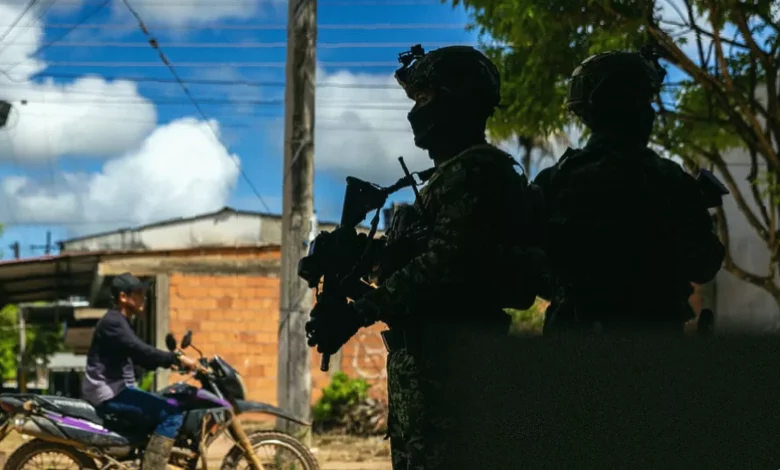
Despite the progress made under Petro, many farmers in ZRCs feel deeply uncertain about the future. They acknowledge that Petro secured land rights but failed to bring armed groups under control. “History shows that the current government has demonstrated this determination, but political will alone, without security, is not enough,” said Jesús Cuestas, a farmer and ZRC member.
Under Petro’s administration, armed groups have expanded their influence, and farmers fear that a Cepeda victory would continue that trend. “Under Petro’s administration, armed groups have expanded, and we fear that if Cepeda wins, this trend will continue,” García said.
Yet the prospect of a far-right government under De la Espriella alarms experts and farmers even more. De la Espriella has campaigned on a platform of security and economic growth, supporting fracking and intending to expand its use—a policy that carries risks of water contamination, greenhouse gas emissions and landscape damage. He has also urged Colombia to withdraw from the United Nations, a move that could jeopardise international investment in rural initiatives and peace efforts.
“De la Espriella links development to extractivism, supporting an extensive livestock model and benefiting the wealthy landowners,” González Posso said. He warned that a far-right administration could bring more violence, not just from armed groups. Farmers, he said, are likely to resist being expelled from their lands to benefit the agroindustry. Guerrillas would be empowered by extensive livestock farming, which is more lucrative, and could increase extortion by charging landowners for each head of cattle and hectare of pasture while imposing fines for each deforested hectare.
Peña, who first visited Guaviare during his military service and later bought his first plot of land for a kilo of coca paste, knows the fragility of rural life all too well. The land he occupied was within a forest reserve, complicating property rights—an all-too-common situation given that, according to the ministry of agriculture, at least 40% of rural land in Colombia lacked formal titles before the peace treaty. When the “war on drugs” led to intensive eradication programmes, farmers like Peña shifted from coca to cattle, driving deforestation. Between 2002 and 2025, Guaviare lost 350,000 hectares of forest—an area nearly five times the size of Singapore.
“While you could survive with five hectares of coca, cattle needed larger extensions of land,” Peña said.
Cepeda, a senator and ally of Petro, has signalled he would deepen the current government’s social democratic reform agenda, emphasising Indigenous rights, environmental conservation and reducing dependence on fossil fuels. “Cepeda aims to strengthen a sustainable economy created with and for the people,” González Posso said. “It’s crucial to develop a medium-term strategy that integrates ZRCs, peace initiatives and environmental considerations.”
Whoever wins, campesinos agree that the next government must deliver far-reaching change to Colombia’s rural economy. “We need to shift focus from discussion to action,” said Cuestas. “A great deal of money has been spent, yet not a single peasant survives on conservation or rainforest resources. The day a hectare of rainforest becomes more expensive than a hectare of grass, we will finally have achieved balance.”