G7 leaders meeting in France have pledged to increase the delivery of air defence capacities, additional systems and interceptors, and long-range capabilities for Ukraine, in what they described as an effort to support and accelerate “new momentum” on the battlefield. The joint statement, published overnight, reaffirmed the bloc’s “unwavering support for Ukraine in defending its freedom, sovereignty, and territorial integrity,” and commended Kyiv for its resilience and recent progress.
G7 pledges on military aid and production
In a direct commitment to Ukraine’s immediate military needs, the G7 agreed not only to scale up deliveries of air defence and long-range weapons but also to consider extending licences to allow Ukraine to increase its own military production. The leaders said they would strengthen sanctions on Russia’s war economy, including on oil and gas sectors, and described the current moment as “the right moment to proceed with additional measures”. Those measures include backing a deal secured by US President Donald Trump to reopen the Strait of Hormuz, which the statement explicitly praised: “President Trump has delivered a deal that we support in reopening the Strait of Hormuz.” The inclusion of that language appeared to be a pointed attempt to keep Trump engaged, a familiar dynamic in recent transatlantic diplomacy.
Beyond defence, the summit also turned to artificial intelligence, with leaders meeting the heads of OpenAI, Anthropic and Google DeepMind — the first time all three major AI companies were represented at a G7 meeting. Discussions covered opportunities, risks, governance and potential job displacement, though the United States is reportedly blocking binding AI governance language.
Nato Secretary General: defence and Ukraine must go hand in hand
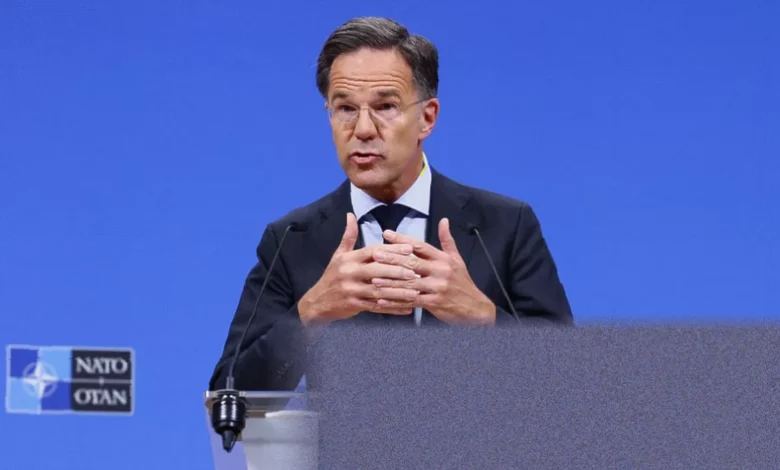
Speaking ahead of a Nato defence ministers’ meeting and less than a month before the alliance’s summit in Ankara, Nato Secretary General Mark Rutte said the G7 statement showed that all allies were “completely committed to making sure that Ukraine maintains its position in the fight against Russia, and is able to defend itself”. He stressed that European allies taking greater responsibility for their own defence must go “hand in hand” with continued support for Ukraine, and said the US continues to provide capabilities that only Washington can deliver — including Patriot air defence systems, which are paid for by European and Canadian allies.
Rutte said he wanted the Ankara summit in July to deliver “an absolute ironclad commitment” to last year’s Nato spending pledges and to Ukraine. He expected Ukrainian President Volodymyr Zelenskyy to have a full programme of meetings at the summit, but notably “no sit down with all the 32 leaders”. The focus, Rutte said, would be on what Ukraine needs to maintain the fight, including the flow of military equipment and particularly US interceptors for the Patriot system, and on “making sure the money is there”.
Pressed repeatedly on a timeline for Ukraine’s needs, Rutte gave a muddled answer, saying it was impossible to answer with a simple yes or no: “It’s not that you can answer that question with a yes or no. It’s clear that the US has adjusted its commitment to the Nato force model, but it’s in technical terms, it is not a yes or no.”
Defence spending, China, and the Strait of Hormuz
On defence spending, Rutte described the overall increases across Nato as “really staggering”, with many countries “really ramping up” their budgets. But some allies are struggling. The Czech Republic, under Prime Minister Andrej Babiš, did not reach the 2% target last year. NATO projections put Czech defence spending at 1.78% of GDP in 2026, well below the benchmark, despite Prague reporting 2.01% in 2025 (Nato recognised 1.85%). Babiš has indicated the country will “probably” miss the target for 2026 due to budget strains and political disagreements. Czech lawmakers approved a 2026 budget allocating just over 1.7% of GDP to defence, with spending only inching above 2% if funding for defence-related projects at other ministries is factored in. Rutte said he knew the Czech government was “working very hard” and expressed confidence that “when it comes to a credible trajectory, it will be there”.
On China, Rutte was asked about reports that Beijing has been training Russian military personnel to fight in Ukraine. The EU’s foreign policy chief, Kaja Kallas, disclosed last week that the bloc has verified such reports, describing China as a “decisive enabler” of Russia’s invasion. Reuters reported in May 2026 that China secretly trained about 200 Russian military personnel in China in late 2025, focusing on drone use. China denies any involvement. Rutte said Nato is “constantly trying to follow exactly what China is doing” and is “not naive”. He added: “We follow everything exactly. I cannot tell you more at this moment, or at least in this open press conference, but you can be assured that we follow every [bit].”
Regarding the Strait of Hormuz, Rutte said any Nato role there would come outside the alliance’s formal framework, but that France and the UK are coordinating on a multinational, independent, defensive initiative to protect merchant vessels. Germany has also announced it is ready to contribute and has dispatched minesweeping boats. Rutte said: “Whether Nato will play a role there, yes or no… if helpful, of course we will play a role, but if they can do it without us, also okay; we are always ready to help if so wanted.”
On adjustments to the Nato force model, journalists pressed Rutte on whether the US was downgrading its commitment. The US has announced it is “rightsizing” its contributions to the NATO Force Model, consistent with its 2026 National Defense Strategy, aiming for Europe to take primary responsibility for its conventional defence. This involves fewer combat aircraft, air-to-air refuelling planes, and navy vessels committed to Nato operations in Europe, as well as the cancellation of an armoured combat brigade deployment to Poland and the departure of 5,000 troops from Germany. Nato spokesperson Allison Hart stated the reduction would strengthen the alliance long-term by reducing dependence on a single ally. Rutte insisted that “other allies have stepped up to contribute more, in some cases completely, in some cases nearly, but there are also areas that require more work, and the overall picture is looking good.”
Macron hosts Trump at Versailles for US independence anniversary
Later on Wednesday evening, French President Emmanuel Macron is hosting Donald Trump at the Palace of Versailles to mark the 250th anniversary of US independence. The event is part of a year-long celebration of American independence initiated by Trump, who described it last night as “a real deal” and said he was looking forward to it. The anniversary dinner follows two days of G7 talks in France that sought to balance unity on Ukraine with the delicate task of keeping the US president on side — a theme that will dominate next month’s Nato summit in Ankara.