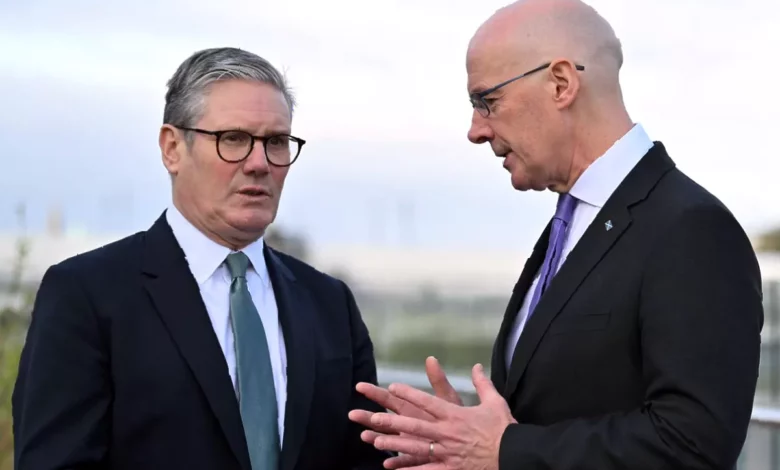
Scotland’s energy wealth should be controlled by Scotland, John Swinney declared as the SNP leader brought his “It’s Scotland’s Energy” campaign to the streets of Aberdeen. The First Minister, campaigning in the Aberdeen South by-election, accused both the Conservatives and Labour of treating the North Sea as a cash cow while Scottish households endure some of the highest energy bills in Europe. “It was put in place by the Tories and it’s been kept in place by the Labour Party,” Swinney said, “and the answer to all of this is to make sure that Scotland’s energy wealth is in Scotland’s hands and that’s exactly what the SNP, and only the SNP, represents in this by-election.”
SNP’s Exclusive Claim to Energy Control
The SNP leader has made full control over energy resources the centrepiece of his party’s pitch to voters, arguing that independence is the only way to ensure the wealth generated by oil, gas and renewables benefits the Scottish people rather than the UK Treasury. The “It’s Scotland’s Energy” campaign, which Swinney launched in recent weeks, deliberately echoes the famous “It’s Scotland’s Oil” slogan of the 1970s, leaning on a decades-old grievance that Scotland’s natural bounty has been exploited by Westminster while the country itself sees little return.
Swinney frames the contest in Aberdeen South as a choice between a “Westminster rip-off” and Scottish stewardship. He claims that Westminster policies — particularly the Energy Profits Levy, commonly called the windfall tax — have directly damaged the oil and gas industry, costing about 1,000 jobs a month in the sector. The SNP asserts that roughly 70,000 oil and gas jobs were lost in Scotland between 2010 and 2023, a period of sustained Conservative government. Swinney has also warned Prime Minister Keir Starmer that continuing the windfall tax would see him “enter our national story as a second Thatcher”.
The SNP’s case rests on the argument that only an independent Scotland could maximise home-grown renewable generation, pass on lower costs to consumers, and cut household energy bills by at least a third in the long term. They propose that an independent Scotland could work in lock-step with Europe, exporting hydrogen and other energy products. The party also accuses Labour of breaking its manifesto promise to cut energy bills by £300 and of imposing what Swinney calls a “tax on Scotland’s energy” through the windfall levy.
Labour, for its part, defends its UK-wide approach. Sir Keir Starmer’s government has established a National Wealth Fund, which includes £1.8 billion set aside to upgrade ports in Scotland and elsewhere, and has pledged investment in hydrogen and industrial clusters. Scottish Labour has attacked the SNP for squandering Scotland’s clean energy potential, pointing to the sale of ScotWind leases at what critics call bargain prices. Friends of the Earth Scotland has also criticised the SNP for favouring big business and failing to deliver on green jobs pledges.
Historical Grievance and the Norway Comparison
The SNP’s narrative draws on a stark comparison with Norway, a country that the party says has managed its energy wealth effectively through public ownership and investment. According to the SNP, Scotland’s oil and gas reserves have generated direct revenues of £450 billion for the UK government since production began — money that, in an independent Scotland, could have been invested in public services or used to keep bills low. By contrast, Scottish households paid an estimated £5.8 billion in excess energy costs between 2021 and 2024, equivalent to roughly £2,260 per home, the party claims.
Westminster’s control, the SNP argues, has led to a series of missed opportunities. High energy bills persist despite Scotland being a net exporter of electricity, and the windfall tax has been blamed for discouraging investment in the North Sea. Scottish Conservatives reject this analysis, accusing Swinney of blocking new North Sea licences and of spending money on “pro-independence propaganda” rather than on public services. They advocate fresh oil and gas drilling and frequently contrast SNP policies with what they say is a pragmatic approach to energy security.
The Scottish Greens push for a faster phase-out of fossil fuels and support community energy projects, while Reform UK opposes current net-zero targets and backs expanded oil and gas production. All major parties speak of a “just transition” for oil and gas workers, but the specifics vary. The SNP emphasises retraining workers for renewables, hydrogen and carbon capture; Labour favours an integrated UK market and nuclear investment, which the SNP opposes.
At the heart of the debate lies the fundamental question of whether energy policy is best managed at a UK level — sharing costs and leveraging a larger market — or devolved to Scotland, allowing tailored policies and direct benefit from resources. The Scottish Parliament has called for all energy powers to be devolved, but the UK Government rejected that demand. The SNP has said it will seek powers over energy via a Section 30 order if it wins re-election.
By-election in the Energy Capital
Aberdeen South is a symbolic battleground. The city styles itself the “energy capital of Europe,” and its economy is deeply tied to the North Sea oil and gas industry. The by-election, triggered by the resignation of the previous MP, gives voters a chance to send a message on energy policy ahead of the next general election. Swinney’s campaign is built on the proposition that a vote for the SNP is a vote to end the “Westminster rip-off” and put Scotland’s energy wealth in Scottish hands.
Scottish Labour has criticised what it calls the SNP’s empty promises and failure to deliver on green jobs. Labour’s UK-wide plans, it argues, would drive down bills and make Scottish businesses competitive while keeping the advantages of a single energy market. The Scottish Conservatives accuse Swinney of ignoring rising bills and of blocking developments that would secure jobs. Reform UK has entered the contest with a platform of scrapping net-zero policies and expanding drilling. The Scottish Greens are fielding a candidate who promotes a rapid fossil fuel exit and community ownership of renewables.
With energy bills, job security and the future of the North Sea all on the ballot, the Aberdeen South by-election has become a proxy for the wider independence debate. Swinney’s refrain — that only the SNP represents Scotland’s energy interests — will be tested at the ballot box, but the party’s rivals argue that his solution of independence is a distraction from the immediate challenges facing households and workers. Whatever the outcome, the contest has sharpened the lines between the parties on a question that is likely to define Scottish politics for years to come.