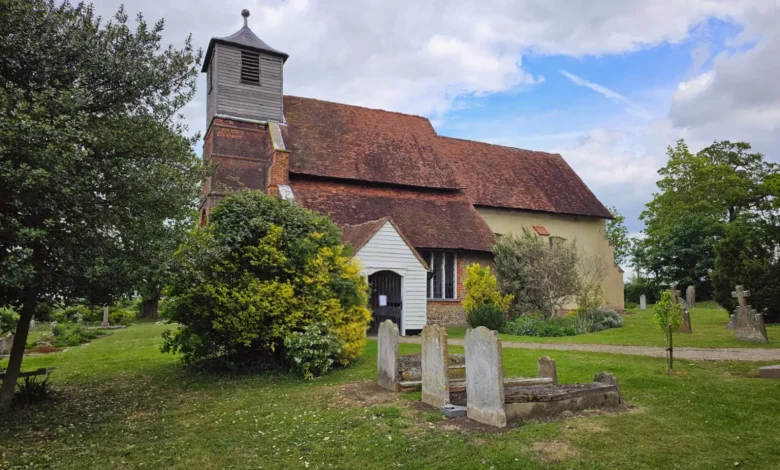
This isolated Essex church still uses candles for services. St Mary’s Buttsbury, standing alone in a sea of fields near the River Wid, has no electricity. When the faithful gather for worship, wooden poles are fitted with candles and lit one by one, recreating an atmosphere that has all but vanished from Church of England life. It is a quiet, deliberate step back into an earlier age — and one of the few places in the country where such a service remains the norm.
The Mystery of the Lost Village
Why St Mary’s stands where it does, roughly midway between Ingatestone and Billericay, is a question that has puzzled historians for generations. The church is not particularly close to any settlement, and no one is entirely sure why it was built here. The secular explanation points to a village that may have existed on or near the spot, possibly Roman in origin, known as Joyberd in Saxon times and recorded as Ginges — or Cinga — in the Domesday Book of 1086. Archaeological evidence, including Roman tiles embedded in the church walls and Roman coins found in the surrounding fields, strongly suggests that dwellings stood here. But whether they amounted to a genuine village, or were sufficient to support a church, remains unclear.
Even less understood is why that village is no longer there. Several theories compete for an answer. The Black Death could have wiped out the population. Executions following the Peasants’ Revolt may have left the area depopulated. Proximity to the River Wid made flooding a recurring hazard. Land clearance for agriculture might have driven people away. Perhaps the simplest explanation is economic: the nearby village of Stock was granted a charter to operate a market, and as it grew, residents of Buttsbury drifted there in search of work. None of these theories is confirmed, and the truth may never be known.
A more romantic tradition offers a different origin. St Botolph, the church’s patron saint, is said to have preached under a pear tree in this very area. The name Buttsbury itself is a contraction of “Botulph’s Pirie” — Botolph’s pear tree. According to the legend, a church was built on the spot to commemorate that event. Whatever the reason for its location, the first written mention of a church here dates to 1190, when Buttsbury was granted to the nunnery of St Leonard-atte-bow in London. By that time, the site had already been in use for centuries.
A Building Forged Over Centuries
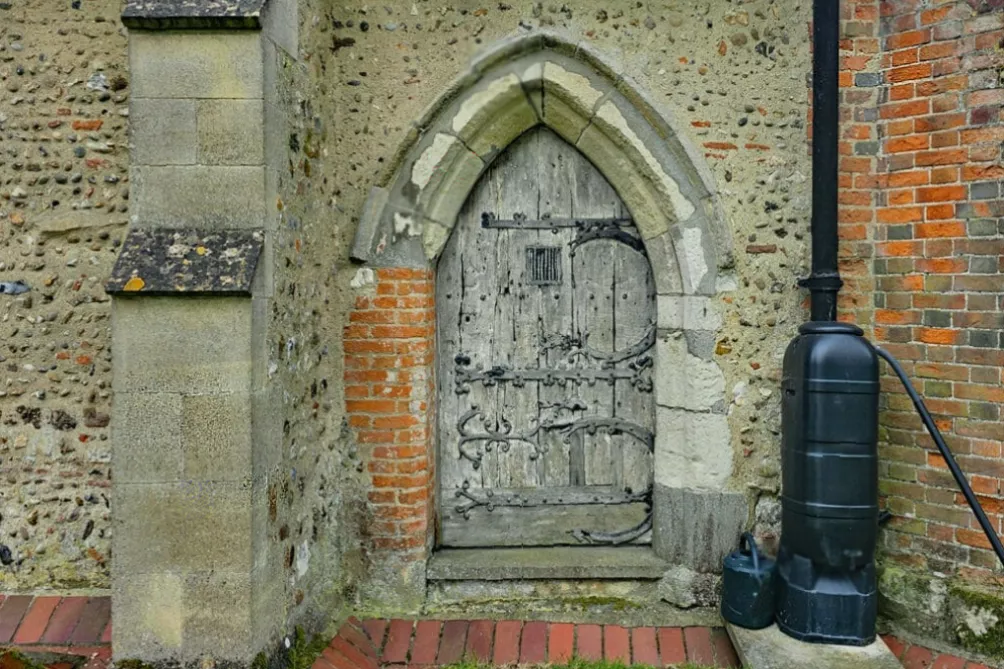
The current building is not the original, but parts of it are extraordinarily old. The north door, an object of national significance, has been carbon-dated: the timber was felled between 1156 and 1180. The medieval ironwork on the door may be older still, possibly dating to the Viking period. The rest of the church largely dates from the 14th century, with a short nave and a chancel built in the same period. In the 15th century, north and south aisles were added — wider than they are long, a layout that may echo the original Saxon design. These aisles are constructed mainly in flint rubble with stone dressings and feature large 14th-century east windows. The west tower, also added in the 15th century, was later reconstructed in brick, its height reduced and topped with weatherboarding and brick buttresses.
The centuries brought heavy renovation. The aisles were substantially reworked in the 18th and 19th centuries. In 1876, the east window was fitted in the Perpendicular style, while the windows on the north and south sides were replaced in the late 18th and early 19th centuries. The exterior was heavily refurbished with cement mortar. During the First World War, a Zeppelin bomb cracked the tower in 1916. Then, in the Second World War, a bomb landed so close to the church that it nearly destroyed it. Reconstruction followed in 1949. The floor, which had previously been nothing but bare soil — traditionally covered with rushes on the Sunday closest to St Botolph’s Day — was replaced after the war with the flooring that remains today. In the 1980s, a priest’s door that had been blocked up some 400 years earlier was uncovered. More recent work includes a restoration of the south porch in September 2021. The church is listed Grade II*.
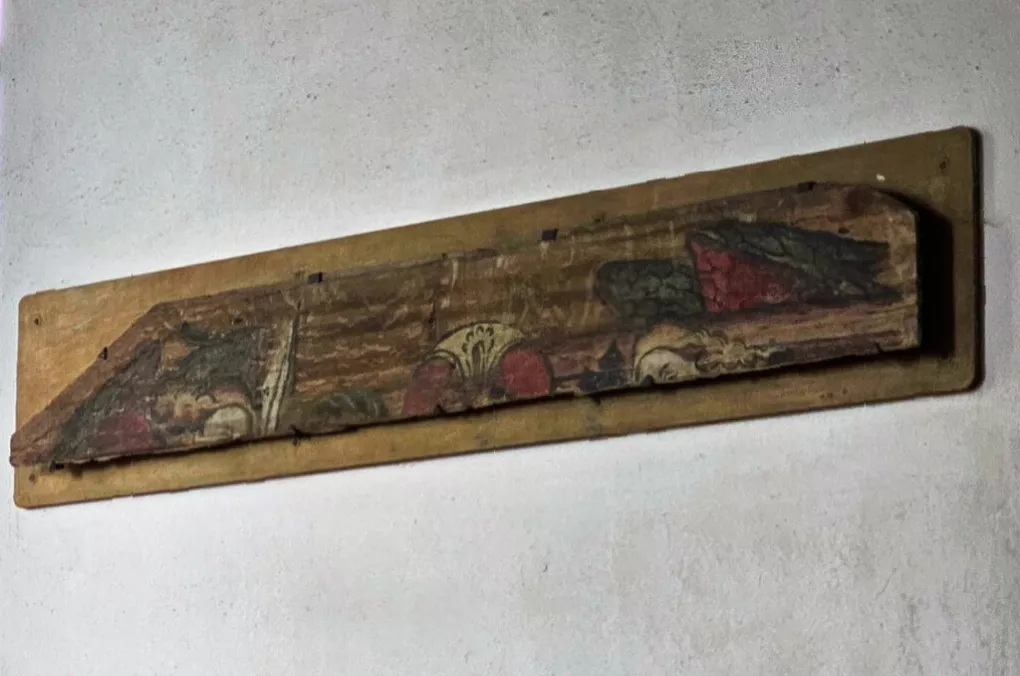
Inside, the impression is plain, but this was not always the case. It is thought the interior was once richly painted until Cromwell’s Puritans arrived with whitewash. A fragment of what may be a depiction of the Last Supper survives near the altar. Few memorials remain: two ledger stones in the ground commemorate Edward Francklin and his daughter Ann Lockley. The church, despite its isolation, remains a functioning place of worship. It is open to visitors every day during daylight hours, though the timetable can vary — a volunteer groundskeeper once had to unlock the door for an arriving journalist on Rogation Sunday. A guidebook is available for a £5 donation. Step-free access is possible via the front porch, though the original brick floor inside is slightly uneven.
Lighting the Way
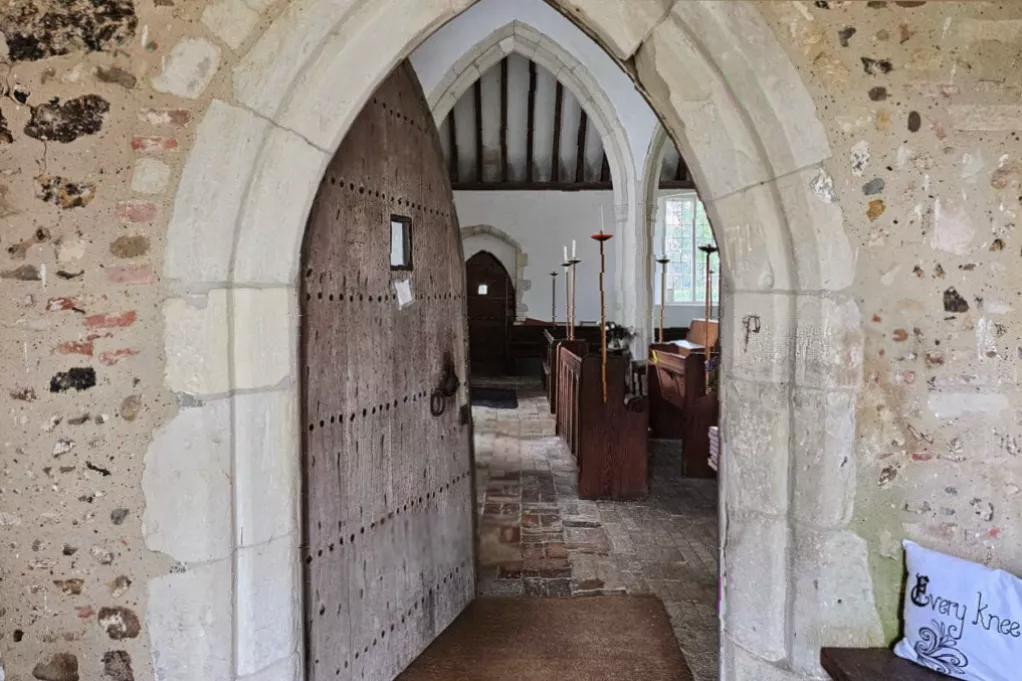
The most distinctive feature of St Mary’s is also the simplest: the candles. In most churches, one or two candles might be placed on the altar, or old holders left empty. Here, because there is no electricity, every wooden pole has a well-used candle at its top, ready to be lit. Services follow the traditional Book of Common Prayer and reflect the church’s rural setting, with celebrations for Plough Sunday, Rogation, Lammas and Harvest — earning it a reputation as an “agricultural church.” For those who attend, the experience is deliberately removed from the modern world, a return to the way worship was conducted for centuries. The church sits on a hill near St Peter’s Way, a long-distance pilgrimage route, and a walk across the fields to nearby Ingatestone Hall, the 16th-century mansion, offers a chance to turn around and see St Mary’s standing alone against the horizon — a lost village’s last remaining landmark.