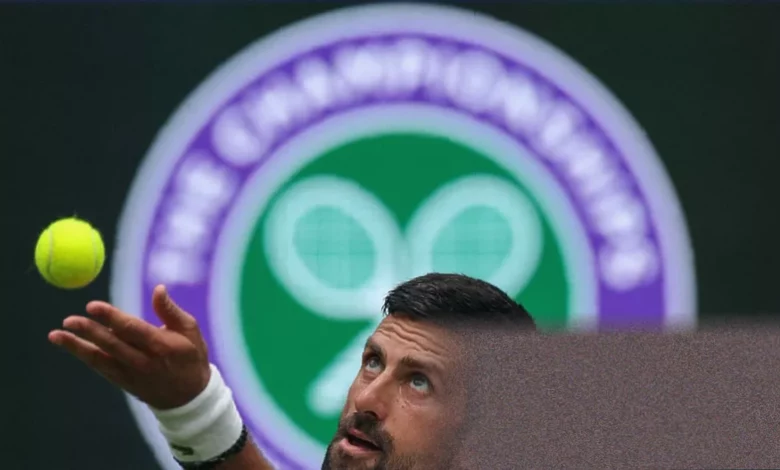
Training on Aorangi Park
Novak Djokovic has begun his 21st Wimbledon campaign at age 39. The seven-time champion arrived at the All England Club on Monday and worked through tentative first steps on the grass courts of Aorangi Park, movement exercises complementing his sparring on court. He found his rhythm against local hitting partners, caught up with his old friend Marin Cilic, and then broke in the grass on No 1 Court alongside the world No 1, Jannik Sinner — iron sharpening iron.
Age and Ambition
For Djokovic, the ultimate goal remains the same: to become the oldest grand slam singles champion in history by winning an unprecedented 25th major title. As the seventh seed at Wimbledon, his chances naturally diminish with each passing tournament, yet he has repeatedly demonstrated that, if fortune favours him over two weeks, he is more than capable of seizing the moment. His run to the Australian Open final earlier this year — where he toppled Jannik Sinner in five spectacular sets in the semi‑finals before losing to Carlos Alcaraz — stands as one of his most impressive results. At 38 years 255 days, he became the oldest finalist in Australian Open history, and he also claimed his 400th Grand Slam match win there, surpassing Roger Federer’s record for most match wins at that tournament. Djokovic is now the first player to record 100 singles match wins at three different grand slams. Yet his 2026 season has been described as average, with a win‑loss record of 9‑4 as of 22 June.
The Physical Challenge
Maintaining his body across two gruelling weeks of grand slam tennis or an entire season is clearly Djokovic’s greatest challenge at his advanced age, and it only grows more difficult. After Australia, his five months between February and May were defined by an inability to stay healthy. He played only once, losing in the fourth round of Indian Wells to Jack Draper. Pushing himself to compete in Rome, he lost his opening match to the world No 79, Dino Prizmic. His poor preparation caught up with him at the French Open, where he led a brilliant João Fonseca by two sets in the third round but could not withstand the physicality of a five‑set contest. It is no coincidence that his deep run in Australia was aided by a retirement from Lorenzo Musetti and a walkover from Jakub Mensik, allowing him to conserve energy.
If there is a venue where Djokovic can still win another major, Wimbledon — a tournament he has won seven times — has always seemed the likeliest. Grass courts produce shorter points, enabling him to rely on his precise serve, close down the net, dictate with his forehand and play a more aggressive brand of first‑strike tennis. At 39, the reduced physicality of that style suits him. His path through the draw, however, is laden with obstacles. Djokovic is in the same quarter as the third seed, Félix Auger‑Aliassime, and Stefanos Tsitsipas, against whom he holds a strong 12‑2 head‑to‑head record. A fourth‑round meeting with Andrey Rublev is possible. Crucially, he shares the same half as Jannik Sinner, meaning a potential semi‑final clash with the world No 1.
Sinner arrives as the defending champion with an extraordinary 2026 season: a 37‑3 record, five Masters 1000 titles (Monte Carlo, Madrid, Rome, Indian Wells and Miami) and a record 32 consecutive Masters 1000 match wins. Yet his own physical frailties were exposed at the French Open, where he suffered a stunning second‑round collapse against Juan Manuel Cerúndolo after leading by two sets and 5‑1 in the third. Sinner spent the weeks after Paris undergoing tests, and his recovery will be watched closely. Carlos Alcaraz, the world No 2 who defeated Djokovic in the Australian Open final and became the youngest man to complete the career grand slam, is absent from Wimbledon due to a right‑wrist injury sustained in April. His return is not expected until August, which opens up the draw significantly.
Beyond the top seeds, the bottom half of the Wimbledon draw — which contains Djokovic — is packed with dangerous grass‑court players. Matteo Berrettini, a finalist in 2021, is the only other man in that half to have reached a Wimbledon final. He begins against Stan Wawrinka. The likes of Taylor Fritz, Ben Shelton, Alex de Minaur, Flavio Cobolli, Jakub Mensik and Arthur Fils (if healthy) all start the tournament with high hopes. Fritz faces Jack Draper in a highly anticipated first‑round match, while Daniil Medvedev, the eighth seed, meets Marin Čilić in Sinner’s quarter. The tournament, running from 29 June to 12 July, offers a total prize fund of £64.2 million. Among British players, wild cards Arthur Fery and Jack Pinnington Jones are in the main draw, while Dan Evans will miss the men’s singles for the first time since 2018 after not receiving a wildcard.