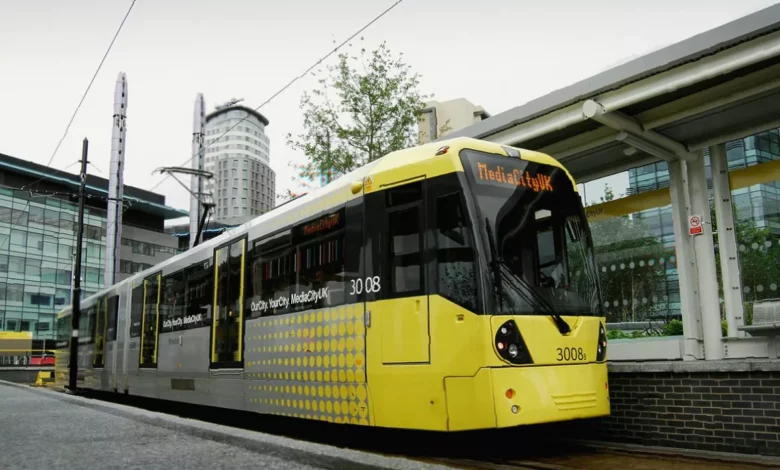
More than £1.5 million has been secured to fund a study into expanding the Metrolink tram network through Salford to Wigan and Bolton, with transport chiefs describing the move as a “very welcome and positive step”.
The money was approved at a meeting of the Bee Network committee on Thursday (June 25) and will be drawn from the government’s City Region Sustainable Transport Settlement (CRSTS) — part of a broader £2.5 billion funding package for Greater Manchester intended to improve local public transport over the five years to 2026/27. A further £200 million for CRSTS was announced in October, though allocations for 2025/26 and beyond remain subject to a multi-year spending review.
According to a report presented to the committee, the cash will be used for “consideration of a potential Metrolink extension from the regional centre to Salford Crescent, a potential link to Salford Quays, and potential onward links beyond Salford to locations in the boroughs of Wigan and Bolton (including consideration of tram-train technology)”. The work will include “modelling and appraisal activity, initial design work and the development of initial cost and carbon estimates”.
A Transport for Greater Manchester (TfGM) spokesperson stressed that no decisions have been made on routes, technology or delivery, and that the process is at an early stage. “Subject to funding being agreed by the Bee Network Committee, TfGM will develop a Strategic Outline Case which will look at potential rapid transit improvements in this corridor,” they said. “This includes exploring possible Metrolink extensions to Salford Crescent, improved connections to Salford Quays and MediaCity, and longer-term options for onward links towards locations in the boroughs of Wigan and Bolton. No decisions have been made on routes, technology or delivery at this stage. The work will consider a range of options and assess their value for money, alongside how they could support growth, improve connectivity and integrate with the wider Bee Network.”
The study is being prepared under the banner of the Salford Connections Project, and formal planning is expected to commence in summer 2026. It builds on a £6 million funding boost announced in August 2025 to advance planning for future rapid transit schemes across Greater Manchester, including business cases for Metrolink extensions and tram-train projects.
Proposed routes and technology
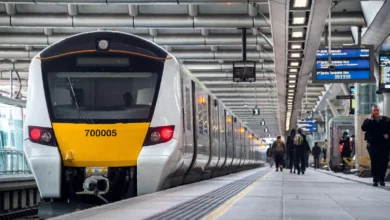
The immediate focus is on an extension from Manchester city centre to Salford Crescent, an area already served by a train station and home to the main campus of the University of Salford. From there, a potential link to Salford Quays and MediaCity is being examined, alongside longer-term connections to Wigan and Bolton. The report explicitly mentions “consideration of tram-train technology” — a hybrid system that allows vehicles to run on both tram tracks and heavy rail lines, capable of serving passengers within and between cities while minimising infrastructure costs.
Tram-train technology has only one operational example in the UK — the Sheffield-Rotherham link, which opened in 2018 — and is being explored for other regions as part of the Northern Powerhouse Rail programme. In Greater Manchester, several tram-train routes are already proposed or under investigation, including links to Stockport, Manchester Airport, and a route from Oldham to Heywood via Rochdale (construction scheduled to begin in 2028). However, designing and implementing such projects in the UK faces challenges due to differing loading gauges, safety standards and legal rules compared with Europe, and the vehicles themselves are complex and expensive.
The study will assess both traditional Metrolink extensions and tram-train options, weighing value for money alongside the potential to support growth, improve connectivity and integrate with the wider Bee Network. The Metrolink network already runs on renewable electricity — around 70 per cent from wind or solar — and produces no local air pollution. Previous expansions, such as the Phase 3 programme, were credited with removing 38.8 million car kilometres from the road network annually, saving an estimated 6,700 tonnes of carbon dioxide in 2019/20, and houses closer to Metrolink stops command a property value premium.
Strategic rationale: regeneration and connectivity
The most detailed case for the expansion centres on Salford Crescent, which is undergoing a £2.5 billion masterplan aimed at building 3,000 homes, creating up to 7,000 full-time jobs, and establishing a hub for education, innovation and living. Key elements include the “Salford Rise” pedestrian and cycle bridge, new University of Salford buildings, and a strong sustainability focus aligned with Greater Manchester’s 2050 Net Zero Carbon targets. The area is a “key gateway” into the city, connecting communities to jobs, education and opportunity, according to Salford’s deputy mayor, Councillor Mike McCusker.
“Given that level of growth, it makes clear strategic sense to explore how the transport network can better serve these areas,” McCusker said. “Better public transport links help connect residents to jobs, reduce congestion, support cleaner air, and make our neighbourhoods more attractive places to live and invest.” He added that the proposal to develop a business case for expanding Metrolink into Salford Crescent and towards Salford Quays “reflects the scale of ambition and change we’re seeing across Salford”.
Beyond the Crescent, the Salford Quays area — already one of the UK’s most celebrated urban regeneration stories, transforming former industrial dockland into a mixed-use district — is set for further expansion. Phase 2 of MediaCity UK, approved in 2024, will double its size, adding approximately 3,000 new homes and 800,000 square feet of commercial space, with new residential, commercial and leisure facilities designed to create a world-class media and digital hub inspired by global waterfront developments. Frustrated commuters in the Quays have long called for better transport options, reporting that trams are already packed at busy times. The Stagecoach 50 bus route, a key link between Salford Crescent and MediaCity, has also been criticised for unreliability, with instances of long waits due to cancellations. A separate £23.4 million scheme along the same corridor is already subject to public consultation.
The expansion ambitions extend further. The study will consider onward links to Wigan and Bolton, part of a long-term vision set out in the Greater Manchester Transport Strategy 2050 and its accompanying Delivery Plan (2027–2037), launched in December 2025. These documents outline how the Bee Network will support economic growth, reduce inequality and meet climate targets, with a key ambition to have 90 per cent of people within a five-minute walk of a bus or tram service running at least every 30 minutes by 2030. The ultimate goal is to connect all ten boroughs to the Metrolink network.
The CRSTS funding that underpins the study is itself part of a wider devolution framework. Greater Manchester holds a Pathfinder Devolution Deal, providing an integrated funding settlement that allows local prioritisation of transport investment. Separately, £25.1 million of CRSTS funding has already been approved for the redevelopment of Bury Interchange, aimed at enhancing accessibility.
“As our city grows, it’s essential that our public transport network grows with it,” McCusker said. “We look forward to working with GMCA and TfGM as this business case develops.”