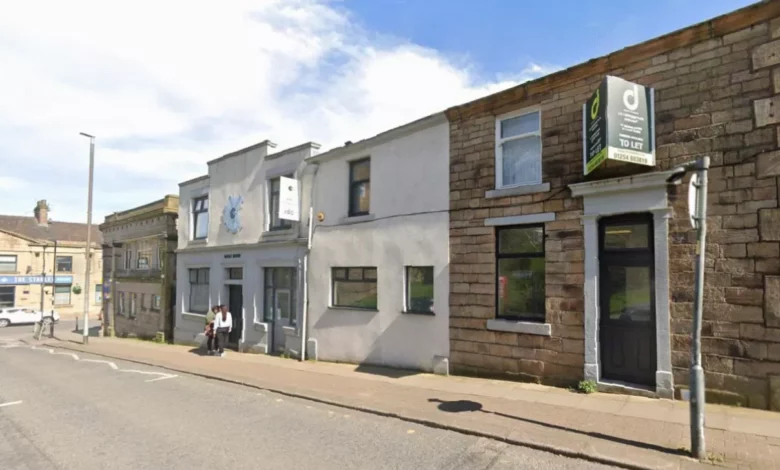
Accrington’s Eagle Street is set to become predominantly residential, with the latest conversion marking a further shift away from its past as a hub for office units. An architecture firm has received approval from Hyndburn Borough Council to transform its own headquarters into four ground-floor apartments, directly adjacent to the railway station and Tesco Extra.
The plans, submitted by IDC Architecture — a small two-person design practice that has operated from the premises for more than a decade — cover the double-sized unit at 5-7 Eagle Street as well as neighbouring numbers 9 and 11. Each office will become a single-bedroom flat with a tailored kitchen-lounge configuration. At number 11, an extended tearoom allows for a separate kitchen unit, while at number 7 the former plotting and printing room will be split into a bedroom and a bathroom. The lobbies and meeting rooms of all three units will be converted into living spaces.
The firm, which also operates as The Intelligent Design Centre Limited, has been involved in a number of developments and renovations in Accrington and beyond. The company was incorporated on 1 October 2024, with its registered office at 5-11 Eagle Street; The Intelligent Design Centre Limited itself was incorporated on 5 September 2011. The architects describe themselves as “problem-solvers who help our clients achieve their dreams”, and their decision to convert their own workspace into housing has been seen as a vote of confidence in the area’s direction.
Eagle Street’s transformation is part of a broader pattern of town-centre regeneration. The site sits within the area covered by the Accrington Town Centre Masterplan Framework, which seeks to revitalise the area as a place to live, work and visit through new parks, active travel routes, and a mix of uses including housing. Recent nearby projects include the £20 million Accrington Town Square scheme — which will turn the Market Hall into a food and drink destination, Burton Chambers into a co-working space, and Market Chambers into a cultural venue — as well as the conversion of the former Law Courts and Police Station on Manchester Road into offices and 25 apartments. Elsewhere in the town centre, the Old Manchester and Liverpool building, Accrington’s first bank, and the former Liberal Club have already been turned into housing, and the Eagle Street offices will join these by adding residential use to their upper floors as well as the new ground-floor flats.
Planning conditions attached to approval
The council granted permission for the change of use from Class E (business space) to Class C3 (dwelling), but attached several conditions that must be satisfied before development can proceed. The most detailed condition concerns noise. A mandatory noise assessment is required, reflecting the site’s location beside a road and near commercial premises. Such assessments follow standards set out in British Standards BS 8233 and BS 4142, which aim to ensure internal noise levels are acceptable for future residents. The planning officer stated that the assessment must be carried out and approved before any conversion work begins.
A further condition relates specifically to number 9 Eagle Street. The original plans showed only a “possible future door” at the front, with residents accessing the flat via a loading yard at the rear. Council planners ruled that a proper front door must be built, and a separate application for that work must be submitted and approved before the conversion of number 9 can go ahead.
Questions about parking and accessibility were dismissed by the planning officer as not critical to the decision, given the site’s location. The officer noted: “The site is located within Accrington Town Centre and as such can be considered highly accessible with excellent access to goods, services and transport links. Some town centre car parks are also within close walking distance of the site.” National and local planning policies often relax traditional parking requirements in town centres where public transport links are strong and sites are constrained.
The conversion is proceeding under the UK’s permitted development rights regime. Since August 2021, Class MA of the Permitted Development Rights has allowed many Class E properties to be converted to Class C3 dwellings without full planning permission, subject to a prior approval process. Recent reforms, effective from 2025, removed the previous 1,500 square metre cap and the three-month vacancy requirement, broadening the range of eligible buildings. However, local authorities can still refuse prior approval on grounds such as noise impact, lack of natural light, contamination, flood risk, loss of community services, and transport or access issues. Even where permitted development rights apply, building regulations for safety and habitability must still be met. Separately, Hyndburn Borough Council has an emerging Article 4 Direction that would require planning permission for the change of use from Class C3 dwelling to small HMOs (Class C4) in nine wards, indicating a local focus on managing residential density.
The approval granted to IDC Architecture stipulates that any development of the site must take place within three years of the decision being issued.