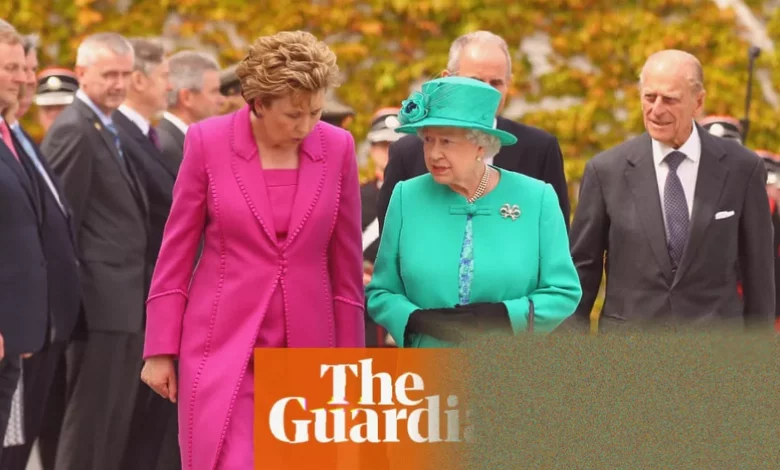
Queen Elizabeth II’s four-day state visit to the Republic of Ireland in May 2011 was, by any measure, a watershed. It marked the first time a reigning British monarch had set foot in what is now the Republic in nearly a century — and, as Fintan O’Toole wrote in the Irish Times, it was an “exquisitely choreographed exercise in statecraft” designed to signal that the United Kingdom and Ireland now related to each other as equals.
The gestures were laden with symbolism. The Queen wore green, laid a wreath at the Garden of Remembrance — a monument honouring Irish rebels who fought against British rule — spoke a few words of Irish, and visited Croke Park stadium, the site of a historical massacre by British forces. She expressed regret for centuries of conflict. The visit was widely described as a “crucial step in the normalisation of relations” and a “positive springboard” for the future. For O’Toole, a prominent Irish journalist and author of Heroic Failure: Brexit and the Politics of Pain, it felt like an exorcism. “The ghosts of a colonial past were banished and with them went the demons of Anglophobia,” he wrote.
That moment of reconciliation did not arise from nowhere. Two developments made it possible. The first was the extraordinarily close cooperation between Dublin and London during the Northern Ireland peace process, where both governments understood that the Troubles could be ended only by working as inseparable partners, learning to speak with one voice. The second was their shared membership of the European Union.
How the EU forged a new equilibrium
The European Union’s peculiar nature, O’Toole noted, is that it gives small nations most of the same rights as big ones. Over nearly half a century, Irish and British officials discovered how to work together to advance their countries’ mutual interests. They were not merely sitting at the same tables — they were often arguing for the same things. The EU provided a framework in which the historical asymmetry between a former imperial power and its former colony could be flattened, enabling a relationship based on equality rather than condescension or resentment.
That equilibrium was placed under catastrophic strain by the 2016 referendum. O’Toole argued that the shock of Brexit for most Irish people was not the act of leaving itself — Ireland knows the distorting logic of nationalism and the emotional weight of severing a larger union — but the sheer recklessness of the Brexiters. Whenever Northern Ireland came up in the referendum debates, they simply changed the subject. The Irish question was, at best, an afterthought, to be settled after what Liam Fox, then international trade secretary, called “the easiest in human history” trade deal had been wrapped up.
David Davis, then Brexit secretary, asserted there was “no downside to Brexit at all, and considerable upsides.” (He later claimed the full quote included conditions that needed to be met, but the damage was done.) O’Toole wrote that this confidence was terrifying not because Davis was lying but because he appeared to believe it — a belief that could only be rooted in “blithe ignorance” of Ireland and the success of British-Irish cooperation over decades. Only those who knew nothing of the meandering, uncontrollable Irish border could believe turning it into one of the EU’s main external frontiers had no downside. Only those with no sense of the human price paid to reach the Good Friday Agreement of 1998 — which created an invisible border and removed physical infrastructure — could think it was acceptable to drag Northern Ireland out of the EU against its will.
Damage limitation and the Irish Sea border
The Irish state had little choice but to enter damage-limitation mode. Strikingly, the Irish government and diplomatic service prepared for Brexit far more thoroughly than their British counterparts. They established inter-departmental working groups, published contingency action plans — including a comprehensive “no-deal” plan in December 2018 — and received significant funding from the EU’s Brexit Adjustment Reserve. Crucially, they got in ahead of the referendum to convince all other EU member states that avoiding the reimposition of a hard border on the island of Ireland must be a precondition for any exit agreement.
That strategy led to the tortuous crisis over the “backstop” — an insurance policy designed to guarantee an open border regardless of the future UK-EU relationship — and eventually to the concession that Northern Ireland would remain, in effect, in the EU’s customs union and single market, with the border drawn down the Irish Sea. Under the Windsor Framework, which replaced the backstop after Boris Johnson’s deal, Northern Ireland legally stays in the UK customs territory but adheres to EU standards for goods, creating a de facto border between Great Britain and Northern Ireland.
For unionism, this was a dreadful outcome. In the zero-sum logic of tribal politics, that meant Irish nationalism had won. O’Toole acknowledged a limited sense in which Ireland did win: for the first time ever, because of the solidarity of all EU member states, the Republic found itself in a stronger position than Britain in a crucial tussle. But in truth, he wrote, nobody won anything. Damage limitation is not victory. Ireland made the best of a bad job, yet very few people on the island were unaware of what had been lost: the trust built over decades, the deep sense of common purpose, and above all the feeling in 2011 that a lot of bad history had been properly acknowledged and was therefore capable of being transcended.
The economic costs have been stark. Ireland is uniquely exposed to Brexit: around 15% of its goods and services exports go to the UK, and two-thirds of Irish exporters use the UK land bridge to reach continental markets. Studies predict that increased trade costs could lower Irish exports by 3–8% and Irish GDP by 3–7% by 2030. The agri-food sector, which sends roughly 40% of its exports to the UK, is particularly vulnerable. Public opinion in the Republic has remained overwhelmingly pro-EU, with polls consistently showing 70–90% approval, and, following the referendum, around 80% believed the UK had made the wrong decision.
Starmer’s reset and the spectre of Farage
In fairness to Keir Starmer, O’Toole wrote — a phrase he noted is not much used in Britain now — the departing prime minister’s government has done a great deal to rebuild trust. Starmer visited Dublin in September 2024, the first British leader to do so in five years, and agreed to hold regular UK-Ireland summits. His government has focused on deepening cooperation in areas including trade, investment, energy, security, climate and culture, with significant Irish investment flowing into the UK. Both governments remain committed to safeguarding the Good Friday Agreement.
The dominant feeling in Ireland about Brexit, O’Toole suggested, is not anger but sadness. There is no pleasure in being proved right about the economic stasis and political instability it created. If Britain wants to move back into a closer relationship with the EU, Ireland will be there to help in every possible way.
Yet there is also fear. O’Toole warned that one of the delayed consequences of Brexit could be Nigel Farage in Downing Street. Farage, a prominent Brexit campaigner and leader of Reform UK, has continued to be a significant voice in right-wing politics, echoing themes similar to Donald Trump’s playbook. From the Irish side of the Irish Sea, it feels as though the aftershocks of Brexit — and of its comprehensive failure — may be not diminishing but strengthening. Having seen what a reactionary British government can do to the delicate fabric of Anglo-Irish relationships, O’Toole argued, the Republic cannot afford to be complacent about that prospect.