UK Climate Change Policy Explained
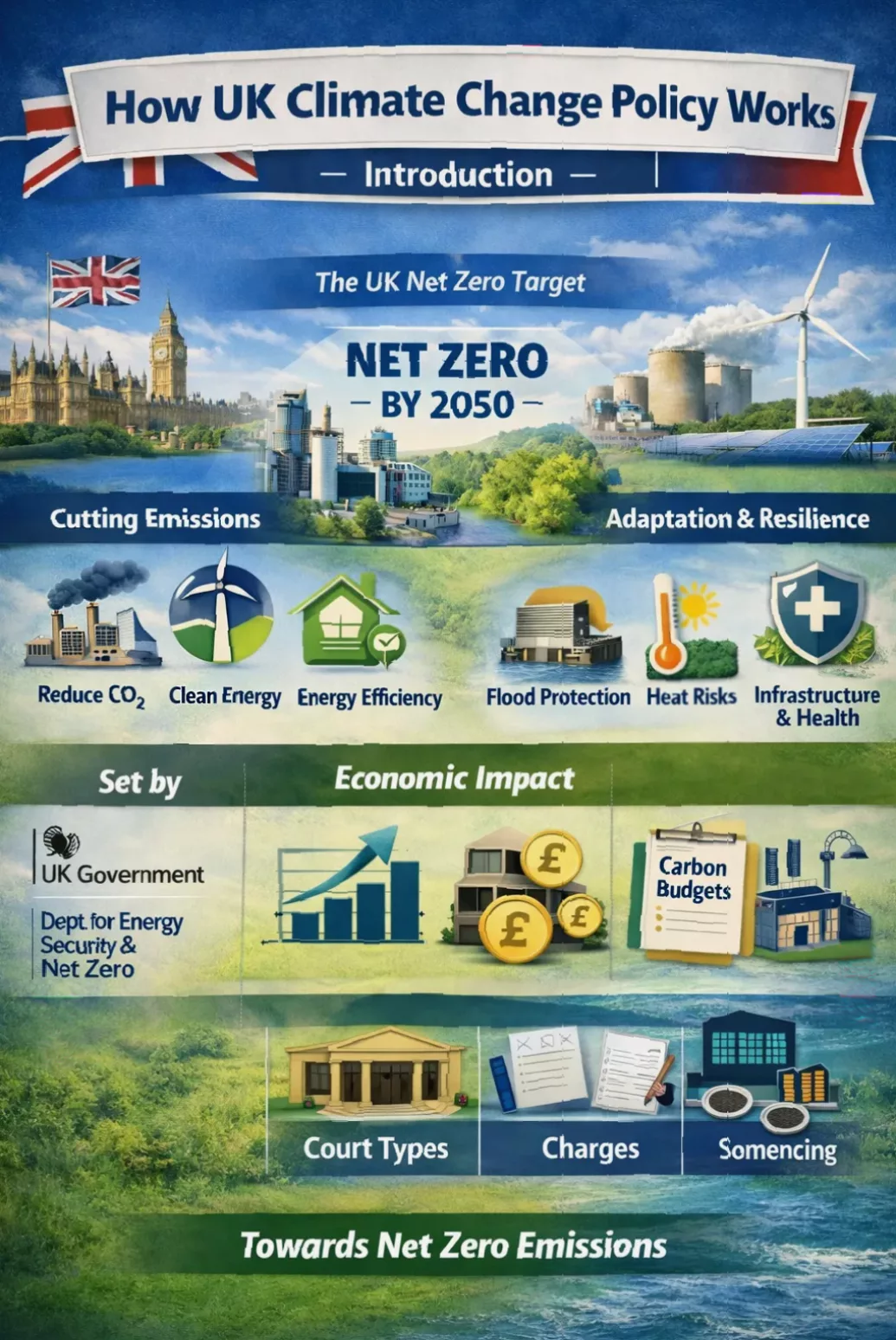
Climate change is one of the defining policy challenges of the twenty-first century, and the United Kingdom has positioned itself as a global leader in climate action. The UK was the first major economy to set a legally binding target of reaching net zero greenhouse gas emissions by 2050, and its climate policy framework — built around the Climate Change Act 2008, carbon budgets and independent oversight by the Climate Change Committee — is widely regarded as one of the most comprehensive in the world.
This guide explains how UK climate change policy works, what the legal framework requires, how emissions are being reduced across different sectors, what role international commitments play and what challenges remain on the path to net zero.
What is the UK’s legal framework for climate action?
The cornerstone of UK climate policy is the Climate Change Act 2008, a landmark piece of legislation that established a legally binding framework for reducing greenhouse gas emissions. The Act originally set a target of reducing emissions by at least 80 per cent from 1990 levels by 2050. In June 2019, this target was amended to net zero — meaning that the UK must reduce its emissions to as close to zero as possible, with any remaining emissions offset through carbon removal methods such as tree planting, peatland restoration or engineered carbon capture and storage.
The Act introduced a system of five-yearly carbon budgets, which set legally binding caps on the total amount of greenhouse gases the UK can emit during each five-year period. Carbon budgets are proposed by the independent Climate Change Committee (CCC), formally known as the Committee on Climate Change, and set by the government through secondary legislation approved by Parliament. The UK is currently operating under its sixth carbon budget (2033-2037), which requires a 78 per cent reduction in emissions compared to 1990 levels — the most ambitious target of any major economy at the time it was set.
The Climate Change Committee is an independent statutory body that advises the government on emissions targets, monitors progress towards meeting carbon budgets and the net zero target, and publishes annual progress reports assessing the government’s performance. The CCC’s reports are influential in shaping public debate and have frequently criticised the gap between government ambition and the pace of policy delivery.
How has the UK reduced its emissions so far?
The UK has achieved significant emissions reductions since 1990, cutting territorial greenhouse gas emissions by approximately 50 per cent — one of the fastest rates of decarbonisation among major economies. The largest reductions have come from the power sector, where the shift from coal-fired electricity generation to renewable energy and natural gas has been dramatic. Coal generated around 40 per cent of UK electricity in 2012 but less than 2 per cent by 2023, with the UK committed to closing its last coal power station. Wind, solar and other renewable sources now generate over 40 per cent of UK electricity.
Emissions from industry have also fallen substantially, partly due to efficiency improvements and partly due to the structural shift in the UK economy away from heavy manufacturing towards services. Emissions from waste have declined through improved landfill management and increased recycling. However, progress in other sectors has been slower. Transport remains the largest emitting sector, accounting for approximately 26 per cent of UK emissions, with road vehicles the dominant source. Emissions from buildings — driven by the use of natural gas for heating — have proven particularly difficult to reduce. Agriculture accounts for around 11 per cent of emissions, with methane from livestock and nitrous oxide from fertiliser use presenting challenges that are inherently difficult to address without changes to farming practices and land use.
What are the key policies for reaching net zero?
The government’s Net Zero Strategy, first published in 2021 and updated subsequently, sets out the policies and proposals for meeting the UK’s carbon budgets and reaching net zero by 2050. Key elements of the strategy span every major sector of the economy.
In the power sector, the government has committed to fully decarbonising electricity generation by 2030, primarily through the massive expansion of offshore wind (targeting 50 GW of capacity), alongside solar, onshore wind, nuclear power and other low-carbon sources. The Contracts for Difference (CfD) scheme provides long-term price guarantees for renewable energy generators, reducing investment risk and driving down costs. Great British Energy, a new publicly owned clean energy company, has been established to invest in renewable generation and accelerate the deployment of clean power.
In transport, the government plans to end the sale of new petrol and diesel cars by 2035, supported by investment in electric vehicle charging infrastructure, a zero-emission vehicle mandate for manufacturers and incentives for the adoption of electric buses and freight vehicles. The Transport Decarbonisation Plan also promotes modal shift to public transport, cycling and walking.
Decarbonising buildings is one of the most challenging and expensive aspects of the net zero transition. Approximately 85 per cent of UK homes are heated by natural gas boilers, and replacing them with low-carbon alternatives — principally heat pumps, but potentially also hydrogen heating and district heat networks — requires significant upfront investment and consumer behaviour change. The government has set a target of installing 600,000 heat pumps per year by 2028, supported by the Boiler Upgrade Scheme and new building standards that require new homes to be built with low-carbon heating from 2025. However, the pace of heat pump installation has fallen well short of the target, and the transition in existing homes remains one of the most politically sensitive aspects of climate policy.
In industry, carbon capture, utilisation and storage (CCUS) technology is central to the government’s strategy for decarbonising heavy industry, including cement, steel, chemicals and refining. The government has committed significant funding to CCUS clusters — initially at locations in the Humber and Merseyside — and aims to capture and store 20-30 million tonnes of CO2 per year by 2030. However, CCUS remains an emerging technology at commercial scale, and its cost, reliability and deployment timeline are subject to considerable uncertainty.
In land use and agriculture, policies include tree planting targets (approximately 30,000 hectares per year), peatland restoration, agri-environment schemes that reward farmers for managing land in ways that reduce emissions and sequester carbon, and research into low-emission farming techniques. The Environmental Land Management scheme (ELMS), which is replacing the EU’s Common Agricultural Policy, is designed to pay farmers for environmental goods including carbon reduction, biodiversity enhancement and water quality improvement.
What is the UK Emissions Trading Scheme?
The UK Emissions Trading Scheme (UK ETS) is a cap-and-trade system that puts a price on carbon emissions from the power sector, heavy industry and aviation. It was launched in January 2021 to replace the UK’s participation in the EU Emissions Trading System following Brexit. Under the UK ETS, a declining cap is set on the total amount of CO2 that covered installations can emit, and companies must hold sufficient allowances to cover their emissions. Allowances can be bought at government auctions, traded between companies, or banked for future use.
The carbon price established by the UK ETS provides an economic incentive for covered sectors to reduce their emissions. The government has committed to aligning the UK ETS cap with the net zero target, and has consulted on expanding the scheme to cover additional sectors including waste incineration and domestic maritime transport. The interaction between the UK ETS and the EU ETS — and the potential for a Carbon Border Adjustment Mechanism (CBAM) to address carbon leakage from trade — are active areas of policy development.
What role does the UK play in international climate action?
The UK has sought to position itself as a leader in international climate diplomacy. It hosted COP26, the UN climate summit, in Glasgow in November 2021, where the Glasgow Climate Pact was agreed, including commitments to phase down coal power and strengthen national climate targets. The UK has been an active participant in the Paris Agreement process and has used its diplomatic influence to encourage other countries to raise their ambition.
The UK also contributes to international climate finance, providing funding to help developing countries reduce their emissions, adapt to climate impacts and protect natural ecosystems. The UK pledged £11.6 billion in international climate finance over the period 2021-2026, though the delivery and allocation of this funding has been the subject of scrutiny by parliamentary committees and NGOs. The UK’s credibility as an international climate leader depends in part on its ability to demonstrate progress in reducing its own emissions at home.
How is the UK adapting to the impacts of climate change?
While mitigation — reducing emissions — is the primary focus of UK climate policy, adaptation to the unavoidable impacts of climate change is also essential. The UK is already experiencing the effects of a changing climate, including more frequent and severe heatwaves, increased flood risk from heavier rainfall and rising sea levels, drought conditions affecting water supplies and agriculture, and disruption to infrastructure and ecosystems.
The Climate Change Act 2008 requires the government to publish a UK Climate Change Risk Assessment (CCRA) every five years and to develop a National Adaptation Programme (NAP) in response. The most recent CCRA identified eight priority risk areas, including risks to health and wellbeing from high temperatures, risks to the viability of habitats and species, risks to food production and trade, risks to infrastructure from flooding and coastal erosion, and risks to the supply of water. The CCC’s Adaptation Committee monitors progress on adaptation and has consistently warned that the UK is not preparing adequately for the climate impacts that are already locked in by past emissions.
Specific adaptation measures include investment in flood defences (the Environment Agency manages a programme of flood risk management in England, with over £5 billion committed over the current spending period), updates to building regulations to address overheating risk in new homes, planning policies that restrict development in high-risk flood areas, drought management plans by water companies, and nature-based solutions such as wetland restoration, sustainable urban drainage systems and urban greening. Local authorities are required to assess and plan for climate risks in their areas, though the resources and capacity available for local adaptation vary significantly.
What role does green finance play in climate policy?
Achieving net zero requires enormous levels of investment — the CCC has estimated that annual investment in low-carbon technologies and infrastructure will need to reach £50-60 billion by the late 2020s. Mobilising private capital alongside public investment is therefore critical. The UK has taken steps to position itself as a global centre for green finance, including issuing the first UK green gilt (government bond) in 2021, introducing mandatory climate-related financial disclosures for large companies and financial institutions, and establishing the Green Finance Institute to promote sustainable investment.
The UK’s green taxonomy — a classification system defining which economic activities can be considered environmentally sustainable — is under development and is intended to provide clarity for investors, prevent greenwashing and direct capital towards genuinely green investments. The Bank of England has conducted climate stress tests on major banks and insurers to assess their resilience to climate-related financial risks, and the Prudential Regulation Authority requires firms to manage climate risk as part of their broader risk management frameworks.
Despite these measures, concerns remain about the pace and scale of green investment. The UK Infrastructure Bank, established in 2021 with an initial capitalisation of £22 billion, is intended to catalyse private investment in clean energy, transport and digital infrastructure, but the total investment needed far exceeds public funding capacity. Ensuring that the regulatory, fiscal and market conditions are in place to attract the necessary private capital is a critical challenge for climate and economic policy.
What are the main challenges for UK climate policy?
Despite its ambitious targets, the UK faces significant challenges in delivering net zero. The CCC’s annual progress reports have repeatedly warned that the pace of emissions reductions must accelerate significantly to meet the fourth, fifth and sixth carbon budgets. Key areas of concern include the slow progress on decarbonising heating in buildings, the continued growth of transport emissions (despite the shift to electric vehicles), the need for massive investment in electricity grid infrastructure to accommodate renewable generation, and the challenge of reducing agricultural emissions without undermining food security.
The cost of the net zero transition — and who bears it — is an increasingly prominent political question. While many climate investments generate long-term savings (for example, insulated homes cost less to heat), the upfront costs of heat pumps, electric vehicles, home insulation and industrial transformation are substantial. The government has faced pressure to ensure that the costs of the transition are distributed fairly and do not disproportionately burden lower-income households or regions dependent on fossil fuel industries.
Public engagement and political consensus are also critical. Climate policy touches on deeply personal aspects of daily life — how people heat their homes, what cars they drive, what they eat and how they travel. Maintaining public support for ambitious climate action while managing the costs, disruptions and trade-offs involved is one of the most important challenges facing the government and will be a defining feature of UK politics in the decades ahead.
Why does climate change policy matter?
Climate change poses existential risks to human welfare, economic stability and the natural world. Rising temperatures, sea level rise, extreme weather events, biodiversity loss and disruption to food and water systems threaten the wellbeing of current and future generations. The UK’s climate policy framework — with its legally binding targets, independent oversight and cross-economy approach — represents one of the most comprehensive attempts by any country to address these risks. Whether the UK can translate its ambitious targets into practical delivery will determine both its contribution to the global effort to limit warming and the economic, social and environmental outcomes for its own citizens.
Related guides
These guides explain related topics in more detail:
- Environmental Regulation and Law in the UK Explained
- UK Energy Transition and Renewable Energy Explained
- Biodiversity and Nature Protection in the UK Explained
- How the UK Economy Works
- UK Public Finances and Government Spending Explained
Related coverage:
Read our latest UK environment and climate news
Prepared by: