Environmental Regulation and Law in the UK Explained
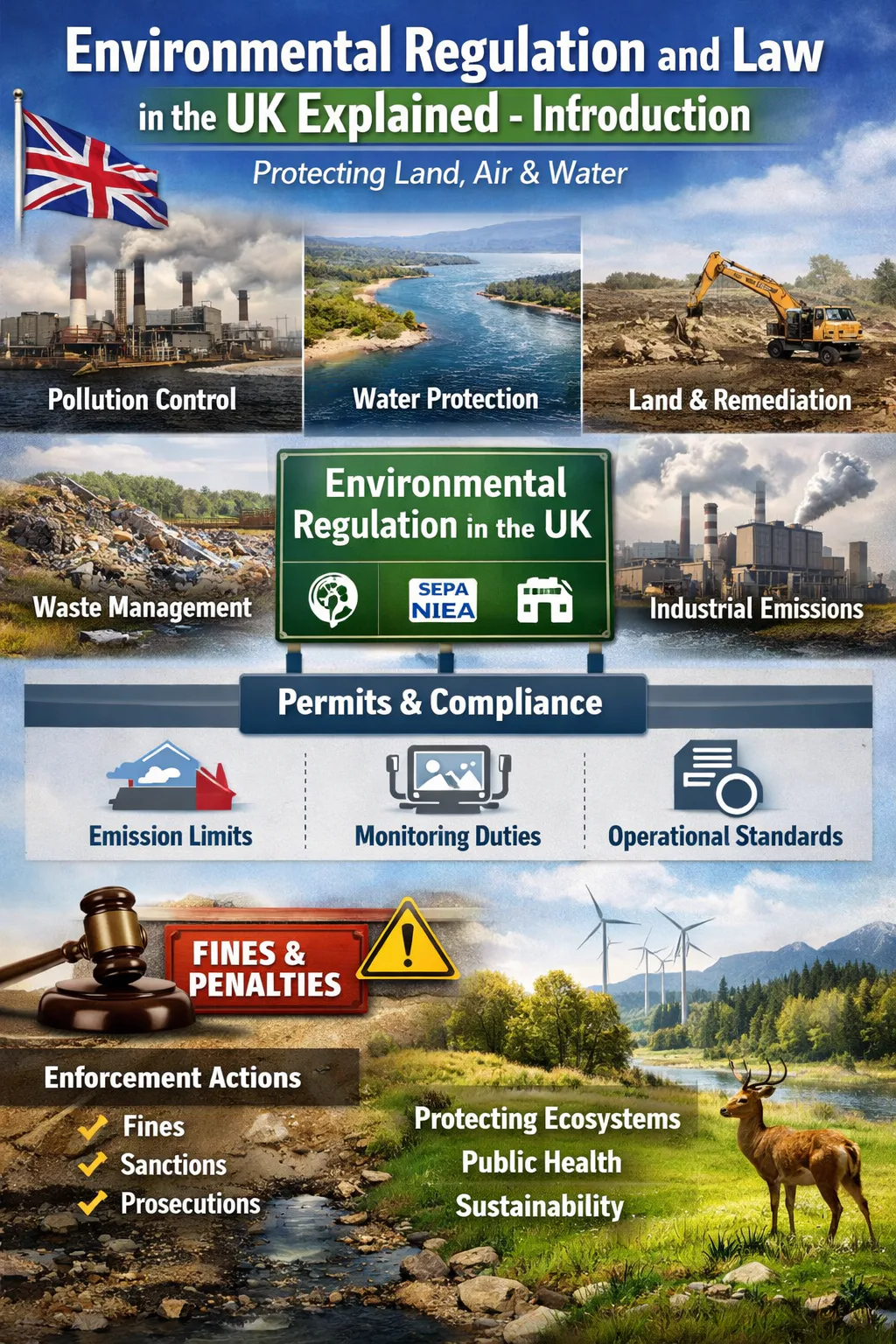
Environmental regulation in the United Kingdom protects air quality, water resources, land, wildlife and the natural environment from pollution and degradation. The UK’s environmental legal framework has evolved over decades, shaped by domestic legislation, European Union directives (many of which were retained in UK law after Brexit), international conventions and the growing urgency of the climate and biodiversity crises. Environmental regulation affects every sector of the economy, from manufacturing and agriculture to construction, transport, energy and waste management.
This guide explains how environmental regulation works in the UK, which bodies are responsible for enforcement, what the main areas of environmental law cover and how the framework is changing following Brexit.
What is environmental regulation?
Environmental regulation encompasses the laws, standards, permits and enforcement mechanisms that control how individuals, businesses and public bodies interact with the natural environment. Its purposes include preventing pollution of air, water and land, managing waste safely, protecting natural habitats and species, controlling the use of chemicals and hazardous substances, ensuring sustainable use of natural resources and holding polluters accountable for environmental damage.
The UK’s environmental regulatory framework is primarily set by the UK government for England, with the devolved governments in Scotland, Wales and Northern Ireland responsible for environmental policy within their territories. Key legislation includes the Environment Act 2021, the Environmental Protection Act 1990, the Clean Air Act 1993, the Water Resources Act 1991, the Wildlife and Countryside Act 1981, and the Conservation of Habitats and Species Regulations 2017 (the Habitats Regulations). The Environment Act 2021 is particularly significant as it establishes the post-Brexit framework for environmental governance, including legally binding environmental targets, environmental principles and the Office for Environmental Protection.
Who enforces environmental regulation in the UK?
The Environment Agency (EA) is the principal environmental regulator in England, responsible for managing flood risk, regulating industrial emissions, overseeing waste management, protecting water quality, issuing environmental permits and prosecuting environmental offences. The EA operates under the policy direction of the Department for Environment, Food and Rural Affairs (Defra) but exercises its regulatory functions independently. It employs approximately 10,000 staff and manages an annual budget of over £1.8 billion.
In Scotland, the Scottish Environment Protection Agency (SEPA) performs equivalent functions. Natural Resources Wales (NRW) combines environmental regulation with nature conservation responsibilities in Wales. The Northern Ireland Environment Agency (NIEA) is part of the Department of Agriculture, Environment and Rural Affairs (DAERA) and regulates environmental matters in Northern Ireland.
Natural England is the government’s adviser on the natural environment in England, responsible for designating and managing protected areas (including Sites of Special Scientific Interest, National Nature Reserves and Areas of Outstanding Natural Beauty), advising on planning applications that affect the natural environment, and administering agri-environment schemes. The Joint Nature Conservation Committee (JNCC) provides scientific advice on nature conservation at a UK and international level.
The Office for Environmental Protection (OEP), established by the Environment Act 2021, is an independent body that oversees the government’s compliance with environmental law in England and Northern Ireland. The OEP can investigate complaints, issue decision notices and, in serious cases, bring legal proceedings against public authorities that fail to comply with environmental law. It was created to fill the governance gap left by the UK’s departure from the EU, where the European Commission had previously held member states accountable for environmental compliance.
How does air quality regulation work?
Air quality is regulated through a combination of national standards, local authority responsibilities and industrial emissions controls. The UK has set legal limits for concentrations of major air pollutants including nitrogen dioxide (NO2), particulate matter (PM2.5 and PM10), ozone, sulphur dioxide and carbon monoxide. The Environment Act 2021 requires the government to set a legally binding target for PM2.5 — the pollutant most harmful to human health — and the government has set a target of an annual mean concentration of 10 micrograms per cubic metre by 2040.
Local authorities are responsible for monitoring air quality in their areas and must declare Air Quality Management Areas (AQMAs) where pollution levels exceed national standards. Many urban areas have introduced Clean Air Zones (CAZs) or Low Emission Zones that charge the most polluting vehicles for entering designated areas. London’s Ultra Low Emission Zone (ULEZ) is the most extensive, covering the whole of Greater London since August 2023. Industrial emissions are controlled through environmental permits issued by the Environment Agency under the Environmental Permitting Regulations.
How is water quality and sewage regulated?
Water quality regulation has become one of the most politically prominent environmental issues in the UK. The discharge of untreated or partially treated sewage into rivers and coastal waters by water companies has attracted intense public concern, media coverage and political pressure. Water companies in England and Wales are regulated by the Environment Agency (for environmental compliance) and Ofwat (the economic regulator, which sets price limits, investment requirements and service standards).
The Environment Act 2021 placed new duties on water companies to reduce the frequency and duration of storm overflow discharges and to publish near-real-time data on sewage discharge events. The government’s Storm Overflows Discharge Reduction Plan sets targets for eliminating ecological harm from storm overflows by 2050, with interim targets requiring significant investment by water companies. Ofwat’s price review process determines how much water companies can invest in infrastructure — including sewage treatment works, storm tanks and sewer upgrades — and how these costs are passed on to customers through water bills.
Water quality in rivers and lakes is assessed against standards set in the Water Environment Regulations, which derive from the EU Water Framework Directive and were retained in UK law after Brexit. The EA monitors water bodies and classifies their ecological and chemical status. Despite decades of improvement since the most polluted era of the mid-twentieth century, only around 16 per cent of water bodies in England are classified as achieving good ecological status, with agricultural pollution, sewage discharges and urban runoff among the main pressures.
How is waste and the circular economy regulated?
Waste regulation in the UK covers the collection, treatment, recycling and disposal of household, commercial and industrial waste. The waste hierarchy — prevent, reuse, recycle, recover, dispose — is the guiding principle of waste policy, requiring that waste is managed in the most environmentally beneficial way. Local authorities are responsible for collecting household waste and providing recycling services, while the Environment Agency regulates waste management sites, issues permits and enforces compliance with waste regulations.
The Environment Act 2021 introduced several significant waste reforms, including a requirement for consistent recycling collections across all local authorities in England (covering the same core set of materials), an Extended Producer Responsibility (EPR) scheme that makes producers financially responsible for the end-of-life management of packaging, and a Deposit Return Scheme (DRS) for drinks containers. These reforms are intended to increase recycling rates, reduce contamination and shift the cost of waste management from taxpayers to producers.
The UK generates approximately 220 million tonnes of waste per year, of which around 26 million tonnes is household waste. The household recycling rate in England has plateaued at around 44 per cent, well below the government’s target and behind many European countries. Reducing waste generation, increasing recycling and moving towards a more circular economy — in which materials are kept in use for as long as possible — are central objectives of UK environmental and industrial policy.
How are chemicals and hazardous substances regulated?
The regulation of chemicals in the UK is governed by the UK REACH framework (Registration, Evaluation, Authorisation and Restriction of Chemicals), which was created as the domestic successor to the EU REACH regulation following Brexit. UK REACH requires manufacturers and importers of chemical substances to register them with the Health and Safety Executive (HSE), providing data on their properties, hazards and safe use. The framework aims to protect human health and the environment from the risks posed by chemicals while maintaining the competitiveness of the UK chemicals industry.
The HSE, working alongside the Environment Agency, is responsible for the regulatory assessment of chemicals, including evaluating proposals to restrict or authorise the use of substances of very high concern (SVHCs). The Classification, Labelling and Packaging (CLP) Regulation ensures that chemicals are properly classified and labelled to inform users of their hazards. The UK’s pesticides regime, administered by the HSE, regulates the approval and use of plant protection products and biocides, balancing agricultural productivity with environmental and health protection.
How does environmental enforcement work?
Environmental enforcement encompasses the range of actions that regulators take to ensure compliance with environmental law and to respond to breaches. The Environment Agency and its devolved equivalents use a graduated approach to enforcement, beginning with advice and guidance, progressing through warning letters and enforcement notices, and culminating in civil sanctions (such as variable monetary penalties and enforcement undertakings) or criminal prosecution for the most serious offences.
The Sentencing Council published definitive guidelines for environmental offences in 2014, which significantly increased the level of fines imposed on companies convicted of pollution and waste offences. Fines of millions of pounds are now regularly imposed on major companies, including water companies convicted of illegal sewage discharges and industrial firms convicted of pollution incidents. The guidelines take into account the financial size of the offending organisation, the seriousness and environmental impact of the offence, the level of culpability and any history of non-compliance.
Despite these powers, enforcement capacity has been affected by budget constraints. The Environment Agency’s monitoring and enforcement budget has been reduced in real terms over the past decade, leading to fewer inspections, slower response times and concerns about the regulator’s ability to detect and deter environmental crime. Waste crime — including illegal dumping, unlicensed waste operations and the illegal export of waste — is estimated to cost the UK economy hundreds of millions of pounds per year and poses significant risks to public health and the environment.
How does the planning system interact with environmental regulation?
The planning system is a critical interface between development and environmental protection. Environmental Impact Assessment (EIA) is required for major development projects — including large housing developments, infrastructure projects, industrial facilities and energy installations — that are likely to have significant environmental effects. The EIA process requires developers to assess and report on the potential environmental impacts of their proposals, including effects on air quality, water, biodiversity, landscape, noise and cultural heritage, and to identify measures to mitigate those impacts.
Habitats Regulations Assessment (HRA) is required for any plan or project that may affect a European protected site — Special Areas of Conservation (SACs) and Special Protection Areas (SPAs) — which continue to be protected in UK law following Brexit. The requirement to demonstrate that development will not adversely affect the integrity of protected sites has been a significant constraint on development in some areas, particularly in relation to nutrient pollution affecting water-dependent habitats. The issue of “nutrient neutrality” has affected housebuilding in parts of England where watercourses draining into protected sites are already in unfavourable condition.
Biodiversity Net Gain (BNG), introduced as a mandatory requirement by the Environment Act 2021 for most developments in England from February 2024, requires developers to deliver a minimum 10 per cent increase in biodiversity value as a condition of planning permission. This can be achieved through on-site habitat creation, off-site habitat enhancement or the purchase of biodiversity credits. BNG represents a significant shift in the relationship between development and nature, requiring that the planning system delivers positive environmental outcomes rather than merely minimising harm.
How has Brexit affected environmental regulation?
Much of the UK’s environmental law originated in EU directives covering air quality, water quality, waste management, chemicals regulation, nature conservation and environmental impact assessment. Following Brexit, the vast majority of this legislation was retained in UK law through the European Union (Withdrawal) Act 2018, providing continuity in environmental standards. However, the UK now has the ability to amend or replace this retained EU law independently.
The Retained EU Law (Revocation and Reform) Act 2023 gave the government powers to revoke, replace or reform retained EU law, raising concerns among environmental organisations about the potential for standards to be weakened. The government has stated that it will maintain or enhance environmental protections, and the Environment Act 2021 establishes environmental principles — including the precautionary principle, the polluter pays principle and the principle of preventive action — that must be considered in policy-making. The OEP provides an independent check on the government’s environmental performance, though some commentators have questioned whether its powers and resources are sufficient to replicate the oversight previously provided by EU institutions.
Why does environmental regulation matter?
Environmental regulation protects the natural systems on which human health, economic prosperity and quality of life depend. Clean air, safe drinking water, healthy rivers and seas, productive soils, thriving wildlife and a stable climate are all dependent on effective environmental law and its rigorous enforcement. The UK’s environmental regulatory framework faces the dual challenge of maintaining and strengthening protections while adapting to the demands of the net zero transition and the opportunities and risks created by post-Brexit regulatory independence.
Related guides
These guides explain related topics in more detail:
- UK Climate Change Policy Explained
- UK Energy Transition and Renewable Energy Explained
- Biodiversity and Nature Protection in the UK Explained
- UK Government Departments and Public Bodies Explained
- How the UK Economy Works
Related coverage:
Read our latest UK environment news
Prepared by: