
UK Government Departments and Public Bodies Explained
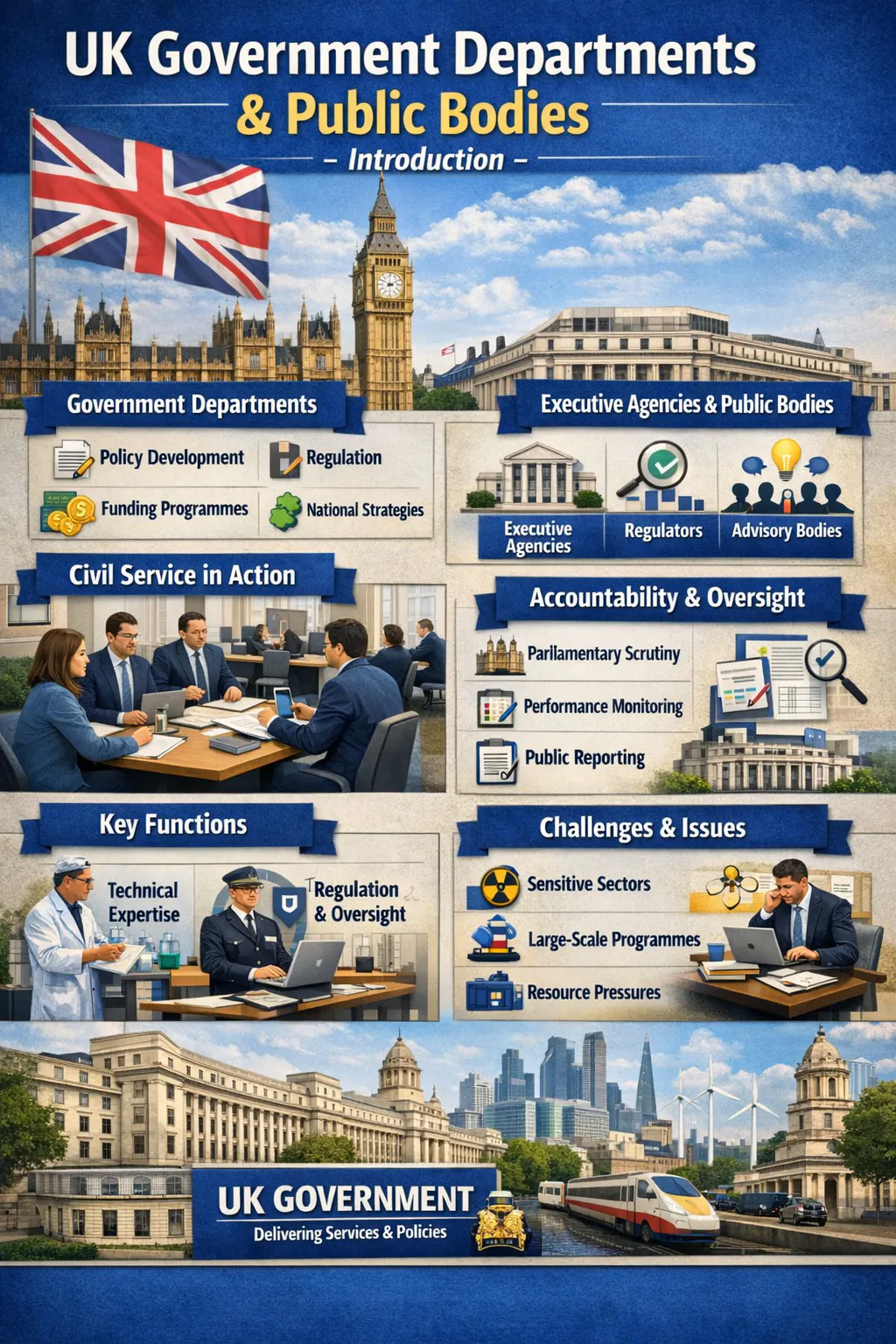
The UK government carries out its work through a network of departments, executive agencies and public bodies. These organisations are responsible for developing policy, delivering public services, enforcing regulations and managing large-scale national programmes on behalf of ministers. From tax collection and border control to healthcare regulation and environmental protection, public bodies touch almost every aspect of life in the United Kingdom.
This guide explains the different types of government organisations, how they relate to ministers and Parliament, how they are governed and held accountable, and why understanding the machinery of government matters.
The landscape of government bodies is complex and can be confusing even to those who work within it. Departments, agencies, regulators, commissions, inspectorates, ombudsmen and advisory committees all play different roles in the system. Knowing the difference between them — and understanding who is responsible for what — is essential for anyone seeking to navigate public services, hold government to account or understand how political decisions translate into real-world outcomes.
What are government departments?
Government departments are the main organisational units through which the UK government operates. Each department is responsible for a specific area of public policy and is led politically by a Secretary of State or other senior minister, and administratively by a Permanent Secretary — the most senior civil servant in the department.
As of 2025, there are around 25 ministerial departments. Major examples include HM Treasury, which manages public finances and economic policy, the Home Office, which is responsible for immigration, policing and national security, the Ministry of Defence, which oversees the armed forces and defence procurement, the Department for Education, the Department of Health and Social Care, and the Department for Environment, Food and Rural Affairs (Defra). Other significant departments include the Department for Energy Security and Net Zero, the Department for Science, Innovation and Technology, the Department for Transport and the Ministry of Justice.
Departments are funded through parliamentary supply — the annual process through which the House of Commons approves government spending. Each department sets out its spending plans, which are scrutinised by HM Treasury and approved through the Estimates process. The Permanent Secretary of each department serves as its accounting officer, personally responsible for ensuring that public money is spent properly, with regularity and in accordance with the principles of value for money set out in HM Treasury’s Managing Public Money guidance.
The structure of government departments is not fixed. The Prime Minister has the power to create, merge, split or rename departments without an Act of Parliament, a process known as machinery of government changes. This means that the landscape of departments can shift significantly when a new government takes office or when a Prime Minister reorganises responsibilities in response to new priorities.
What are non-ministerial departments?
Non-ministerial departments are government bodies that operate with a degree of independence from direct political control. They are headed by senior officials rather than ministers and typically carry out regulatory, technical or statistical functions where impartiality and operational independence are essential.
Key non-ministerial departments include HM Revenue and Customs (HMRC), which collects taxes, administers customs and manages the tax credit system, the Office for National Statistics (ONS), which produces official data on the economy, population, health and society, the Crown Prosecution Service (CPS), which makes independent decisions on whether to prosecute criminal cases in England and Wales, Ofsted, which inspects schools, children’s services and further education providers, and the Food Standards Agency (FSA), which oversees food safety and hygiene standards.
Although non-ministerial departments are not under the direct day-to-day control of a minister, they remain accountable to Parliament and operate within policy frameworks set by the government. Their heads can be summoned to give evidence before select committees, and their spending is audited by the National Audit Office.
What are executive agencies?
Executive agencies are operational bodies that sit within government departments but have a degree of managerial autonomy. They were introduced following the Next Steps report of 1988, which recommended separating the policy-making functions of government from the delivery of services. Executive agencies are headed by a chief executive who is accountable to the department’s minister and Permanent Secretary, but who has day-to-day operational control over the agency’s work.
There are more than 40 executive agencies across government. Examples include the Driver and Vehicle Licensing Agency (DVLA), which administers driving licences and vehicle registration from its base in Swansea, the Medicines and Healthcare products Regulatory Agency (MHRA), which regulates medicines, medical devices and clinical trials, the Met Office, which provides weather forecasting, climate science and severe weather warnings, HM Prison and Probation Service, which manages prisons and probation in England and Wales, and the Planning Inspectorate, which handles planning appeals and major infrastructure applications.
Each executive agency operates within a framework document agreed with its parent department that sets out its objectives, governance arrangements, performance targets and financial management procedures. Executive agencies are expected to operate efficiently and are often held to specific service standards — for example, the Passport Office has targets for how quickly passport applications should be processed.
What are arm’s-length bodies and non-departmental public bodies?
Arm’s-length bodies (ALBs) are organisations that carry out public functions but operate at a distance from ministers. The most common type is the non-departmental public body (NDPB), which may have executive, advisory or tribunal functions. As of 2024, there are several hundred ALBs across government, employing tens of thousands of staff and managing billions of pounds of public money.
Executive NDPBs have their own staff, budgets and boards of directors, and deliver specific services or regulatory functions. Prominent examples include the Environment Agency, which manages flood risk, water quality, waste regulation and environmental permitting, Natural England, which advises on nature conservation and manages national nature reserves, the Arts Council England, which distributes public funding to cultural organisations, Sport England, which invests in grassroots sport and physical activity, and the Care Quality Commission (CQC), which inspects and rates hospitals, care homes, GP practices and other health and social care services.
Advisory NDPBs provide expert guidance to ministers on specific issues — for example, the Committee on Climate Change (officially the Climate Change Committee) advises the government on carbon budgets and progress towards the UK’s net zero target. Tribunal NDPBs hear appeals and make quasi-judicial decisions in areas such as immigration, tax, social security and mental health.
ALBs are sponsored by a parent department, which sets their strategic direction and monitors their performance through framework agreements. The relationship between a department and its ALBs is governed by the Cabinet Office’s Partnerships Between Departments and Arm’s-Length Bodies: Code of Good Practice, which sets out expectations for governance, accountability and mutual responsibilities.
What role do regulators play in the UK?
Regulators are a specific category of public body responsible for overseeing particular sectors and ensuring that rules and standards are followed. They operate with statutory independence to protect consumers, maintain market integrity and enforce legal requirements. The independence of regulators from political interference is considered essential to maintaining public and business confidence in regulated markets.
Major UK regulators include Ofcom, which regulates telecommunications, broadcasting, postal services and — since the Online Safety Act 2023 — online platforms and content, Ofgem, which oversees energy markets and protects consumers, the Financial Conduct Authority (FCA), which regulates financial services firms and markets, the Prudential Regulation Authority (PRA), which is part of the Bank of England and supervises banks, building societies and insurers, the Competition and Markets Authority (CMA), which enforces competition law and reviews mergers, and the Information Commissioner’s Office (ICO), which enforces data protection law including the UK General Data Protection Regulation (UK GDPR) and the Data Protection Act 2018.
Regulators have significant powers including the ability to investigate potential breaches, issue fines, revoke licences, require changes to business practices and in some cases refer matters for criminal prosecution. For example, the CMA can block mergers that would substantially lessen competition, and the FCA can fine firms millions of pounds for market abuse or failure to treat customers fairly. Regulatory decisions can usually be appealed through specialised tribunals or the courts.
How are public bodies governed and held accountable?
Public bodies are accountable through several layers of governance. Each ALB has a sponsoring department that oversees its performance, appoints its board and agrees its strategic objectives. Board members and chairs of major public bodies are appointed through regulated public appointment processes overseen by the Commissioner for Public Appointments, who ensures that appointments are made on merit and in accordance with the Governance Code on Public Appointments.
Public bodies are required to publish annual reports and accounts, which are audited by the National Audit Office (NAO) or other approved auditors. Their accounts must comply with government accounting standards and demonstrate that public money has been used appropriately. The NAO also produces value-for-money reports on the work of significant public bodies, which are examined by the House of Commons Public Accounts Committee.
Select committees in Parliament can summon the leaders of public bodies to give evidence and answer questions about their performance and use of public funds. The Health and Social Care Committee, for example, regularly takes evidence from the chief executive of NHS England, while the Environmental Audit Committee scrutinises the work of environmental regulators.
The Cabinet Office periodically conducts reviews of public bodies to assess whether they are still needed, whether they are operating effectively and whether their functions could be delivered differently. These reviews are part of the government’s approach to ensuring that the landscape of public bodies remains efficient, transparent and accountable to taxpayers.
How do departments and public bodies work together?
Many policy challenges cut across the boundaries of individual departments and public bodies. Issues such as climate change, public health, digital transformation, national security and immigration require coordinated action across multiple organisations. The government manages this through cross-departmental programmes, joint ministerial committees, shared data platforms, inter-agency working groups and formal concordats between departments.
The Cabinet Office plays a central coordinating role, supporting the Prime Minister and Cabinet in managing priorities that span several departments. In some cases, dedicated units are established within the Cabinet Office or Number 10 to drive forward specific cross-cutting programmes. The government’s Integrated Review of security, defence, development and foreign policy, for example, required coordination across multiple departments and public bodies.
Effective coordination is essential to ensuring that government policy is implemented consistently and that public services work together in the interests of citizens. However, inter-departmental coordination remains one of the persistent challenges of the UK’s system of government, with reports from the NAO and the Institute for Government regularly highlighting cases where poor coordination has led to duplication, gaps in service delivery or conflicting policy objectives.
How has the structure of government changed over time?
The structure of government departments and public bodies has changed significantly over the past century. The Haldane Report of 1918 established the principle that departments should be organised around functions rather than the groups of people they serve — a principle that still broadly applies today. The Fulton Report of 1968 called for a more professional and specialist civil service, while the Rayner Scrutinies of the 1980s under Prime Minister Margaret Thatcher focused on eliminating waste and improving efficiency.
The most transformative change came with the Next Steps initiative of 1988, which led to the creation of executive agencies as separate operational units within departments. This separated the policy-making role of Whitehall from the delivery of public services and introduced more businesslike management practices into government. By the mid-1990s, the majority of civil servants worked in executive agencies rather than in traditional departmental headquarters.
More recently, successive governments have pursued agendas of public body reform. The Coalition Government’s Public Bodies Reform programme in 2010-2015 abolished, merged or reformed hundreds of quangos (quasi-autonomous non-governmental organisations) in an effort to reduce costs and improve accountability. The landscape continues to evolve — new regulators have been created in response to emerging challenges such as online safety, artificial intelligence governance and post-Brexit regulatory independence, while others have seen their powers expanded or reduced.
What challenges do departments and public bodies face?
Government departments and public bodies face a number of recurring challenges. Recruitment and retention of skilled staff is a persistent issue, particularly in areas such as digital technology, data science, commercial management and specialist regulation, where the public sector competes with higher-paying private sector employers. The Institute for Government and the NAO have repeatedly highlighted workforce capacity as a constraint on effective government delivery.
Digital transformation presents both opportunities and risks. The Government Digital Service (GDS), established in 2011, has driven significant improvements in online public services through the GOV.UK platform, but many departments still rely on legacy IT systems that are expensive to maintain and difficult to upgrade. Major government IT projects have a mixed track record, with high-profile failures in areas such as healthcare records, Universal Credit and border systems attracting significant parliamentary and media scrutiny.
The relationship between ministers and their departments can also be a source of tension. Ministers may arrive with ambitious reform agendas that are difficult to implement within existing structures and timescales, while civil servants may feel that political demands are unrealistic or insufficiently informed by evidence. Managing this relationship effectively is one of the most important skills in government and one of the factors that most influences whether policies succeed or fail in practice.
Why do government departments and public bodies matter?
Departments and public bodies are the practical machinery through which the UK government delivers its priorities. They determine how policies are implemented, how public money is spent, how regulations are enforced and how services reach millions of people across the United Kingdom. From the NHS to tax collection, from environmental protection to national defence, from school inspections to financial regulation, these organisations shape the everyday experience of government for UK citizens.
Understanding how they are organised and held accountable helps explain the gap that can sometimes exist between political announcements and real-world delivery, and why reform of the machinery of government is a recurring theme in British politics. It also helps citizens, journalists and businesses understand where to direct questions, complaints and engagement with the public sector.
Related guides
These guides explain related topics in more detail:
- How the UK Government Works
- How UK Government Policy Is Made
- How UK General Elections Work
- The UK Electoral Commission and Election Rules Explained
- UK Public Finances and Government Spending Explained
Related coverage:
Explore recent UK government and politics news
Prepared by:
