
How UK General Elections Work
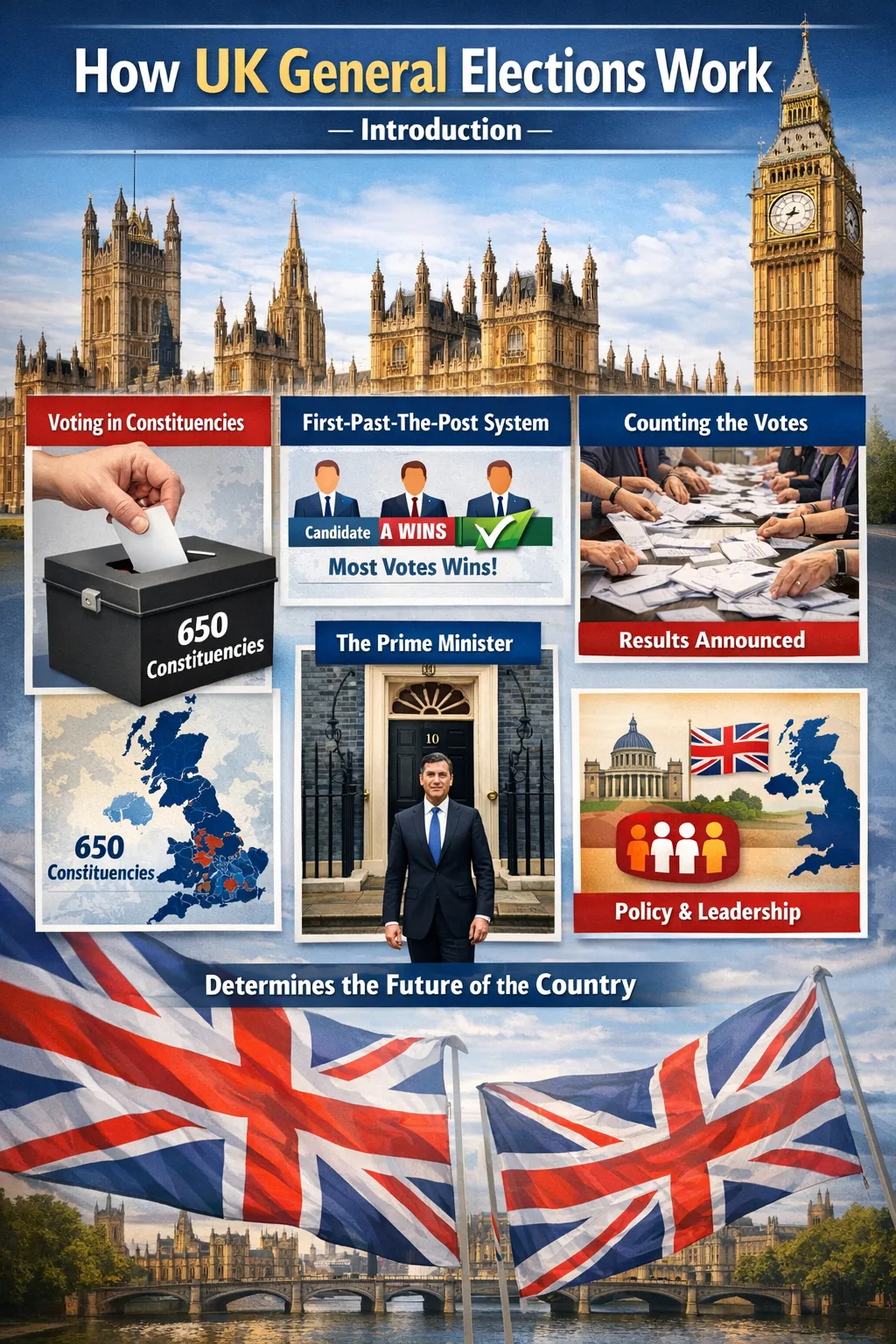
General elections are the principal mechanism through which the people of the United Kingdom choose their representatives in the House of Commons and, in turn, determine which political party or coalition forms the government. Elections in the UK are conducted under the first-past-the-post voting system, in which the candidate with the most votes in each constituency wins the seat.
This guide explains how UK general elections work, from the dissolution of Parliament and the calling of an election through to voting, counting, the declaration of results and the formation of a new government.
What is a UK general election?
A general election is a nationwide vote to elect all 650 Members of Parliament (MPs) to the House of Commons. Each MP represents a geographic constituency — a defined area of the country — and is elected by voters who are registered in that constituency. The party that wins a majority of seats (326 or more) normally forms the government, and its leader becomes Prime Minister.
General elections must be held at least every five years under the terms of the Dissolution and Calling of Parliament Act 2022, which replaced the Fixed-term Parliaments Act 2011. The Prime Minister can request that the monarch dissolves Parliament and calls an election at an earlier date. An election must also be held if the government loses a vote of no confidence in the House of Commons and no alternative government can be formed within 14 days.
How are constituencies organised?
The United Kingdom is divided into 650 parliamentary constituencies, each represented by one MP. Constituency boundaries are reviewed periodically by independent Boundary Commissions for England, Scotland, Wales and Northern Ireland to ensure that each constituency has a broadly similar number of registered voters — typically around 70,000 to 80,000 electors, although there is some variation.
Boundary reviews take into account population changes, geographic features and local authority boundaries. They can be politically significant, as changes to constituency boundaries may affect the electoral prospects of individual parties and candidates.
Who can stand as a candidate?
Any British, Irish or qualifying Commonwealth citizen aged 18 or over can stand as a candidate in a UK general election, subject to certain disqualifications. People who are disqualified include serving prisoners, members of the House of Lords, holders of certain public offices such as judges and senior civil servants, and undischarged bankrupts.
Candidates are typically nominated by political parties, but independent candidates can also stand. To appear on the ballot paper, a candidate must submit nomination papers signed by at least ten registered voters in the constituency and pay a deposit of £500, which is returned if the candidate receives at least five per cent of the votes cast.
The selection of candidates within political parties is an internal matter, with each party having its own rules for choosing who will stand in each constituency.
What happens during the election campaign?
The election campaign period begins when Parliament is dissolved and the election date is announced. The formal campaign period typically lasts around five to six weeks, during which political parties and candidates compete for votes through a combination of public events, media appearances, targeted advertising, doorstep canvassing and increasingly sophisticated digital campaigns.
Parties publish manifestos setting out their policy commitments — detailed documents that outline what the party would do if elected to government. Manifestos cover a wide range of issues including the economy, taxation, public services, defence, immigration, housing, education and the environment. They serve as the basis for the party’s appeal to voters and, if the party wins, as a reference point for judging the government’s record in office.
Television debates between party leaders have become an established feature of UK general election campaigns since the first debates were held in 2010. Broadcasters are required by Ofcom’s Broadcasting Code to maintain due impartiality in their election coverage, and the allocation of broadcast time to parties is governed by rules that take into account past electoral performance and current support.
During the campaign period, the government enters a period of restraint known as purdah (or the pre-election period), during which ministers and civil servants are expected to avoid making major policy announcements, entering into significant new commitments or using government resources in ways that could be seen as giving an electoral advantage to the governing party. The Cabinet Office publishes guidance on the conduct of government business during the pre-election period.
What role do political parties play in elections?
Political parties are the primary organisational vehicles through which candidates seek election to the House of Commons. The United Kingdom has a multi-party system, though the first-past-the-post voting system has historically produced two dominant parties — currently the Conservative Party and the Labour Party. Other significant parties include the Liberal Democrats, the Scottish National Party (SNP), Plaid Cymru in Wales, the Green Party, Reform UK and, in Northern Ireland, parties such as Sinn Féin, the Democratic Unionist Party (DUP), the Social Democratic and Labour Party (SDLP) and the Alliance Party.
Parties select candidates through internal processes that vary between parties. Some use open selection meetings of local members, while others use panels, shortlists or, in some cases, centrally imposed candidates. Parties also provide financial support, campaign materials, data analytics, training and strategic coordination to their candidates during the election period.
Party funding is regulated by the Electoral Commission. Parties must declare donations above specified thresholds, and there are strict limits on campaign spending during the regulated period. The question of how political parties should be funded — and whether the current system adequately prevents undue influence — is a recurring subject of political debate.
How does the first-past-the-post voting system work?
The UK uses the first-past-the-post (FPTP) system for general elections. In each constituency, voters mark a single cross next to their preferred candidate on the ballot paper. The candidate who receives the most votes wins the seat — there is no requirement to win an absolute majority of votes cast.
FPTP tends to produce clear election outcomes and strong single-party governments, because it amplifies the seat share of the leading party relative to its share of the total national vote. However, it is criticised for underrepresenting smaller parties whose votes are spread thinly across many constituencies, and for producing results in which a party can win a parliamentary majority with well under half the national vote.
Alternative voting systems are used in other UK elections. The Scottish Parliament and the Senedd Cymru (Welsh Parliament) use the Additional Member System, Northern Ireland Assembly elections use the Single Transferable Vote, and mayoral and local elections in some parts of the UK use different methods. The debate about whether FPTP should be replaced with a more proportional system is a long-standing one in British politics. A referendum on switching to the Alternative Vote system was held in 2011 and rejected by a large majority, but campaigners for electoral reform continue to argue that FPTP produces unrepresentative outcomes.
Under FPTP, the concept of “safe seats” — constituencies where one party has such a large majority that the outcome is virtually certain — means that election campaigns tend to focus heavily on “marginal” or “swing” seats where the result is competitive. This concentration of campaign resources and attention on a relatively small number of constituencies is a distinctive feature of UK general elections.
Who is eligible to vote?
To vote in a UK general election, a person must be aged 18 or over on polling day, be a British, Irish or qualifying Commonwealth citizen, be resident in the UK or a British citizen living abroad who has been registered to vote in the UK within the last 15 years, and be registered on the electoral register.
Voter registration in the UK is managed through individual electoral registration. Each eligible person must register individually, either online through the GOV.UK website or by completing a paper form. Local authorities maintain the electoral register and are responsible for ensuring that it is accurate and up to date.
Since the introduction of the Elections Act 2022, voters in Great Britain must present an approved form of photo identification at the polling station in order to cast their ballot. Accepted forms of ID include a passport, driving licence, bus pass with photograph and certain other official documents. Voters without an accepted form of ID can apply for a free Voter Authority Certificate from their local council.
What happens on election day?
Polling day for a UK general election is traditionally held on a Thursday. Polling stations open at 7:00am and close at 10:00pm. Voters attend their designated polling station, present photo ID, receive a ballot paper and cast their vote in a private booth by marking a cross next to their chosen candidate.
Voters who are unable to attend the polling station in person can apply in advance for a postal vote. Proxy voting — appointing another person to vote on one’s behalf — is also available in certain circumstances, such as illness or disability.
After polls close, ballot boxes are transported to counting centres, where votes are counted by hand under the supervision of the returning officer for each constituency. Candidates and their agents are permitted to observe the count. The returning officer announces the result for each constituency, declaring the winning candidate elected as the Member of Parliament.
How is a government formed after an election?
Once the results are declared, the political party that commands a majority in the House of Commons is invited by the monarch to form a government. In most cases, the leader of the largest party becomes Prime Minister and appoints their Cabinet and ministerial team.
If no single party wins an overall majority — a situation known as a hung parliament — negotiations may take place between parties to form a coalition government or a minority government supported by confidence and supply agreements with other parties. The incumbent Prime Minister has the first opportunity to attempt to form a government, but if they cannot command a majority, they are expected to resign.
The transition between governments in the UK is typically rapid — often taking place within hours of the result becoming clear. Civil servants prepare briefing materials for incoming ministers through a process coordinated by the Cabinet Office, and the new Prime Minister takes office as soon as the outgoing Prime Minister has formally tendered their resignation to the monarch at Buckingham Palace. The new Prime Minister then travels to Downing Street and begins appointing their Cabinet, typically within the first 24 to 48 hours.
The concept of a “caretaker government” applies during the period between the election result and the formal appointment of a new Prime Minister. During this time, the outgoing government continues to manage routine business but is expected to avoid making major policy decisions or commitments that would bind the incoming administration. The speed and smoothness of the transition process is often cited as one of the strengths of the UK’s democratic system.
How are elections regulated?
UK elections are overseen by the Electoral Commission, an independent body responsible for regulating political finance, setting standards for electoral administration and promoting public confidence in the democratic process. The Commission monitors campaign spending, publishes data on political donations and investigates breaches of electoral law.
There are strict rules governing campaign spending. National spending limits apply to political parties during the election period, and separate limits apply to individual candidates in each constituency. Parties and candidates must report their spending and sources of funding to the Electoral Commission after the election.
What are by-elections?
A by-election is held in a single constituency when a seat in the House of Commons becomes vacant between general elections. Vacancies arise when an MP dies, resigns, is disqualified or is expelled from Parliament. By-elections follow the same voting process as general elections — candidates are nominated, voters in the constituency cast their ballots and the candidate with the most votes wins the seat.
By-elections often attract significant political and media attention, particularly when they are seen as a test of the government’s popularity or when there is a prospect of a seat changing hands between parties. Turnout in by-elections is typically lower than in general elections, and the results can be influenced by local factors, protest voting and the intensity of campaigning by individual parties. While by-elections do not change the overall composition of government, a series of by-election losses can damage a government’s authority and influence the political narrative between general elections.
What are voter turnout trends in UK elections?
Voter turnout in UK general elections has fluctuated over the decades. In the post-war period, turnout was consistently high — reaching 83.9 per cent in 1950 and remaining above 70 per cent for most of the second half of the twentieth century. Turnout fell sharply to a historic low of 59.4 per cent in 2001, before recovering somewhat to around 65-68 per cent in subsequent elections. The 2024 general election saw a turnout of approximately 60 per cent, one of the lowest in modern history.
Turnout varies significantly by age, with younger voters consistently less likely to vote than older age groups. Geographic variation is also significant — turnout tends to be higher in marginal constituencies where the outcome is competitive and lower in safe seats where the result is seen as a foregone conclusion. Socioeconomic factors such as income, education and housing tenure also correlate with voting behaviour.
Low turnout is a source of concern for democratic legitimacy. Various proposals have been made to increase participation, including automatic voter registration, extending voting over multiple days, online voting and lowering the voting age to 16. Scotland and Wales have already lowered the voting age to 16 for their devolved elections, but the UK Parliament has not yet extended this to general elections. The debate about how to encourage higher levels of democratic engagement remains active in British politics.
Why do UK general elections matter?
General elections are the most important democratic event in the United Kingdom. They determine the composition of Parliament, the political leadership of the country and the direction of national policy on issues ranging from the economy and taxation to healthcare, education, defence and international relations. The outcome of a general election shapes the priorities of government for up to five years and has direct consequences for public services, regulation and the lives of millions of people across the UK.
Related guides
These guides explain related topics in more detail:
- How the UK Government Works
- UK Local and Devolved Elections Explained
- The UK Electoral Commission and Election Rules Explained
- How UK Government Policy Is Made
- UK Government Departments and Public Bodies Explained
Related coverage:
Browse recent stories from UK politics
Prepared by:
