
How the UK Government Works
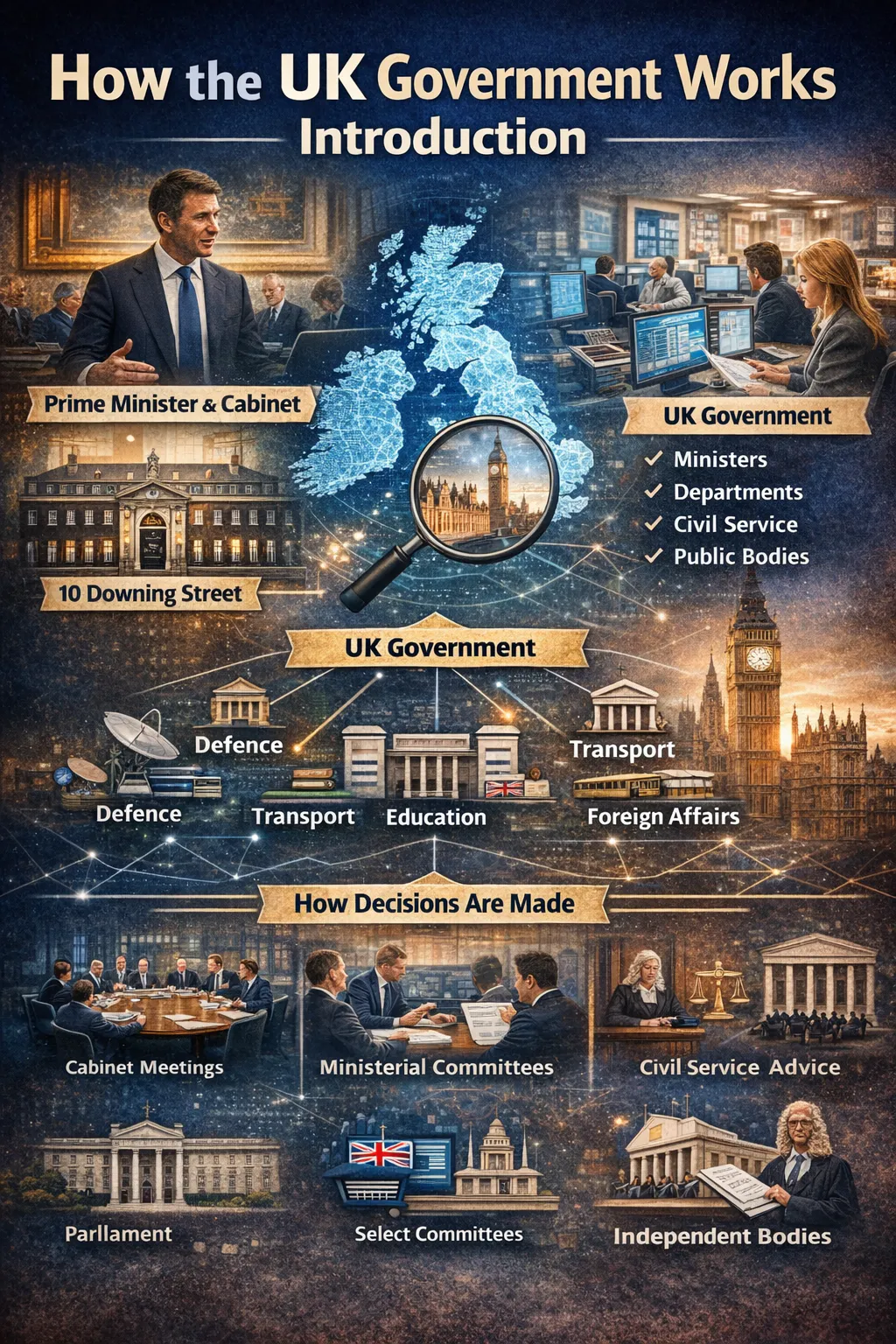
The United Kingdom is governed through a parliamentary system in which executive power is exercised by the government on behalf of the Crown. The UK government is led by the Prime Minister, supported by Cabinet ministers, government departments and a permanent civil service. Together, these institutions develop policy, propose legislation, manage public services and represent the United Kingdom at home and abroad.
This guide explains how the UK government is structured, how executive decisions are made, and how political power is organised across Westminster and Whitehall. It covers the roles of the Prime Minister, Cabinet, ministers, departments, the civil service and the systems of accountability that hold government to account.
What is the UK government?
The UK government is the executive branch of the state. It is separate from Parliament, which is the legislative branch, and from the judiciary, which interprets and applies the law. The government’s core functions include developing and implementing public policy, managing the delivery of public services such as healthcare and education, proposing new legislation to Parliament, negotiating international agreements and treaties, and representing the United Kingdom in diplomatic and trade relations.
The government operates primarily from Whitehall in central London, where most major departments are based. While the term “government” is sometimes used loosely to refer to the entire state, in constitutional terms it refers specifically to the executive — the Prime Minister, ministers and the machinery that supports them.
The UK does not have a single written constitution. Instead, the government operates within a framework of statute law, constitutional conventions, common law and international obligations. Key constitutional statutes include the Parliament Acts 1911 and 1949, the Human Rights Act 1998, the Scotland Act 1998, the Government of Wales Act 1998 and the Northern Ireland Act 1998. The lack of a codified constitution means that many important rules about how the government operates rely on convention rather than formal legal requirement — for example, the convention that the Prime Minister must be a member of the House of Commons rather than the House of Lords.
The Prime Minister and the Cabinet
The Prime Minister is the head of government in the United Kingdom. The role is not defined by a single statute but has evolved through constitutional convention over several centuries. The Prime Minister is normally the leader of the political party that commands a majority in the House of Commons following a general election. The monarch formally appoints the Prime Minister on the basis of who can command the confidence of the House.
The Prime Minister chairs the Cabinet, sets the overall direction of government policy, appoints and dismisses ministers, and represents the UK at international summits and in bilateral diplomacy. The Prime Minister also has significant powers of patronage, including recommending appointments to the House of Lords, senior judicial positions and public bodies. The Prime Minister’s official residence is 10 Downing Street, which also serves as the base for the Prime Minister’s Office, a team of civil servants, political advisers and communications staff that supports the Prime Minister in running the government.
The Cabinet is the senior decision-making body in government. It is composed of the most senior ministers, known as Secretaries of State, who each lead a major government department. Cabinet members include the Chancellor of the Exchequer, who manages the nation’s finances and economic policy from HM Treasury, the Foreign Secretary, the Home Secretary, the Defence Secretary and around 20 other senior ministers. The Cabinet meets weekly, usually on a Tuesday morning at 10 Downing Street, to discuss and agree on major policy decisions, respond to emerging crises and coordinate the government’s programme.
Cabinet operates under the principle of collective responsibility, which means that all ministers are expected to publicly support decisions made collectively, even if they privately disagreed during discussion. A minister who cannot support a Cabinet decision is conventionally expected to resign. This principle is central to the cohesion of UK government and ensures that the public receives a single, unified message on policy issues. Breaches of collective responsibility — for example, ministers publicly criticising agreed policy — are rare but politically significant when they occur.
Ministers and ministerial responsibilities
Government ministers are appointed by the Prime Minister and are drawn almost exclusively from members of the House of Commons or the House of Lords. There are typically around 120 ministers across government, though only around 20–25 attend Cabinet. Ministers are politically accountable for the work of their departments and are expected to answer questions in Parliament, appear before select committees and explain government policy to the public and the media.
There are several ranks of minister. Secretaries of State are the most senior, heading major departments such as the Department of Health and Social Care, the Ministry of Defence or the Home Office. Ministers of State hold mid-ranking positions and take responsibility for specific policy areas within a department — for example, a Minister of State for Immigration within the Home Office. Parliamentary Under-Secretaries of State are the most junior ministerial rank and typically handle detailed policy work, answer parliamentary questions on technical matters or represent the department in the House of Lords.
The doctrine of individual ministerial responsibility holds that ministers are accountable to Parliament for the conduct and performance of their departments. If serious failings occur — such as a major policy failure, misuse of public funds or a breach of the Ministerial Code — a minister may be expected to resign. The Ministerial Code, published by the Cabinet Office, sets out the standards of conduct expected of ministers, including rules on conflicts of interest, the use of government resources and the relationship between ministers and civil servants.
Ministers are supported by special advisers, commonly known as “spads,” who are politically appointed rather than recruited through the civil service. Special advisers provide political advice, media support and policy input that it would be inappropriate for politically neutral civil servants to offer. Their role, number and influence have been the subject of ongoing debate in British politics.
How are UK government departments organised?
The work of government is carried out through departments, each responsible for a major area of public policy. As of 2025, there are around 25 ministerial departments in the UK government. Major departments include HM Treasury, which manages public finances and economic policy, the Home Office, which oversees immigration, policing and national security, the Department for Education, the Department for Environment, Food and Rural Affairs (Defra), the Department for Energy Security and Net Zero, the Department for Science, Innovation and Technology, and the Department for Transport.
Each department is led politically by a Secretary of State and administratively by a Permanent Secretary, who is the most senior civil servant in the department. The Permanent Secretary serves as the department’s accounting officer, personally responsible for ensuring that public money is spent properly and in accordance with Treasury rules. Departments develop policy, draft legislation, manage budgets, oversee the delivery of public programmes and sponsor executive agencies and arm’s-length public bodies that carry out operational or regulatory functions at a distance from ministers.
In addition to ministerial departments, the UK government includes non-ministerial departments such as HM Revenue and Customs (HMRC), the Office for National Statistics (ONS) and the Crown Prosecution Service (CPS), which operate with a degree of independence from political direction. The machinery of government can be reorganised by the Prime Minister — departments can be created, merged, split or renamed — without requiring an Act of Parliament, which means that the structure of government departments can change significantly from one administration to the next.
What is the role of the civil service?
The civil service is the permanent, politically neutral body of officials that supports the government of the day. Civil servants advise ministers on policy options, implement decisions, manage public programmes and ensure the continuity of government when political leadership changes after elections. The civil service is governed by the Constitutional Reform and Governance Act 2010, which sets out the core principles of impartiality, integrity, honesty and objectivity.
Civil servants are recruited on merit through open competition overseen by the Civil Service Commission, an independent body that regulates recruitment to the senior civil service. The head of the civil service is the Cabinet Secretary, who also serves as the principal policy adviser to the Prime Minister. The Cabinet Secretary is typically one of the most influential figures in government, coordinating the work of Whitehall and managing the relationship between the political leadership and the permanent bureaucracy.
There are approximately 500,000 civil servants in the UK, working across departments, agencies and public bodies. Their roles range from frontline service delivery — such as processing benefit claims, issuing passports and managing job centres — to specialist policy analysis, legal advice, digital services, procurement and operational management. Civil servants do not change with the government — they serve whichever party is in power, providing consistent institutional knowledge and expertise. This permanence is considered one of the strengths of the British system of government, though it has also been criticised at times for creating resistance to reform or a lack of accountability for poor performance.
How are executive decisions made?
Executive decisions in the UK government are made through a combination of Cabinet meetings, Cabinet committees, bilateral discussions between ministers, and departmental processes. The most significant policy decisions are taken collectively by Cabinet or by Cabinet committees — smaller groups of ministers tasked with specific policy areas such as economic affairs, national security, home affairs or social policy.
Cabinet committees are chaired by the Prime Minister or a senior minister and allow detailed discussion of complex issues before they reach full Cabinet. The Cabinet Office, based in Whitehall, coordinates the work of government across departments, manages the Cabinet committee system and supports the Prime Minister in overseeing cross-cutting priorities. The Cabinet Office also manages the “write-round” process, in which policy proposals are circulated to all relevant departments for comment before they are formally agreed.
Routine departmental decisions are made by ministers within their areas of responsibility, supported by advice from civil servants. Some decisions require formal legal instruments such as statutory instruments, orders in council or ministerial directions. The use of secondary legislation — rules made under powers granted by Acts of Parliament — is a significant part of how government policy is implemented in practice, with around 3,000 statutory instruments made each year.
How does devolution affect the UK government?
Since the late 1990s, significant powers have been devolved from Westminster to legislatures and governments in Scotland, Wales and Northern Ireland. The Scottish Government, the Welsh Government and the Northern Ireland Executive each have authority over devolved matters such as health, education, transport, the environment and some areas of taxation within their respective nations. The Scottish Parliament was established by the Scotland Act 1998, the Senedd Cymru (Welsh Parliament) by the Government of Wales Act 1998, and the Northern Ireland Assembly by the Northern Ireland Act 1998.
The UK government retains responsibility for reserved matters, which include defence, foreign affairs, immigration, social security, most taxation and macroeconomic policy. The relationship between the UK government and the devolved administrations is managed through intergovernmental relations frameworks and regular meetings between ministers. In practice, tensions between the UK government and devolved governments over policy differences, funding and the boundaries of devolved powers are a recurring feature of British politics.
England does not have its own devolved parliament or government. English policy on devolved matters such as health and education is set by the UK government and passed through the UK Parliament. Some powers have been devolved to combined authorities and directly elected mayors in English regions, particularly in areas such as transport, housing and economic development, through individual devolution deals negotiated with the government.
How is the UK government held accountable?
The UK government is subject to multiple forms of scrutiny and accountability. Parliament is the primary mechanism — ministers must answer questions in the House of Commons and the House of Lords, respond to debates, and appear before select committees that examine departmental policy, spending and administration. Prime Minister’s Questions (PMQs), held every Wednesday when Parliament is sitting, is one of the most visible forms of parliamentary accountability, in which the Prime Minister responds to questions from the Leader of the Opposition and backbench MPs.
Select committees play a particularly important role in holding government to account. Each major department has a corresponding select committee composed of backbench MPs, which can call ministers, civil servants, external experts and members of the public to give evidence. Select committees publish reports and recommendations that the government is expected to respond to within 60 days. The Public Accounts Committee (PAC), supported by the National Audit Office (NAO), scrutinises government spending and value for money across all departments.
Beyond Parliament, the government is also scrutinised by independent bodies. The NAO examines public spending and publishes reports on major programmes and projects. The Independent Adviser on Ministers’ Interests investigates potential breaches of the Ministerial Code. The Commissioner for Public Appointments oversees the process for appointing the leaders of public bodies. The courts can review government decisions through judicial review, ensuring that the executive acts within its legal powers and follows proper procedures. Freedom of information legislation, principally the Freedom of Information Act 2000, also allows the public and media to request government documents and data, promoting transparency in decision-making.
What is the relationship between government and Parliament?
Although the government and Parliament are closely connected — most ministers sit in the House of Commons — they have distinct constitutional roles. Parliament’s primary functions are to pass legislation, approve taxation and public spending, and hold the government to account. The government proposes most legislation and controls the parliamentary timetable, but it requires parliamentary approval to pass laws and raise revenue.
The House of Commons is the dominant chamber. A government that loses a vote of no confidence in the Commons must either resign or seek a dissolution of Parliament and a new general election. The Dissolution and Calling of Parliament Act 2022 restored the Prime Minister’s ability to request a dissolution at a time of their choosing, replacing the Fixed-term Parliaments Act 2011 which had set fixed five-year terms.
The House of Lords acts as a revising chamber, scrutinising and amending legislation. Although the Lords can delay legislation, the Parliament Acts 1911 and 1949 allow the Commons to override the Lords in most circumstances. The Lords also holds the government to account through questions, debates and its own select committees. Membership of the House of Lords consists of life peers appointed by the monarch on the advice of the Prime Minister, bishops of the Church of England and, until recent reforms, a number of hereditary peers. Reform of the House of Lords has been the subject of debate for over a century, and the current Labour government has introduced the House of Lords (Hereditary Peers) Act 2024 to remove the remaining hereditary peers.
How does the UK government manage public finances?
The management of public finances is one of the most important functions of government. HM Treasury is the department responsible for fiscal policy, public spending and economic strategy. The Chancellor of the Exchequer presents the annual Budget to Parliament, setting out the government’s taxation and spending plans. Since 2010, the Office for Budget Responsibility (OBR), an independent fiscal watchdog, has produced economic and fiscal forecasts alongside the Budget, providing an independent assessment of whether the government is likely to meet its fiscal rules.
Government spending is allocated through Spending Reviews, in which the Treasury negotiates multi-year funding settlements with each department. Day-to-day spending — on public services, welfare and the running costs of government — is funded through taxation, while capital spending on infrastructure, buildings and equipment may be funded through borrowing. The balance between taxation, spending and borrowing is one of the central political and economic questions facing any UK government.
Why understanding the UK government matters
The UK government makes decisions that directly affect the lives of everyone in the United Kingdom. Government policy shapes public services including the National Health Service, schools and universities, transport networks, taxation, employment law, housing, defence and national security. Understanding how the government is structured and how decisions are made helps explain why policies are adopted, how public money is spent and how citizens can engage with the political process.
The UK system of government has evolved over centuries and continues to adapt to new challenges, including devolution, digital transformation, post-Brexit regulatory independence and changing public expectations of transparency and accountability. Knowing how the machinery of government works is essential for understanding the news and holding those in power to account.
Related guides
These guides explain related topics in more detail:
- UK Government Departments and Public Bodies Explained
- How UK Government Policy Is Made
- How UK General Elections Work
- UK Local and Devolved Elections Explained
- The UK Electoral Commission and Election Rules Explained
- How the UK Economy Works
Related coverage:
Read our latest reporting on UK politics
Prepared by:
