How the UK Public Transport System Works
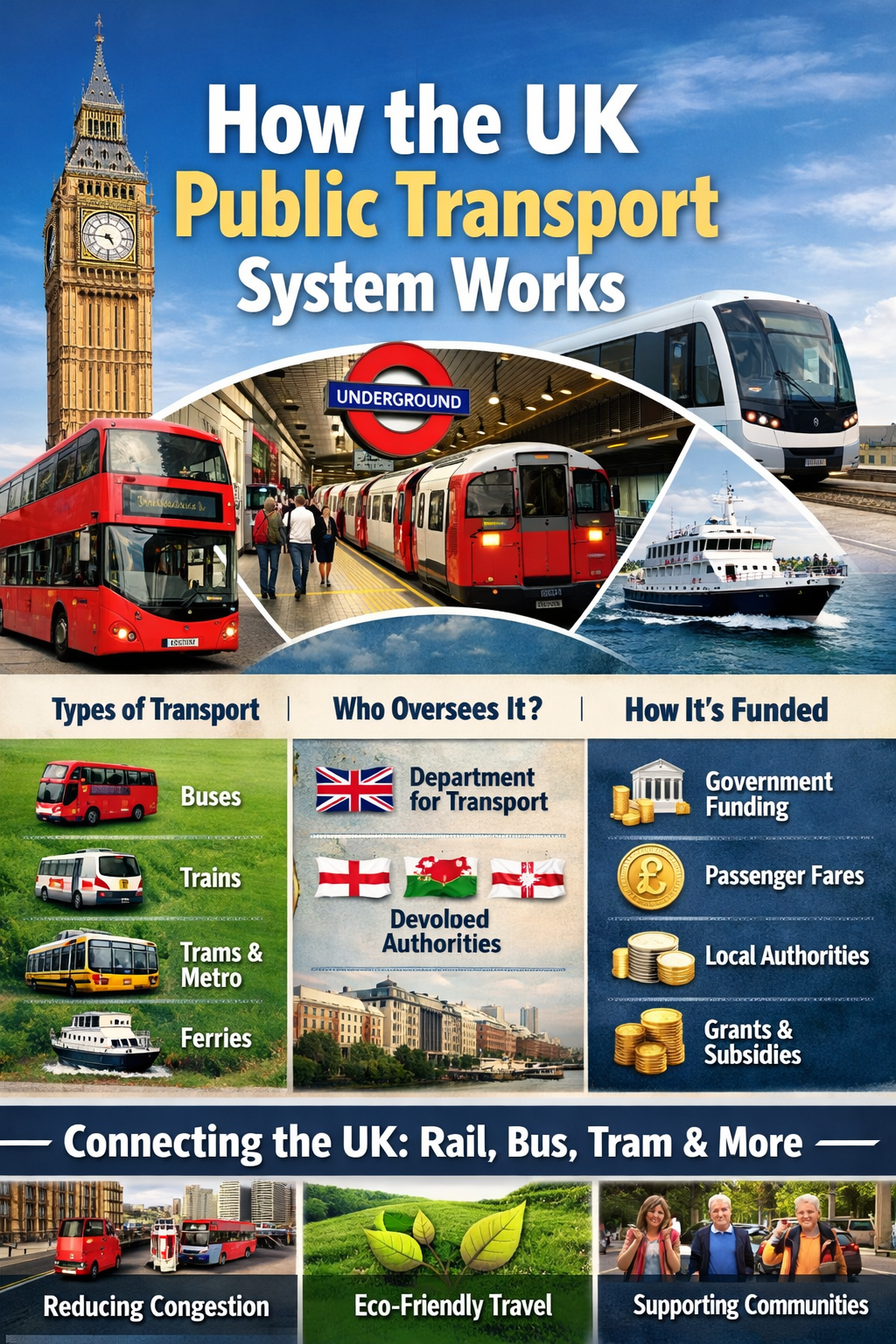
Public transport is essential to the daily lives of millions of people across the United Kingdom. Buses, trains, trams, ferries and underground systems connect communities, enable people to reach workplaces and services, support economic activity and play a growing role in reducing the country’s carbon emissions. The UK’s public transport network is one of the most complex in Europe, involving multiple modes of travel, a mix of public and private operators, and overlapping responsibilities between national, regional and local government.
This guide explains how the UK public transport system is structured, who is responsible for different aspects of the network, how services are funded and operated, what rights passengers have and why public transport is a major policy issue.
What is public transport in the UK?
Public transport in the UK encompasses all forms of shared passenger transport that are available to the general public. The main modes include buses, which carry more passengers than any other form of public transport and serve both urban and rural areas across the country, railways, which provide intercity, regional and commuter services through an extensive national network, the London Underground and other urban metro systems such as the Tyne and Wear Metro and the Glasgow Subway, tram and light rail systems operating in cities including Manchester (Metrolink), Sheffield (Supertram), Birmingham, Nottingham and Edinburgh, and ferry services connecting the mainland with islands and coastal communities, particularly in Scotland.
London has the most integrated public transport network in the UK, managed by Transport for London (TfL) under the authority of the Mayor of London. TfL operates or oversees the Underground, Overground, Elizabeth line, Docklands Light Railway (DLR), buses, trams, river services, cycling infrastructure and the Congestion Charge zone. Outside London, public transport is less integrated, with services often operated by different companies with separate ticketing systems, making multi-modal journeys more complex for passengers.
Who is responsible for public transport in the UK?
Responsibility for public transport in the UK is divided between national government, devolved administrations, regional transport bodies and local authorities. The Department for Transport (DfT) is the main UK government department responsible for transport policy in England and for reserved transport matters across the UK, including aviation and maritime regulation. The DfT sets the strategic framework for transport, manages rail franchising (through Great British Railways in its transitional phase), funds major infrastructure projects and regulates the transport industry.
In Scotland, transport policy is devolved to the Scottish Government, which manages ScotRail services (now publicly owned), funds Transport Scotland and oversees the trunk road network and ferry services to the Scottish islands. In Wales, Transport for Wales is responsible for rail services and strategic transport planning. In Northern Ireland, Translink operates public transport services as a publicly owned company under the oversight of the Northern Ireland Department for Infrastructure.
At the regional and local level, combined authorities with elected mayors — such as Transport for Greater Manchester, the West Midlands Combined Authority and the Liverpool City Region — have increasing powers over local transport, including bus services, cycling infrastructure, road management and in some cases light rail. Local councils are responsible for maintaining local roads, managing parking, supporting community transport and, in some areas, subsidising bus routes that are not commercially viable. The Buses Act, expected to give local authorities greater powers to franchise or run bus services directly, represents a significant shift in the governance of local public transport.
How are public transport services operated?
The operation of public transport in the UK involves a complex mix of public and private sector involvement that varies by mode and region. The rail network has undergone significant structural change since privatisation in the 1990s. Track and infrastructure are managed by Network Rail, a public body, while passenger train services have historically been operated by private companies under franchise agreements with the government. Following the disruption caused by the COVID-19 pandemic, most franchises were replaced by temporary contracts, and the government has announced plans to bring passenger rail services into public ownership through Great British Railways (GBR).
Bus services outside London are largely deregulated, meaning that private operators decide which routes to run based on commercial viability. The major bus operators include FirstGroup, Stagecoach, Arriva, Go-Ahead and National Express. Local authorities can subsidise routes that operators do not wish to run commercially, but funding for these “supported” services has declined significantly, leading to widespread route cuts, particularly in rural areas. In London, buses operate under a franchised model managed by TfL, with private companies competing for contracts to run specific routes to TfL’s specifications.
The government’s plan to allow local authorities to franchise bus services — similar to the London model — through the Buses Act is expected to give combined authorities and councils greater control over routes, frequencies, fares and standards. Greater Manchester became the first area outside London to introduce bus franchising in 2024, bringing all bus services under the coordination of the combined authority.
How is public transport funded?
Public transport in the UK is funded through a combination of fare revenue from passengers, government subsidies and grants, local authority funding and, for major capital projects, borrowing. The balance between fares and public subsidy varies significantly between modes and regions.
The rail network receives substantial public funding. Government support for the railways — including payments to operators, investment in infrastructure and subsidies for loss-making routes — runs to billions of pounds per year. Passengers also contribute through fares, which in the UK are among the highest in Europe relative to income. The regulation of rail fares is complex, with some fares (such as season tickets on certain routes) regulated by government and others set freely by operators.
Bus funding comes from fare revenue, government subsidies (including the Bus Service Operators Grant, which compensates operators for fuel duty), concessionary travel reimbursement (for free bus passes for older and disabled people) and local authority support for non-commercial routes. The government introduced a national bus fare cap of £2 per single journey in 2023, later extended, to encourage ridership and support passengers with the cost of living.
Transport for London is funded through fares, business rates, government grants and borrowing. TfL’s finances were severely affected by the pandemic, which caused a collapse in fare revenue, and have been the subject of ongoing negotiations with the UK government over long-term funding settlements.
What rights do public transport passengers have?
Passengers using public transport in the UK have legal rights that vary by mode. Rail passengers are protected by the National Rail Conditions of Travel and by consumer protection law. If a train is delayed or cancelled, passengers may be entitled to compensation under the operator’s Delay Repay scheme — typically 25 per cent of the fare for delays of 15-30 minutes and 50 per cent for delays of 30-60 minutes, with higher refunds for longer delays. The Rail Ombudsman provides an independent dispute resolution service for complaints that operators fail to resolve.
Bus passengers have fewer statutory rights than rail passengers, though they are protected by general consumer law and the operator’s conditions of carriage. The introduction of bus franchising is expected to strengthen accountability to passengers by giving local authorities greater control over service standards.
The Equality Act 2010 requires public transport operators to make reasonable adjustments to ensure that their services are accessible to disabled passengers. This includes providing accessible vehicles, audio and visual announcements, ramps and designated wheelchair spaces. Transport operators are also required to provide assistance to disabled passengers, and the government has published an Inclusive Transport Strategy setting out plans to improve accessibility across all modes of transport.
How does public transport contribute to climate goals?
Transport is the largest source of greenhouse gas emissions in the UK, accounting for around 26 per cent of total emissions. Encouraging a shift from private car use to public transport is a key element of the government’s strategy for reaching its net zero target by 2050. Public transport is significantly more carbon-efficient per passenger journey than private cars, particularly in urban areas where vehicles are well-used.
The electrification of public transport is accelerating. Many cities are transitioning their bus fleets to zero-emission electric or hydrogen vehicles, supported by government funding through schemes such as the Zero Emission Bus Regional Areas (ZEBRA) programme. The rail network is pursuing electrification of key routes, replacing diesel trains with electric or battery-hybrid rolling stock. The government’s Transport Decarbonisation Plan, published in 2021, set out a comprehensive strategy for reducing emissions from all transport modes, including ambitious targets for public transport.
What challenges does rural and regional public transport face?
Public transport provision outside major cities faces significant and growing challenges. Bus services in rural and semi-rural areas have been cut dramatically over the past 15 years, as local authority subsidies have declined and commercial operators have withdrawn from routes that do not generate sufficient fare revenue. The Campaign for Better Transport has documented the loss of thousands of bus routes across England since 2010, leaving many communities — particularly older residents, young people and those without access to a car — with limited or no public transport options.
Rail services in regional areas also face challenges. Many branch lines and secondary routes operate with lower frequency services, older rolling stock and limited investment compared to the main intercity corridors. Journey times on some regional routes have not improved in decades, and some areas — particularly in parts of the North, the Midlands and the South West — have significantly poorer rail connectivity than London and the South East.
Community transport — demand-responsive services, dial-a-ride schemes and volunteer driver programmes — provides an alternative for some residents in areas with poor conventional public transport, but these services are typically small-scale, reliant on grant funding and unable to replicate the coverage and frequency of a regular bus network. The government has funded trials of demand-responsive transport (DRT) services using app-based booking systems, but the long-term viability and scalability of these models remains uncertain.
How are cycling and walking integrated with public transport?
Active travel — walking and cycling — is increasingly recognised as an important complement to public transport, particularly for first-mile and last-mile journeys between homes, workplaces and transport hubs. The government established Active Travel England in 2022 as a new executive agency responsible for promoting and funding cycling and walking infrastructure across England.
Many cities have invested in cycling infrastructure, including segregated cycle lanes, bike-sharing schemes (such as Santander Cycles in London and similar schemes in other cities), secure cycle parking at stations and integration of cycling with public transport journeys. Low Traffic Neighbourhoods (LTNs), which restrict through-traffic in residential areas to encourage walking and cycling, have been introduced in many urban areas, though they have been controversial in some communities.
The government’s second Cycling and Walking Investment Strategy sets targets for increasing the proportion of journeys made by active travel modes, and local authorities are required to produce Local Cycling and Walking Infrastructure Plans (LCWIPs) to guide investment in their areas. The integration of active travel with public transport is seen as essential to reducing car dependency and supporting the transition to a lower-carbon transport system.
How is technology changing public transport?
Technology is transforming how public transport is planned, operated and experienced by passengers. Contactless payment — pioneered by TfL in London — has been adopted across much of the rail network and is being extended to bus services, reducing the need for paper tickets and simplifying fare payment. Multi-modal journey planning apps, real-time service information and digital passenger information displays have improved the accessibility of information for travellers.
Behind the scenes, data analytics and artificial intelligence are being used to optimise service planning, predict demand patterns, manage disruption and improve maintenance of vehicles and infrastructure. The development of autonomous vehicle technology has the potential to transform public transport in the longer term, with trials of autonomous buses and shuttles already taking place in several UK locations.
The roll-out of integrated ticketing — allowing passengers to use a single payment method across different modes and operators — remains a major goal for UK transport policy. While London has achieved a high degree of fare integration through the Oyster and contactless system, most other areas still require passengers to buy separate tickets for bus, rail and tram services, creating complexity and additional cost for multi-modal journeys.
Why does public transport matter?
Public transport connects people to employment, education, healthcare, leisure and social opportunities. It is essential for economic productivity — businesses depend on reliable transport networks to move their workforce, and areas with good transport links tend to attract more investment, higher property values and stronger labour markets. For the millions of people who do not have access to a car — including many older people, younger people, disabled people and those on lower incomes — public transport is the primary means of accessing essential services.
The quality and availability of public transport varies dramatically across the UK. London benefits from a dense, integrated and heavily invested network, while many towns, smaller cities and rural areas have seen significant reductions in bus services and face limited rail connectivity. Addressing these disparities — often described as part of the “levelling up” agenda — is a major policy challenge for the UK government and for local leaders across the country.
Related guides
These guides explain related topics in more detail:
- UK Rail System Explained
- UK Road Transport and Driving Laws Explained
- UK Transport Policy and Funding Explained
- UK Climate Change Policy Explained
- How the UK Economy Works
Related coverage:
Read our latest UK transport news
Prepared by: