UK Road Transport and Driving Laws Explained
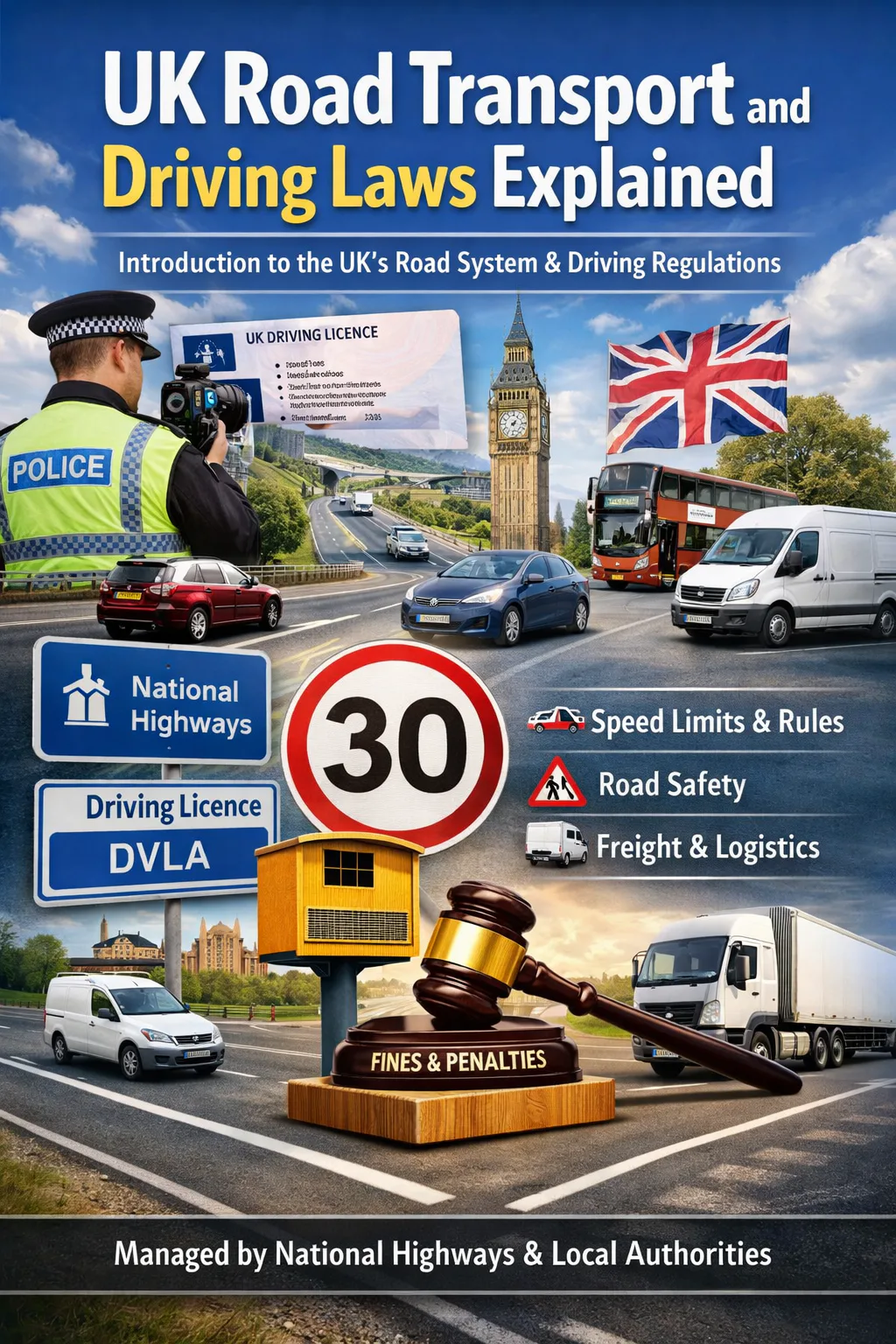
Roads are the backbone of the UK’s transport system, carrying the vast majority of passenger and freight journeys across the country. The UK road network consists of motorways, major A-roads, minor roads and local streets, maintained by a combination of national agencies and local authorities. Road transport is governed by a comprehensive framework of driving laws, vehicle regulations, traffic rules and enforcement mechanisms that aim to keep road users safe while enabling the movement of people and goods.
This guide explains how the UK road network is organised, who is responsible for managing roads, how driving is regulated, what the key traffic laws are, how enforcement works and why road transport policy matters.
How is the UK road network organised?
The UK has approximately 262,000 miles of paved roads, making it one of the densest road networks in the world relative to the country’s size. The network is divided into several categories. Motorways (designated with an “M” prefix, such as the M1, M25 and M6) are high-speed, multi-lane roads designed for long-distance travel. They account for a small fraction of total road length but carry a disproportionate share of traffic, particularly freight. A-roads are major routes connecting cities and towns — some are dual carriageways with motorway-like characteristics, while others pass through urban areas. B-roads and minor unclassified roads make up the majority of the network and serve local traffic.
The strategic road network in England — comprising motorways and the most important A-roads — is managed by National Highways (formerly Highways England), a government-owned company. This network carries around a third of all traffic in England and two thirds of freight. In Scotland, Transport Scotland manages the trunk road network. In Wales, the Welsh Government manages trunk roads through its Transport division. In Northern Ireland, the Department for Infrastructure manages the strategic road network.
Local roads — the vast majority of the network — are maintained by local councils, which are responsible for resurfacing, pothole repair, street lighting, traffic signals, road markings and winter maintenance. The condition of local roads has been a major public concern, with significant backlogs of maintenance caused by funding pressures on local authorities. The state of local roads, particularly the prevalence of potholes, is consistently identified as one of the top transport concerns in public surveys.
How is driving regulated in the UK?
Driving in the UK is regulated through a licensing system administered by the Driver and Vehicle Licensing Agency (DVLA), based in Swansea. To drive on UK roads, a person must hold a valid driving licence, have passed both a theory test and a practical driving test, and meet minimum age requirements (17 for cars and motorcycles, 18 for medium-sized vehicles and 21 for large goods vehicles and buses, subject to certain exceptions).
The UK driving licence is a photocard licence that must be renewed every 10 years for the photo to be updated. It uses a penalty points system — drivers who commit traffic offences receive endorsements on their licence, and accumulating 12 or more points within three years normally results in disqualification. New drivers who accumulate six points within the first two years of holding a full licence have their licence revoked and must retake their tests.
All vehicles used on UK roads must be registered with the DVLA, display valid vehicle tax (Vehicle Excise Duty), be covered by motor insurance and, if over three years old, hold a valid MOT certificate confirming that the vehicle meets minimum safety and environmental standards. The MOT test is carried out annually by approved testing stations and covers areas including brakes, lights, steering, suspension, tyres, exhaust emissions and structural integrity.
What are the main traffic laws and speed limits?
The Road Traffic Act 1988 and the Highway Code set out the rules for road users in the UK. The Highway Code is not itself law, but many of its provisions reflect legal requirements, and failure to follow the Code can be used as evidence in court proceedings. The Code covers rules for drivers, motorcyclists, cyclists, pedestrians and horse riders, and is updated periodically — the most recent significant revision in 2022 introduced a hierarchy of road users, giving greater priority to pedestrians and cyclists.
National speed limits in the UK are 30 mph in built-up areas (indicated by the presence of street lighting), 60 mph on single carriageway roads and 70 mph on dual carriageways and motorways. Local authorities can set different speed limits where appropriate — 20 mph zones are now widespread in residential areas and near schools, particularly in Wales, which introduced a default 20 mph speed limit on restricted roads in 2023. Speed enforcement is carried out through fixed cameras, mobile cameras, average speed cameras and police patrols.
Drink-driving is a serious offence in the UK. The legal blood alcohol limit is 80 milligrams per 100 millilitres of blood in England, Wales and Northern Ireland, and 50 milligrams in Scotland. Drug-driving is also prohibited, with specified limits for both illegal drugs and certain prescription medications. Penalties for drink-driving and drug-driving include driving bans, unlimited fines and imprisonment of up to six months for a first offence, with more severe penalties for repeat offenders and those involved in causing death or serious injury.
Using a handheld mobile phone while driving is illegal and carries a fixed penalty of six points and a £200 fine, or higher penalties if the case goes to court. Seatbelt use is compulsory for drivers and all passengers, and children must use appropriate child seats until they are 12 years old or 135 cm tall.
How does road safety policy work?
Road safety has improved dramatically in the UK over the past 50 years. The number of road deaths has fallen from over 7,000 per year in the early 1970s to around 1,600-1,700 in recent years, despite a significant increase in traffic volumes. The UK consistently has one of the lowest road death rates in the world, though the rate of improvement has slowed in recent years.
Road safety policy is overseen by the Department for Transport and delivered through a combination of engineering measures (such as road design, barriers, speed cameras and junction improvements), education and awareness campaigns (including the THINK! road safety campaign), enforcement by police forces and local authorities, and vehicle safety standards set through international regulations. The introduction of technologies such as automatic emergency braking, lane departure warnings and intelligent speed assistance in new vehicles is expected to contribute to further reductions in casualties.
Vulnerable road users — pedestrians, cyclists and motorcyclists — account for a disproportionate share of road casualties. Policy measures to protect these groups include the introduction of 20 mph zones in residential areas, the expansion of cycling infrastructure, the revision of the Highway Code to establish a hierarchy of responsibility based on the potential to cause harm, and investment in safer junction design. The government’s road safety statement commits to continued efforts to reduce the number of people killed and seriously injured on UK roads.
How is commercial and freight road transport regulated?
Commercial road transport — including heavy goods vehicles (HGVs), vans, coaches and buses — is subject to additional regulation beyond that applying to private motorists. HGV operators must hold an operator’s licence issued by the Traffic Commissioners, independent regulators who oversee the licensing and compliance of goods vehicle and bus operators across Great Britain. The licensing system is designed to ensure that operators maintain their vehicles to proper safety standards, comply with drivers’ hours regulations and operate within the law.
Drivers’ hours are regulated to prevent fatigue-related accidents. Under the retained EU rules that continue to apply in the UK, HGV drivers must take regular breaks and rest periods, and their driving and rest time is recorded by a digital tachograph fitted to the vehicle. The Driver and Vehicle Standards Agency (DVSA) enforces these rules through roadside checks, depot inspections and analysis of tachograph data.
Road freight accounts for approximately 89 per cent of all goods moved in the UK by weight, making it by far the dominant freight mode. The sector has faced challenges including a shortage of qualified HGV drivers, the impact of Brexit on cross-border operations, rising fuel costs and increasing pressure to reduce carbon emissions. The transition to zero-emission freight vehicles — including electric and hydrogen-powered HGVs — is a major challenge given the weight, range and duty cycle requirements of commercial vehicles.
How is the transition to electric vehicles affecting road transport?
The UK government has set a target of ending the sale of new petrol and diesel cars by 2035 (revised from an earlier target of 2030), as part of its strategy to reach net zero emissions by 2050. Sales of battery electric vehicles (BEVs) have grown rapidly, reaching over 16 per cent of new car sales in 2023, and the UK now has one of the largest electric vehicle markets in Europe.
The rollout of charging infrastructure is critical to supporting the transition. The government has committed to ensuring that there are at least 300,000 public charge points available by 2030, supported by regulations requiring new homes and commercial buildings to include charging facilities, and by funding for rapid charging hubs along the strategic road network. However, the current distribution of charging points is uneven, with significantly more availability in London and the South East than in rural areas and parts of the North.
The transition to electric vehicles also has implications for public finances, as fuel duty — currently one of the largest sources of government revenue from motoring — will decline as vehicles switch to electric power. The government has not yet set out how it intends to replace this revenue, though road pricing — charging drivers based on distance travelled or road usage — is widely seen as a likely long-term replacement.
How does road safety regulation work?
Road safety is a major public policy concern in the United Kingdom. Despite significant progress over recent decades — road deaths have fallen from over 5,000 per year in the 1980s to approximately 1,600-1,700 in recent years — the UK government, devolved administrations and road safety organisations continue to work towards further reductions. The Department for Transport sets road safety policy in England, while the devolved governments are responsible in Scotland, Wales and Northern Ireland.
Key road safety measures include speed limits (20mph in residential areas is increasingly common, with Wales implementing a default 20mph limit on restricted roads in 2023), drink-driving laws (the legal limit in England, Wales and Northern Ireland is 80mg of alcohol per 100ml of blood, while Scotland has adopted the lower European standard of 50mg), seatbelt requirements, the MOT test for vehicle roadworthiness, graduated licensing proposals and the use of technology such as average speed cameras, automated number plate recognition (ANPR) and vehicle safety systems.
The Driver and Vehicle Standards Agency (DVSA) oversees driving tests, MOT standards and commercial vehicle compliance. The driving test itself — consisting of a theory test and a practical test — is the gateway to obtaining a full driving licence. Proposals for a graduated licensing system, which would impose restrictions on newly qualified drivers (such as limits on night driving, passenger numbers or engine power), have been discussed but not yet implemented in the UK, despite evidence from other countries that such systems reduce young driver casualties.
How is road freight and logistics regulated?
Road freight is the dominant mode of goods transport in the UK, carrying approximately 75 per cent of all freight by tonnage. The haulage industry is regulated by the Traffic Commissioners, who issue operator licences to businesses running heavy goods vehicles (HGVs) and public service vehicles. Operators must demonstrate that they are of good repute, financially sound and professionally competent, and their vehicles must meet safety and environmental standards.
The UK experienced a severe shortage of HGV drivers in 2021-22, caused by a combination of Brexit (which ended the free movement of EU drivers), the COVID-19 pandemic (which disrupted driver testing), an ageing workforce and poor working conditions in the industry. The shortage led to visible supply chain disruptions, including fuel delivery problems and empty supermarket shelves, and prompted government action including streamlined testing, temporary visa schemes and efforts to improve pay and conditions in the sector. The logistics industry employs approximately 2.7 million people in the UK and is essential to the functioning of the economy.
How is cycling and active travel being promoted?
Active travel — walking and cycling for everyday journeys — has become an increasingly important element of transport policy, driven by its benefits for health, air quality, carbon reduction and urban congestion. The government established Active Travel England in 2022 as an executive agency responsible for promoting walking and cycling, funding active travel infrastructure and reviewing local authority schemes.
Investment in cycling infrastructure has grown significantly, with cities including London, Manchester, Birmingham and Bristol developing networks of protected cycle lanes, low-traffic neighbourhoods (LTNs), bike-sharing schemes and cycle parking. The introduction of LTNs — which use planters, bollards or cameras to prevent through motor traffic in residential areas — has been popular among some residents but controversial among others, leading to heated local debates about the balance between promoting active travel and maintaining access for drivers. The government has published design guidance through Local Transport Note 1/20, which sets quality standards for cycling infrastructure.
Why does road transport matter?
Roads carry the vast majority of journeys in the UK — for commuting, business travel, personal trips, deliveries and freight distribution. The condition, capacity and safety of the road network directly affect economic productivity, access to services, quality of life and the environment. Road transport policy — including decisions about investment in roads, the regulation of vehicles and drivers, the transition to zero-emission vehicles and the balance between road and public transport — is one of the most important and contested areas of UK government policy.
Related guides
These guides explain related topics in more detail:
- How the UK Public Transport System Works
- UK Rail System Explained
- UK Transport Policy and Funding Explained
- UK Climate Change Policy Explained
- How the UK Economy Works
Related coverage:
Read our latest UK transport news
Prepared by: