UK Rail System Explained
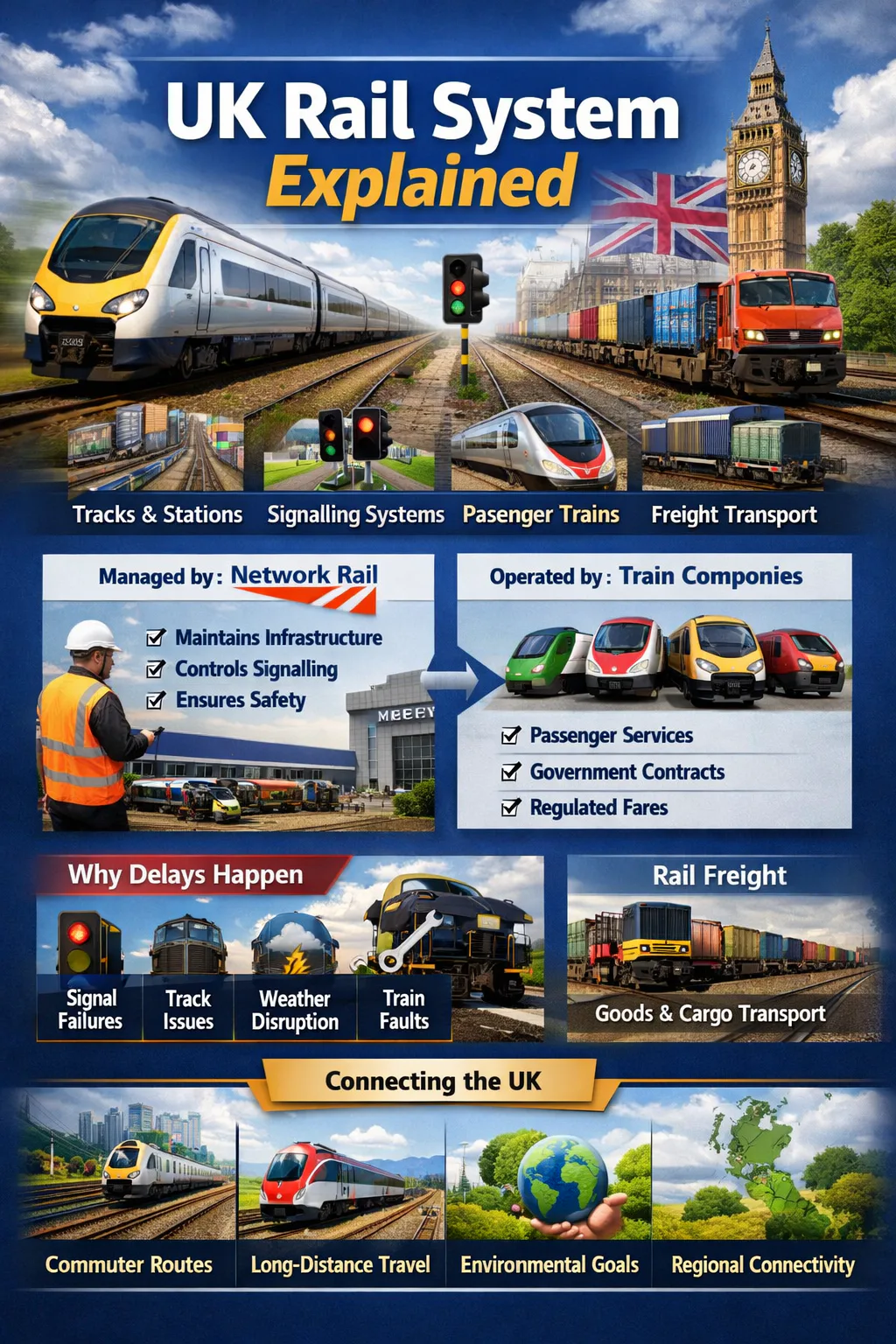
The railway is one of the United Kingdom’s most important transport networks, carrying hundreds of millions of passenger journeys each year and moving significant volumes of freight across the country. The UK rail system has a complex structure that has evolved through decades of public ownership, privatisation and, most recently, plans to return services to public control. Understanding how the railways work — who runs them, how they are funded and why performance varies — is essential to making sense of one of the most debated areas of UK transport policy.
This guide explains how the UK rail system is structured, who manages the infrastructure and operates services, how fares and ticketing work, why disruption occurs and what reforms are planned.
What is the UK rail system?
The UK rail network consists of approximately 20,000 kilometres of track, over 2,500 stations and more than 30 train operating companies providing passenger and freight services. The network connects major cities, towns, commuter areas and some rural communities across England, Scotland and Wales. Northern Ireland has a separate, smaller rail network operated by NI Railways, part of the publicly owned Translink group.
The rail system handles around 1.7 billion passenger journeys per year, though this figure dropped sharply during the COVID-19 pandemic and has not fully recovered to pre-pandemic levels. Commuter services into London account for a significant proportion of total journeys, but intercity services linking cities such as London, Birmingham, Manchester, Leeds, Edinburgh, Glasgow, Bristol and Cardiff are also heavily used. Rail is generally the fastest mode of public transport for medium and long-distance journeys within the UK.
Who manages UK rail infrastructure?
The physical rail infrastructure — including track, signalling, bridges, tunnels, managed stations and electrical supply systems — is managed by Network Rail, a public body that was reclassified as an arm’s-length body of the Department for Transport in 2014. Network Rail is responsible for maintaining and renewing the existing infrastructure, operating the signalling system, managing the timetable and allocating capacity on the network to train operators.
Network Rail is funded through a combination of government grants, track access charges paid by train operators and commercial income from its property and retail estate. Its spending is regulated by the Office of Rail and Road (ORR), which sets five-year funding settlements known as Control Periods and monitors Network Rail’s performance, efficiency and safety record. The current Control Period (CP7) runs from 2024 to 2029.
In Scotland, Network Rail’s operations are overseen by the Scottish Government through Transport Scotland, reflecting the devolution of rail policy. The Scottish Government has greater direct control over rail spending priorities north of the border, including decisions about infrastructure investment, service levels and fare regulation.
Who operates passenger train services?
Since the privatisation of British Rail in the 1990s, passenger train services have been operated by private companies under contracts with the government. The franchise system, under which operators competed for the right to run services on specific parts of the network for a set period, was the dominant model for over 25 years. Major franchise operators included companies such as Avanti West Coast, CrossCountry, Greater Anglia, Southeastern, TransPennine Express and Great Western Railway.
The franchise system came under severe strain during the COVID-19 pandemic, when passenger numbers collapsed and fare revenue fell dramatically. The government replaced franchises with Emergency Recovery Measures Agreements (ERMAs) and later National Rail Contracts (NRCs), under which operators run services for a management fee rather than bearing commercial risk. Several operators have already been brought into public ownership — including LNER (the East Coast Main Line service), Northern Trains and ScotRail — and the government has announced plans to bring all remaining operators into public ownership as contracts expire, through the creation of Great British Railways (GBR).
GBR is intended to be a new public body that will integrate the functions of Network Rail and the train operating companies, acting as a “guiding mind” for the railway. It will be responsible for setting timetables, managing infrastructure, overseeing operators, setting fares policy and coordinating investment. Legislation to establish GBR is expected to be one of the most significant transport reforms in decades.
How do rail fares and ticketing work?
Rail fares in the UK are among the most complex and, for many passengers, the most expensive in Europe. There are three main categories of fare: regulated fares, which are set by government and increase annually by a formula linked to inflation, and include most season tickets and some off-peak fares; unregulated fares, which are set by operators and can vary widely based on demand, time of travel and how far in advance tickets are purchased; and advance fares, which offer cheaper prices for booking ahead but are tied to specific trains and are non-refundable.
The ticketing system has been widely criticised for its complexity, with passengers frequently struggling to identify the cheapest fare for their journey and sometimes being penalised for minor errors. The government has committed to simplifying fares and ticketing as part of the GBR reforms, including the wider rollout of pay-as-you-go contactless payment and digital ticketing. A barcode-based system for flexible tickets has been introduced on some routes, and the long-term ambition is for a single, national ticketing platform.
The Railcard system offers discounted fares for specific groups, including 16-25 year olds, people over 60, disabled people, families and groups. The Great British Rail Sale and other promotional fare initiatives have been introduced to encourage off-peak travel and attract passengers back to the railway following the pandemic.
Why do delays and cancellations occur?
Rail disruption is one of the most common sources of passenger dissatisfaction with the UK rail system. Delays and cancellations can be caused by a wide range of factors, including infrastructure failures (such as signal faults, track defects, overhead line damage and points failures), rolling stock problems (mechanical breakdowns and shortages of trains), weather events (flooding, heat-related speed restrictions, fallen trees and ice), trespass and fatalities on the railway, industrial action by rail workers, and crew shortages.
Performance is measured through metrics such as the On Time percentage (the proportion of trains arriving within one minute of their scheduled time at each calling point) and the cancellations score. Performance varies significantly between operators and routes — some services consistently achieve over 90 per cent punctuality, while others struggle with chronic reliability problems. The ORR publishes detailed performance data by operator and route, allowing passengers and policymakers to track trends and hold operators and Network Rail to account.
Industrial disputes have been a significant cause of disruption in recent years. The rail unions — principally the RMT (National Union of Rail, Maritime and Transport Workers) and ASLEF (Associated Society of Locomotive Engineers and Firemen) — have engaged in extended periods of strike action over pay, conditions and the impact of modernisation on jobs. These disputes have affected services across the network and have intensified the political debate about the future structure of the railways.
What major rail investment is planned?
The UK has a significant pipeline of rail investment projects, though several major schemes have been scaled back or cancelled in recent years. High Speed 2 (HS2), originally planned as a high-speed line from London to Birmingham, Manchester and Leeds, has been reduced in scope — the Birmingham to Manchester leg was cancelled in 2023, and the project now extends only from London Euston to Birmingham Curzon Street. Despite the reduced scope, HS2 remains one of the largest infrastructure projects in Europe.
Other significant investment programmes include the Transpennine Route Upgrade, which will improve rail capacity and journey times between Manchester and York, the East West Rail project connecting Oxford, Milton Keynes and Cambridge, electrification of key routes including parts of the Midland Main Line and Trans-Pennine corridor, and ongoing programmes to modernise signalling through the European Train Control System (ETCS) digital signalling technology.
The funding of rail investment is a constant source of political debate. Decisions about which routes to invest in, whether to prioritise new capacity or improve existing services, and how to balance spending between London and the regions are among the most politically sensitive questions in UK transport policy.
How does rail freight work in the UK?
While passenger services attract most public attention, the railway also plays an important role in moving freight across the UK. Rail freight operators — the largest being DB Cargo UK, Freightliner and GB Railfreight — transport bulk commodities such as construction materials, coal, petroleum, metals and aggregates, as well as intermodal containers carrying consumer goods, automotive parts and other products. Rail freight removes approximately 7.6 billion lorry kilometres from UK roads each year, reducing congestion, road wear and carbon emissions.
Rail freight has grown significantly in volume over recent decades, particularly in the intermodal sector, where goods are transported in standard shipping containers that can be transferred between ships, trains and lorries. The development of strategic rail freight interchanges — large logistics hubs located on the rail network near major distribution centres — has supported this growth by providing efficient connections between rail and road transport.
However, rail freight faces challenges including competition for capacity with passenger services on congested parts of the network, the need for investment in freight-specific infrastructure such as gauge clearance for larger containers, and the commercial viability of shorter-distance rail freight movements. The government has expressed support for growing rail freight as part of its decarbonisation strategy, and Network Rail includes freight considerations in its infrastructure planning.
How is rail safety regulated?
The UK has one of the safest railways in Europe, a record that is maintained through rigorous safety regulation, investment in safety systems and a strong safety culture across the industry. The Office of Rail and Road (ORR) is the independent safety regulator for the railway, responsible for setting and enforcing health and safety standards, investigating safety incidents and ensuring that Network Rail, operators and contractors comply with their safety duties.
The Rail Accident Investigation Branch (RAIB) investigates serious rail accidents and incidents in the UK, publishing independent reports with safety recommendations aimed at preventing recurrence. RAIB operates independently of the railway industry and the ORR, ensuring that its investigations are impartial. Major safety improvements since the privatisation era include the nationwide rollout of the Train Protection and Warning System (TPWS), which automatically applies the brakes if a train passes a signal at danger, and ongoing investment in level crossing safety.
Despite the strong overall safety record, challenges remain. Trespass on the railway — including people walking on tracks, at level crossings and in tunnels — is a persistent risk and a leading cause of fatalities. Mental health-related incidents on the railway are a significant concern for the industry and for public health. Network Rail, operators and charities such as the Samaritans work together on prevention programmes, staff training and infrastructure measures such as platform barriers and CCTV.
How does the UK rail system compare internationally?
Compared to other European countries, the UK rail system has both strengths and weaknesses. The network is among the most heavily used in Europe in terms of passenger kilometres, and the safety record is consistently among the best. However, UK rail fares are significantly higher than in most European countries — a factor that is a regular source of public and political criticism.
Countries such as France, Germany, Spain and Italy have invested heavily in high-speed rail networks, with extensive lines operating at speeds of 300 km/h or more. The UK’s high-speed network is limited to HS1, the 108-kilometre line connecting London St Pancras to the Channel Tunnel, and the under-construction HS2 between London and Birmingham. The cancellation of the northern sections of HS2 has been seen as a setback for the UK’s ambitions to match European standards of intercity rail connectivity.
The move towards public ownership of the railways under Great British Railways aligns the UK more closely with the models used in many European countries, where state-owned operators run the majority of passenger services. However, the detailed design of the GBR model — including the role of the private sector, the extent of competition on the network and the governance arrangements for the new body — will determine whether the reform delivers the improvements in performance, efficiency and passenger experience that its supporters expect.
Why does the rail system matter?
The railway is essential to the UK’s economy, connecting labour markets, enabling business travel, supporting tourism and moving freight. It is also a critical part of the country’s strategy for reducing carbon emissions, as rail travel produces significantly lower emissions per passenger kilometre than car or air travel. The performance, affordability and accessibility of the rail network directly affect the daily lives of millions of commuters, business travellers and leisure passengers across the country.
Related guides
These guides explain related topics in more detail:
- How the UK Public Transport System Works
- UK Road Transport and Driving Laws Explained
- UK Transport Policy and Funding Explained
- UK Climate Change Policy Explained
- UK Public Finances and Government Spending Explained
Related coverage:
Read our latest UK transport news
Prepared by: