
UK Public Finances and Government Spending Explained
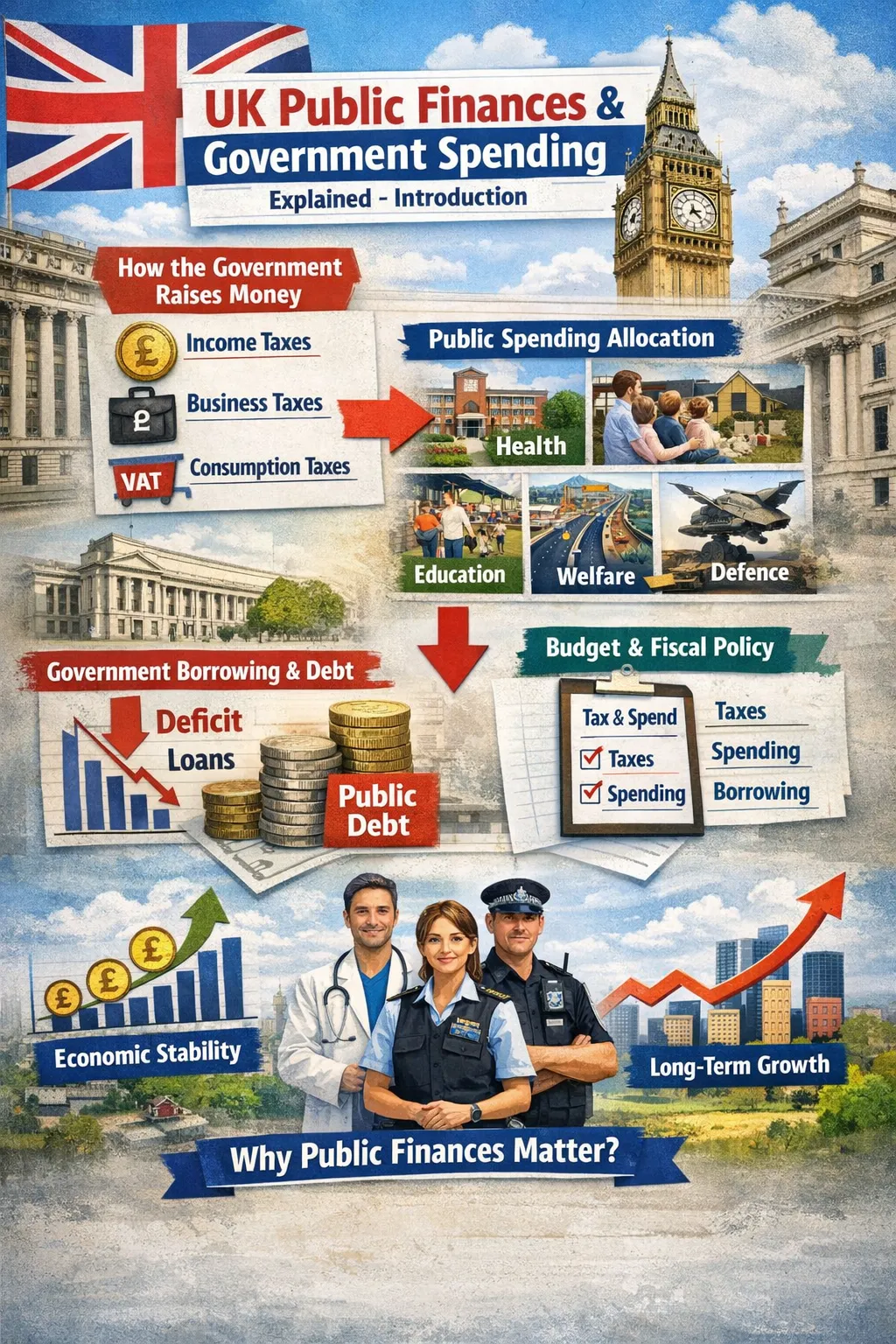
Public finances are at the heart of how the United Kingdom is governed. The government raises revenue through taxation and other sources, and spends that money on public services, welfare, infrastructure and debt interest. The balance between how much the government raises and how much it spends determines whether the public finances are in surplus or deficit, and shapes the level of national debt that is passed on to future generations.
This guide explains how UK public finances work, how the government raises money, how spending decisions are made, what fiscal rules are in place and why public finances matter for everyone in the United Kingdom. It covers the roles of HM Treasury, the Office for Budget Responsibility, HMRC and the National Audit Office in managing and scrutinising the nation’s finances.
What are public finances?
Public finances refer to the management of government revenue, expenditure and debt. In the UK, public finances are managed primarily by HM Treasury, the government department responsible for fiscal policy and economic strategy. The Chancellor of the Exchequer, who heads the Treasury, is the minister responsible for the government’s financial plans and presents the annual Budget to Parliament.
The key measures of public finances include total government revenue (how much the government collects), total managed expenditure (how much it spends), the budget deficit or surplus (the difference between revenue and expenditure in any given year), and public sector net debt (the total accumulated debt owed by the government). These figures are published regularly by the Office for National Statistics (ONS) and the Office for Budget Responsibility (OBR).
How does the government raise money?
The UK government raises the majority of its revenue through taxation. The main taxes include income tax, which is the single largest source of revenue and is levied on earnings from employment, self-employment and pensions; National Insurance contributions (NICs), which are paid by employees, employers and the self-employed and fund certain state benefits including the State Pension and the NHS; value added tax (VAT), a consumption tax charged at 20 per cent on most goods and services; corporation tax, levied on the profits of UK companies; and fuel duty, alcohol duty, tobacco duty and other excise taxes.
Other significant sources of government revenue include council tax, which is collected by local authorities to fund local services, business rates, stamp duty on property transactions and share transactions, capital gains tax on profits from the sale of assets, and inheritance tax on estates above the nil-rate threshold. The government also receives income from North Sea oil and gas production, the Bank of England’s Asset Purchase Facility, and various fees and charges.
HM Revenue and Customs (HMRC) is the non-ministerial department responsible for collecting most UK taxes. HMRC processes millions of tax returns, administers the PAYE (Pay As You Earn) system for collecting income tax and NICs from employees, and is responsible for investigating and prosecuting tax evasion and fraud. Total government revenue in recent years has been approximately £1 trillion per year, equivalent to around 37-40 per cent of GDP.
How is public spending allocated?
Government spending is divided into two main categories: departmental expenditure limits (DEL), which cover the day-to-day and capital spending of government departments and are set through multi-year Spending Reviews, and annually managed expenditure (AME), which covers demand-led spending that cannot easily be fixed in advance, such as welfare benefits, state pensions and debt interest payments.
The largest areas of public spending include health, which accounts for the biggest share of departmental spending through the National Health Service, education and training, defence, public order and safety, welfare and social protection (including the State Pension, Universal Credit, housing benefit and disability benefits), and debt interest. Local government, transport and housing also represent significant areas of expenditure.
Spending Reviews are conducted by HM Treasury every two to five years and set multi-year budgets for each government department. During a Spending Review, departments bid for funding, negotiate with the Treasury and are allocated budgets for both resource (day-to-day) and capital (investment) spending. The process involves intense negotiation and reflects the government’s political priorities — departments aligned with the government’s key agenda items tend to fare better than those seen as lower priority.
What is the Budget and how does it work?
The Budget is the government’s annual fiscal event, presented to Parliament by the Chancellor of the Exchequer. It sets out the government’s tax and spending plans, announces changes to tax rates and allowances, and provides an updated assessment of the economic and fiscal outlook. The Budget is accompanied by independent forecasts from the Office for Budget Responsibility (OBR), which assesses whether the government is on track to meet its fiscal rules.
The OBR was established in 2010 to provide independent and authoritative analysis of the UK’s public finances. It produces economic and fiscal forecasts at each Budget and fiscal event, assesses the cost of new policy measures and publishes long-term projections of the sustainability of the public finances. The creation of the OBR was intended to end the practice of governments making over-optimistic economic forecasts to justify their spending and borrowing plans.
Budget announcements can have significant and immediate effects on households and businesses — changes to income tax thresholds, fuel duty, alcohol duty, business rates and welfare payments directly affect millions of people. The Budget is closely watched by financial markets, and unexpected announcements can affect the value of the pound, government borrowing costs and share prices. The “mini-Budget” of September 2022, which announced large unfunded tax cuts, triggered a sharp fall in the pound and a spike in government bond yields, demonstrating the market sensitivity of fiscal announcements.
What are fiscal rules?
Fiscal rules are self-imposed targets that the government sets to guide its management of the public finances. They are intended to provide a framework for responsible fiscal management and to give financial markets and the public confidence that the government is managing borrowing and debt sustainably. In practice, fiscal rules have been changed frequently by successive Chancellors — the Institute for Fiscal Studies has documented more than a dozen different fiscal rules since 1997.
Common types of fiscal rules include targets for reducing the budget deficit (the gap between annual revenue and spending), targets for reducing public sector net debt as a proportion of GDP, and rules requiring that day-to-day spending is covered by revenue rather than borrowing (known as the “current budget” rule). Capital spending — investment in infrastructure, buildings and equipment — is often excluded from current budget rules on the basis that it generates long-term economic returns.
The OBR assesses whether the government is on track to meet its fiscal rules at each Budget. If the forecast shows that the rules are likely to be breached, the Chancellor may need to announce tax increases or spending cuts to restore compliance, or may choose to revise the rules themselves — a politically risky move that can undermine credibility with financial markets.
What is the national debt?
The national debt — formally known as public sector net debt — is the total amount of money owed by the UK government. It represents the accumulated borrowing of successive governments over many decades. As of 2025, UK public sector net debt stands at approximately 100 per cent of GDP, equivalent to around £2.7 trillion — the highest level relative to national income since the early 1960s.
The government borrows by issuing gilts — UK government bonds — which are bought by institutional investors, pension funds, banks, foreign governments and, through the Bank of England’s quantitative easing programme, by the central bank itself. The cost of servicing the national debt — the interest payments the government must make on its outstanding borrowing — has risen sharply since interest rates began increasing from their historic lows in late 2021. Debt interest now costs the government over £80 billion per year, making it one of the largest single items of public expenditure.
The sustainability of the national debt is a central concern of fiscal policy. A growing debt burden can crowd out spending on public services, make the government vulnerable to rises in interest rates and reduce the fiscal space available to respond to future crises. However, economists disagree about the appropriate level of debt, with some arguing that higher borrowing is justified when it funds productive investment that raises long-term economic growth.
How is public spending scrutinised?
Public spending is subject to multiple layers of scrutiny and accountability. The National Audit Office (NAO), headed by the Comptroller and Auditor General, audits the accounts of all government departments and many public bodies, and produces value-for-money reports examining whether public money has been spent efficiently and effectively. The NAO is independent of government and reports to Parliament.
The House of Commons Public Accounts Committee (PAC), one of the most powerful select committees in Parliament, examines NAO reports and calls senior officials — including departmental Permanent Secretaries in their role as accounting officers — to give evidence on how public money has been spent. PAC reports frequently attract media attention and have led to significant changes in government policy and practice.
The Treasury Committee, another influential select committee, scrutinises the work of HM Treasury, the Bank of England and the financial regulators. It examines Budget measures, monetary policy decisions and the performance of the OBR. The devolved parliaments in Scotland, Wales and Northern Ireland have their own arrangements for scrutinising public spending within their areas of responsibility.
How are local government finances managed?
Local authorities in England, Scotland, Wales and Northern Ireland manage their own budgets, funded through a combination of central government grants, council tax revenue, locally retained business rates and fees for services. The balance between central and local funding has shifted significantly over the past 15 years, with central government grants falling in real terms while councils have become increasingly reliant on council tax and business rates to fund essential services.
Council tax is a property-based tax levied on domestic properties, with rates varying by local authority and property band. The banding system is based on property valuations from 1991 in England and Scotland and from 2003 in Wales, which means that the relationship between property values and council tax bills has become increasingly distorted over time. Revaluation of council tax bands is politically sensitive and has been repeatedly deferred by successive governments.
Local authorities are legally required to set balanced budgets each year — unlike central government, they cannot borrow to fund day-to-day spending. Financial pressures on local government have intensified significantly since 2010, with rising demand for adult social care, children’s services and homelessness support coinciding with reductions in central government funding. Several councils have issued Section 114 notices — formal declarations that they are unable to balance their budgets — a situation that was almost unheard of before 2020 but has become increasingly common.
How do devolved finances work?
The devolved governments in Scotland, Wales and Northern Ireland receive the majority of their funding through block grants from the UK government, calculated using the Barnett formula. The formula adjusts the devolved block grants based on changes to comparable spending in England — if the UK government increases NHS spending in England, for example, the Scottish, Welsh and Northern Irish blocks receive a proportionate increase based on their population share.
The Barnett formula has been the subject of longstanding debate. Critics argue that it produces arbitrary outcomes that do not reflect the actual spending needs of the devolved nations, and that it should be replaced with a needs-based funding formula. Defenders argue that it provides a simple and transparent mechanism for allocating funding and that its effects have converged over time.
Scotland has the most extensive devolved fiscal powers, including the ability to set Scottish income tax rates and bands through the Scottish Rate Resolution, which is voted on annually by the Scottish Parliament. The Scottish Government has used these powers to set different income tax rates from the rest of the UK, with higher rates for higher earners. Scotland also has limited borrowing powers through the Scottish National Investment Bank and can vary certain other taxes. Wales has more limited but growing fiscal powers, including partial devolution of income tax and the ability to set its own rates of land transaction tax. Northern Ireland has theoretical power to vary corporation tax but has not yet implemented this.
Why do public finances matter?
Public finances affect every person in the United Kingdom. The taxes people pay, the public services they receive, the benefits they are entitled to, the infrastructure they use and the economic environment in which they live and work are all shaped by decisions about government revenue and spending. Fiscal policy — the balance between taxation, spending and borrowing — is one of the most important tools the government has for managing the economy and responding to crises.
Understanding how public finances work helps explain the trade-offs at the heart of political debate — why tax cuts may require spending reductions, why increased borrowing carries long-term costs, and why decisions about the allocation of limited resources between competing priorities are among the most contentious in politics. The state of the public finances shapes the fiscal constraints within which every government must operate and determines the range of policy options available to address the challenges facing the country. With an ageing population increasing demand for health and pension spending, rising debt interest costs, the need for investment in infrastructure and the green transition, and ongoing pressures on defence spending, the management of public finances will remain one of the defining challenges of UK economic policy for decades to come.
Related guides
These guides explain related topics in more detail:
- How the UK Economy Works
- UK Inflation and Cost of Living Explained
- UK Interest Rates and Monetary Policy Explained
- How the UK Government Works
- UK Government Departments and Public Bodies Explained
Related coverage:
Read our latest UK business and economy news
Prepared by:
