UK Interest Rates and Monetary Policy Explained
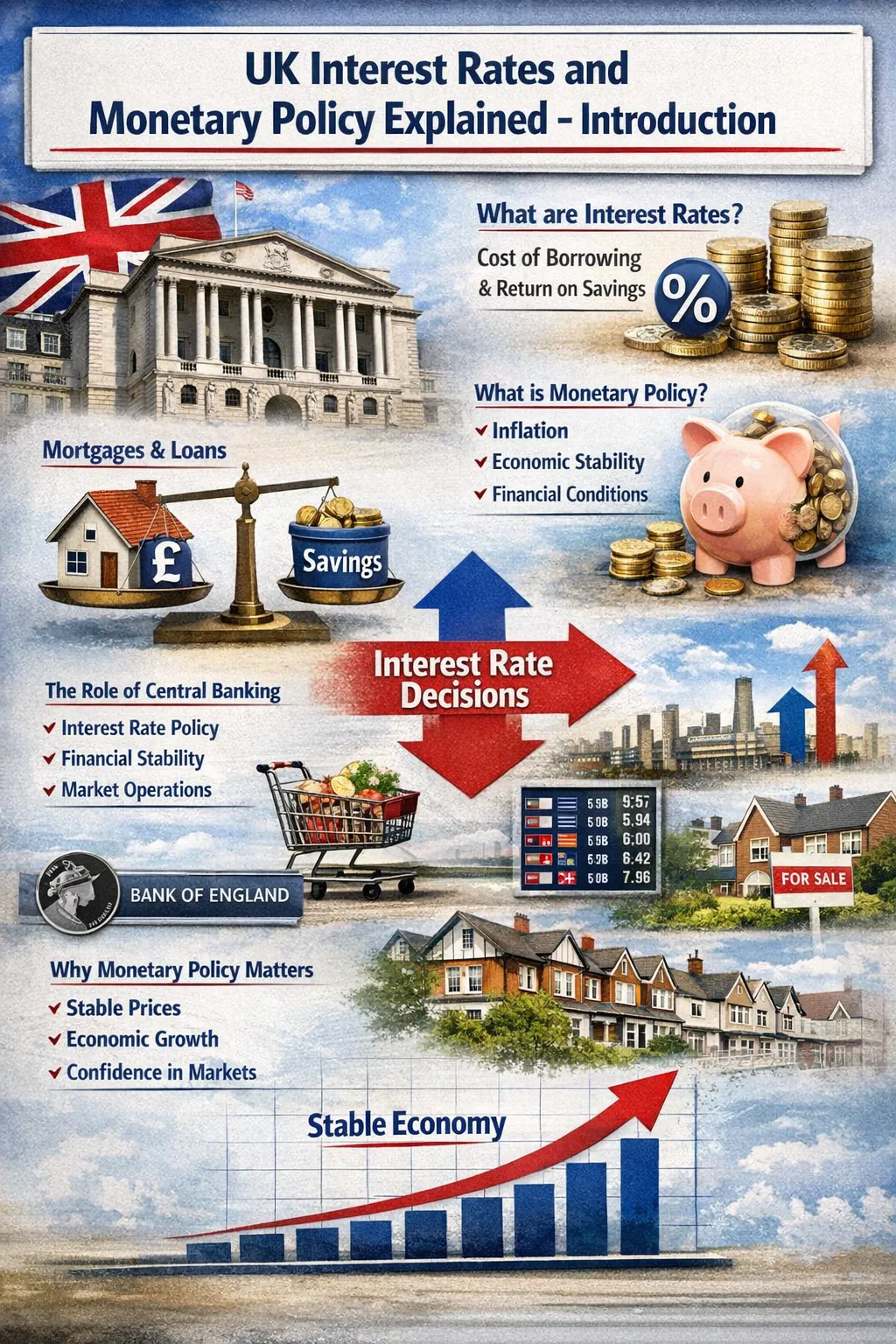
Interest rates are one of the most powerful tools in economic policy, influencing the cost of borrowing, the return on savings, the level of spending and investment in the economy, and ultimately the rate of inflation. In the United Kingdom, the base interest rate is set by the Bank of England’s Monetary Policy Committee (MPC), which operates independently of the government to achieve the inflation target of 2 per cent.
This guide explains what interest rates are, how monetary policy works in the UK, how decisions on interest rates are made, what tools the Bank of England uses beyond the base rate, and why changes in interest rates affect households, businesses and the wider economy.
What are interest rates?
An interest rate is the cost of borrowing money, expressed as a percentage of the amount borrowed. When a bank lends money to a household through a mortgage or to a business through a loan, it charges interest as the price for providing the funds. Conversely, when a household deposits money in a savings account, the bank pays interest in return for the use of those funds. Interest rates are fundamental to the functioning of the financial system, determining how much it costs to borrow and how much savers earn on their deposits.
The Bank of England’s base rate — officially called the Bank Rate — is the most important interest rate in the UK economy. It is the rate at which the Bank of England lends to commercial banks overnight, and it serves as the reference point for virtually all other interest rates in the economy. When the Bank Rate changes, the interest rates charged on mortgages, personal loans, credit cards, business loans and overdrafts tend to move in the same direction, as do the rates paid on savings accounts and deposit products.
What is monetary policy?
Monetary policy refers to the actions taken by a central bank to manage the supply of money and credit in the economy in order to achieve its objectives. In the UK, the primary objective of monetary policy is to maintain price stability — defined as keeping CPI inflation close to 2 per cent. Subject to achieving this objective, the Bank of England is also required to support the government’s economic policy objectives, including those for growth and employment.
The Bank of England was granted operational independence to set interest rates by the incoming Labour government in May 1997, one of the most significant institutional reforms of recent British economic history. Before independence, interest rate decisions were made by the Chancellor of the Exchequer, which meant that political considerations — such as the proximity of an election — could influence monetary policy. The decision to grant independence was based on the evidence that countries with independent central banks tend to achieve lower and more stable inflation, because markets and the public trust that interest rate decisions will be based on economic conditions rather than political pressures.
How does the Monetary Policy Committee work?
Interest rate decisions in the UK are made by the Monetary Policy Committee (MPC), a nine-member body that meets eight times a year (roughly every six weeks) to set the Bank Rate. The MPC is chaired by the Governor of the Bank of England and includes four other Bank of England officials (the Deputy Governors for Monetary Policy, Financial Stability, Markets and Banking, and the Chief Economist) and four external members appointed by the Chancellor of the Exchequer.
Before each meeting, MPC members receive a comprehensive briefing from Bank of England staff covering the latest economic data, inflation forecasts, financial market developments, surveys of business and consumer confidence, and analysis of global economic conditions. Members also conduct their own research and meet with businesses, trade unions and other organisations across the country to gather intelligence on economic conditions.
At each meeting, the MPC votes on the level of the Bank Rate. Each member has one vote and decisions are made by simple majority. Members frequently disagree — split votes are common, and the minutes of each meeting, published two weeks later, record how each member voted and the key arguments on each side. This transparency is designed to help markets, businesses and households understand the thinking behind monetary policy decisions and anticipate the likely direction of future policy.
Alongside four of its eight annual meetings, the MPC publishes the Monetary Policy Report, a detailed assessment of the economic outlook including the Bank’s forecasts for GDP growth, inflation and unemployment. The Governor holds a press conference after the publication of the report to explain the MPC’s assessment and take questions from journalists.
How do interest rate changes affect the economy?
Changes in the Bank Rate transmit through the economy via several channels, collectively known as the monetary policy transmission mechanism. When the Bank Rate rises, the cost of borrowing increases for households with variable-rate mortgages, tracker mortgages or those taking out new fixed-rate deals. Higher mortgage payments reduce the disposable income available for other spending. Similarly, businesses face higher borrowing costs for investment, expansion and working capital, which can lead to reduced investment and hiring.
Higher interest rates also make saving more attractive, as banks and building societies pass on at least some of the rate increase to their savers. This encourages households to save rather than spend, further reducing demand in the economy. Higher rates also tend to push up the exchange rate of sterling, as international investors are attracted by higher returns on UK assets. A stronger pound makes imports cheaper (helping to reduce inflation) but makes exports more expensive (potentially harming UK businesses that sell overseas).
The combined effect of these channels is to reduce overall demand in the economy, which in turn puts downward pressure on prices and wages — bringing inflation back towards the 2 per cent target. The reverse process operates when the Bank Rate is cut: lower borrowing costs encourage spending and investment, stimulating demand and economic activity. The time lag between an interest rate change and its full effect on the economy is typically estimated at 12 to 24 months, which means the MPC must make decisions based on forecasts of where the economy is heading rather than current conditions alone.
What is quantitative easing?
Quantitative easing (QE) is an unconventional monetary policy tool used by the Bank of England when conventional interest rate cuts alone are insufficient to stimulate the economy. QE involves the Bank creating new electronic money and using it to purchase financial assets — primarily UK government bonds (known as gilts) — from banks, pension funds and other financial institutions.
By purchasing gilts, the Bank pushes up their price and pushes down their yield (the effective interest rate), which reduces longer-term borrowing costs across the economy. The money received by the institutions that sell their gilts is then available to be lent to businesses and households or invested in other assets, supporting economic activity. QE was first used by the Bank of England in 2009, during the global financial crisis, when the Bank Rate had already been cut to 0.5 per cent and further conventional cuts were considered impractical. The Bank ultimately accumulated a portfolio of around £895 billion in government bonds and corporate bonds through successive rounds of QE during the financial crisis, the Brexit referendum period and the COVID-19 pandemic.
The Bank began the process of quantitative tightening (QT) in 2022, gradually reducing the size of its bond portfolio by allowing gilts to mature without reinvesting the proceeds and through active sales of gilts back to the market. QT is designed to normalise the Bank’s balance sheet and is conducted at a pace intended to avoid disrupting financial markets. The process of unwinding QE is expected to take many years.
How have UK interest rates changed over time?
UK interest rates have varied dramatically over the decades. In the late 1970s and early 1980s, the Bank Rate was above 10 per cent for extended periods, reaching a peak of 17 per cent in 1979 as the government and the Bank attempted to bring down double-digit inflation. Rates gradually fell through the 1990s and 2000s, reaching a then-record low of 0.5 per cent in March 2009 during the global financial crisis.
The Bank Rate was cut further to 0.25 per cent in August 2016 following the EU referendum and then to a historic low of 0.1 per cent in March 2020 in response to the COVID-19 pandemic. This ultra-low rate environment persisted for nearly two years, during which time households and businesses became accustomed to very cheap borrowing. The subsequent rapid increase in rates — from 0.1 per cent in December 2021 to 5.25 per cent by August 2023, the fastest tightening cycle in over 30 years — was a significant shock, particularly for mortgage holders who had taken on large debts at historically low rates.
By late 2024 and into 2025, with inflation falling back towards target, the MPC began gradually reducing the Bank Rate. However, rates were expected to settle at a higher level than the ultra-low rates of the 2010s, as the Bank and markets assessed that the “neutral” rate of interest — the rate consistent with stable inflation and full employment — had risen compared to the pre-pandemic period.
How do interest rates affect mortgages and housing?
The mortgage market is the channel through which interest rate changes have the most direct and visible impact on household finances. Approximately 28 per cent of UK households have a mortgage, and for many of them, mortgage payments are the single largest monthly expense. The UK mortgage market offers a range of products including fixed-rate mortgages (where the interest rate is locked in for a period, typically two or five years), variable-rate mortgages (where the rate can change at the lender’s discretion) and tracker mortgages (where the rate moves in line with the Bank Rate).
When the Bank Rate rises, households on tracker mortgages see an immediate increase in their monthly payments. Those on variable-rate mortgages typically see increases soon after. Households on fixed-rate mortgages are protected for the duration of their fixed period, but face a potentially significant increase when their deal expires and they need to remortgage at a higher rate. The sharp rise in rates from 2022 onwards meant that millions of households faced substantially higher mortgage costs when their fixed-rate deals ended, with average mortgage payments increasing by hundreds of pounds per month for many borrowers. These pressures feed directly into how the UK housing market works, shaping what buyers can afford to offer and how prices move.
How do interest rates affect savings and investment?
Interest rates have a direct impact on the returns that savers earn on their deposits and the cost of borrowing for businesses seeking to invest. When the Bank Rate rises, commercial banks typically increase the interest rates they offer on savings accounts, making saving more attractive. Conversely, when rates fall, the returns on savings decline, which can discourage saving and encourage spending or investment in higher-risk assets such as equities and property.
For businesses, higher interest rates increase the cost of borrowing to fund investment in new equipment, premises, research and development or expansion. This can lead firms to delay or scale back investment plans, which in turn affects economic growth, employment and productivity. Small and medium-sized enterprises (SMEs), which often rely on bank lending rather than capital markets, can be particularly sensitive to changes in interest rates. The British Business Bank, a government-backed institution, provides finance and support to SMEs to help mitigate some of these effects.
Interest rates also affect the value of the pound on foreign exchange markets. Higher UK interest rates tend to attract international investors seeking better returns, which increases demand for sterling and can push up its value. A stronger pound makes imports cheaper but can make UK exports less competitive in international markets, affecting trade-exposed sectors such as manufacturing, agriculture and financial services.
What is the relationship between interest rates and inflation?
The primary purpose of changing interest rates is to influence the rate of inflation. When inflation is above the Bank of England’s two per cent target, the MPC typically raises interest rates to cool demand in the economy — higher borrowing costs mean households and businesses spend less, reducing upward pressure on prices. When inflation is below target or the economy is in recession, the MPC may cut rates to stimulate spending and investment.
The transmission mechanism from interest rate changes to inflation is neither immediate nor certain. Changes in the Bank Rate take time to feed through to the wider economy — the Bank of England estimates that the full effect of a rate change on inflation takes between 18 months and two years. During this period, the MPC must make decisions based on forecasts and projections rather than current data, which introduces an inherent element of uncertainty into monetary policy.
The relationship between interest rates and inflation can also be complicated by supply-side factors that are beyond the control of monetary policy. The surge in global energy prices following Russia’s invasion of Ukraine in 2022, for example, drove UK inflation above 11 per cent — a level that could not be fully addressed by domestic interest rate policy alone. In such circumstances, the MPC faces difficult trade-offs between controlling inflation and avoiding unnecessary damage to economic growth and employment.
Why do interest rates and monetary policy matter?
Interest rates and monetary policy are among the most important determinants of economic conditions in the United Kingdom. They influence the cost of housing, the affordability of borrowing, the return on savings, the level of business investment, the exchange rate, the pace of job creation and the rate of inflation. Decisions made by the Monetary Policy Committee affect the finances of every household and business in the country, making monetary policy one of the most consequential areas of economic management. Understanding how interest rates work and why they change is essential for making informed decisions about mortgages, savings, investment and personal finances.
Related guides
These guides explain related topics in more detail:
- How the UK Economy Works
- UK Inflation and Cost of Living Explained
- UK Public Finances and Government Spending Explained
- How UK Companies Are Regulated
- Business Reporting and Financial Disclosure in the UK
Related coverage:
Read our latest UK business and economy news
Prepared by: