
How UK Companies Are Regulated
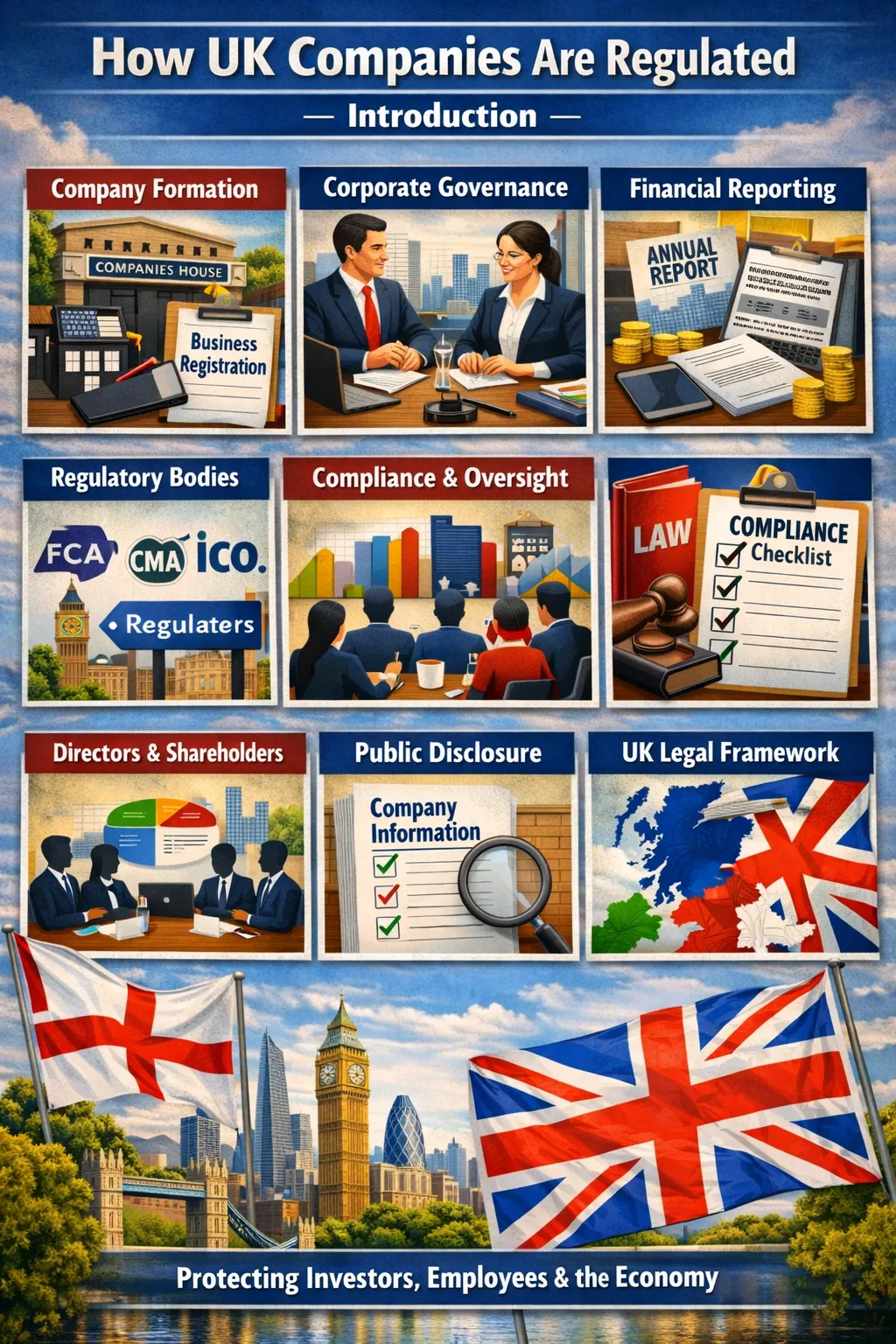
The United Kingdom has one of the world’s most established frameworks for regulating companies. From the moment a company is incorporated to its ongoing obligations around accounts, governance and disclosure, a comprehensive system of law and regulation governs how businesses operate. This framework is designed to protect investors, creditors, employees and the public while maintaining the UK’s attractiveness as a place to do business.
This guide explains how UK companies are regulated, which bodies are responsible for enforcement, what obligations companies must meet and why corporate regulation matters.
What does company regulation mean in the UK?
Company regulation in the UK refers to the legal framework that governs how companies are formed, managed, financed and dissolved. It encompasses company law (primarily the Companies Act 2006, the most comprehensive piece of company legislation in UK history), financial regulation, competition law, employment law, environmental regulation and sector-specific rules that apply to businesses operating in regulated industries.
The UK regulatory system is based on a combination of statute law, common law, self-regulatory codes and independent regulatory bodies. It applies to all companies registered in the UK, including private limited companies (Ltd), public limited companies (PLC), limited liability partnerships (LLPs) and other corporate entities. Foreign companies operating in the UK through a branch or establishment are also subject to certain registration and reporting requirements.
How are companies formed and registered?
Companies in the UK are formed by registration with Companies House, the government agency that maintains the public register of companies. To incorporate a company, the founders must submit a memorandum of association, articles of association (which set out the rules for running the company), details of the initial directors and shareholders, and information about the company’s registered office address and intended activities.
Companies House holds records on approximately 5 million companies registered in England, Wales, Scotland and Northern Ireland. The register is publicly accessible — anyone can search for a company and view its basic details, including its directors, registered address, accounts and filing history. This transparency is a cornerstone of the UK regulatory system, allowing creditors, investors, customers and the public to make informed decisions about the companies they deal with.
The UK has faced increasing scrutiny over the misuse of corporate structures for fraud, money laundering and tax evasion. The Economic Crime and Corporate Transparency Act 2023 introduced significant reforms to Companies House, including new powers to verify the identity of company directors and persons with significant control (PSCs), reject suspicious filings and share data with law enforcement agencies. These reforms are intended to strengthen the integrity of the UK’s corporate register and combat economic crime.
What are the main regulatory bodies?
Several bodies are responsible for different aspects of company regulation in the UK. Companies House administers the register of companies and ensures that companies comply with their filing obligations. The Financial Conduct Authority (FCA) regulates financial services firms, supervises financial markets and enforces rules designed to protect consumers and maintain market integrity. The Prudential Regulation Authority (PRA), part of the Bank of England, supervises banks, building societies and insurers to ensure their financial soundness.
The Competition and Markets Authority (CMA) enforces competition law, investigates anti-competitive behaviour, reviews mergers and acquisitions and studies markets where competition may not be working effectively. The Financial Reporting Council (FRC), which is being replaced by the Audit, Reporting and Governance Authority (ARGA), sets standards for corporate reporting, auditing, actuarial work and corporate governance. The Insolvency Service, an executive agency of the Department for Business and Trade, handles company insolvencies, investigates allegations of misconduct by company directors and can apply to the courts for directors to be disqualified.
Sector-specific regulators also play important roles. Ofcom regulates telecommunications and broadcasting companies, Ofgem oversees energy firms, the Care Quality Commission regulates health and social care providers, and the Environment Agency enforces environmental regulations affecting businesses. Companies operating in the UK must comply with the rules of all relevant regulators, which can create a complex web of overlapping obligations.
What ongoing obligations do companies have?
Once incorporated, UK companies have a range of ongoing legal obligations. They must file annual accounts with Companies House, providing a public record of their financial position. The level of detail required depends on the size of the company — large companies must file full accounts audited by an independent auditor, while smaller companies may qualify for simplified reporting requirements.
Companies must also file an annual confirmation statement (formerly the annual return), confirming that the information held by Companies House about the company’s directors, shareholders, registered address and share capital is up to date. They must maintain a register of persons with significant control — individuals or entities that hold more than 25 per cent of the company’s shares or voting rights, or who otherwise exercise significant influence over the company.
Public companies listed on the London Stock Exchange or other UK markets face additional obligations under the FCA’s Listing Rules, Disclosure Guidance and Transparency Rules. These include requirements to publish annual and half-yearly financial reports, disclose price-sensitive information promptly through the Regulatory News Service, comply with the UK Corporate Governance Code (on a “comply or explain” basis) and report on executive remuneration. Listed companies are also subject to the Market Abuse Regulation, which prohibits insider dealing, market manipulation and the unlawful disclosure of inside information.
How is corporate misconduct investigated and enforced?
When companies or their directors breach their legal obligations, enforcement action can be taken by several bodies depending on the nature of the offence. Companies House can impose late filing penalties on companies that fail to file accounts on time, and can ultimately strike a company off the register for persistent non-compliance. The Insolvency Service investigates allegations of director misconduct, particularly in the context of insolvent companies, and can apply to the courts to have directors disqualified for periods of up to 15 years.
The Serious Fraud Office (SFO) investigates and prosecutes the most serious and complex cases of fraud, bribery and corruption involving companies and individuals. The SFO has powers to compel the production of documents and can use deferred prosecution agreements (DPAs) — negotiated settlements in which a company agrees to pay a financial penalty and implement compliance reforms in exchange for the suspension of criminal charges.
The Economic Crime and Corporate Transparency Act 2023 introduced a new “failure to prevent fraud” offence, which makes large organisations criminally liable if an employee or agent commits fraud for the benefit of the organisation and the organisation failed to have reasonable fraud prevention procedures in place. This new offence represents a significant expansion of corporate criminal liability in the UK and brings fraud into line with existing “failure to prevent” offences for bribery and tax evasion.
What role does competition law play in regulating companies?
Competition law is a critical part of the UK’s corporate regulatory framework. The Competition Act 1998 prohibits anti-competitive agreements between businesses (such as price-fixing cartels) and the abuse of a dominant market position. The Enterprise Act 2002 provides the framework for merger control, giving the Competition and Markets Authority (CMA) the power to investigate and, if necessary, block mergers that would substantially lessen competition in a market.
The CMA has become an increasingly prominent regulator since Brexit, as the UK can no longer rely on the European Commission to review mergers and anti-competitive practices affecting UK markets. The CMA has attracted international attention for its investigations into major technology companies, including its market studies into digital advertising, mobile ecosystems and cloud computing. The Digital Markets, Competition and Consumers Act 2024 gave the CMA new powers to regulate the most powerful digital platforms through a “strategic market status” designation, reflecting the growing importance of technology markets to the UK economy.
Breaches of competition law can result in significant financial penalties — the CMA can impose fines of up to 10 per cent of a company’s worldwide turnover — and individuals involved in cartel activity can face criminal prosecution and imprisonment. Companies that are harmed by anti-competitive behaviour can also bring private damages claims through the courts or the Competition Appeal Tribunal.
How does employment regulation affect UK companies?
UK companies are subject to a comprehensive framework of employment law that governs the relationship between employers and workers. Key legislation includes the Employment Rights Act 1996, the Equality Act 2010, the National Minimum Wage Act 1998, the Working Time Regulations 1998 and the Trade Union and Labour Relations (Consolidation) Act 1992. These laws set out requirements for minimum pay, working hours, holiday entitlements, protection against unfair dismissal, anti-discrimination protections and the rights of trade unions.
Enforcement of employment rights is carried out through employment tribunals, which hear claims from workers about unfair dismissal, discrimination, unpaid wages and other workplace disputes. HMRC enforces the National Minimum Wage and National Living Wage, and the Health and Safety Executive (HSE) is responsible for workplace health and safety regulation. The Equality and Human Rights Commission (EHRC) has powers to investigate and enforce compliance with equality law.
Recent years have seen significant developments in employment regulation, including the growth of the gig economy and the legal status of platform workers, the introduction of mandatory gender pay gap reporting for large employers, new requirements for modern slavery statements, and proposals for further reform through the Employment Rights Bill. The balance between protecting workers’ rights and maintaining a flexible labour market remains one of the most actively debated areas of UK business regulation.
How does environmental regulation affect UK businesses?
Companies operating in the UK are subject to environmental regulations covering emissions, waste management, water quality, energy use and biodiversity. The Environment Agency in England, together with equivalent bodies in Scotland (SEPA), Wales (NRW) and Northern Ireland (NIEA), enforces environmental permits and can prosecute companies that breach environmental law. Penalties for serious environmental offences can include unlimited fines and, in the most serious cases, imprisonment of company directors.
Climate-related reporting requirements have expanded significantly. Large UK companies and financial institutions are now required to make disclosures aligned with the Task Force on Climate-related Financial Disclosures (TCFD) framework, covering their governance arrangements, strategy, risk management and targets related to climate change. The UK’s net zero target, established by the Climate Change Act 2008 as amended, has far-reaching implications for businesses across all sectors, requiring them to reduce carbon emissions, adapt to physical climate risks and respond to changing consumer expectations.
How has UK company regulation changed since Brexit?
The UK’s departure from the European Union has had significant implications for company regulation. While the UK has retained much of the regulatory framework that was derived from EU law — including rules on financial reporting, data protection, environmental standards and competition — it now has the ability to diverge from EU rules and develop its own regulatory approach.
Areas where the UK is pursuing regulatory divergence include financial services (through the Edinburgh Reforms and the Financial Services and Markets Act 2023), data protection (through proposed reforms to the UK GDPR), sustainability reporting, and the regulation of artificial intelligence. The government has stated its intention to create a more agile and proportionate regulatory environment that supports economic growth while maintaining high standards of investor protection and market integrity.
How does data protection regulation affect companies?
All UK companies that process personal data are subject to the UK General Data Protection Regulation (UK GDPR) and the Data Protection Act 2018, enforced by the Information Commissioner’s Office (ICO). These rules require companies to process personal data lawfully, transparently and for specified purposes, to implement appropriate security measures to protect data from breaches, and to respect the rights of individuals over their personal information, including the right to access, correct and delete their data.
Companies that suffer data breaches must notify the ICO within 72 hours if the breach poses a risk to individuals’ rights and freedoms. The ICO has the power to impose fines of up to £17.5 million or four per cent of annual global turnover, whichever is greater, for serious breaches of data protection law. High-profile enforcement actions against companies including British Airways, Marriott International and Clearview AI have demonstrated the ICO’s willingness to use its powers against organisations of all sizes.
How are companies taxed in the UK?
UK companies are subject to corporation tax on their profits. The main rate of corporation tax was increased to 25 per cent in April 2023 for companies with profits above £250,000, with a lower rate of 19 per cent for small companies with profits below £50,000 and a marginal rate for those in between. The UK also participates in the OECD’s global minimum tax framework (Pillar Two), which establishes a minimum effective tax rate of 15 per cent for large multinational enterprises.
Companies must also account for VAT if their turnover exceeds the registration threshold (currently £90,000), operate PAYE for their employees, and comply with the UK’s transfer pricing rules if they engage in transactions with related parties in other jurisdictions. HMRC’s approach to corporate tax compliance has shifted increasingly towards digital reporting, with Making Tax Digital requiring businesses to keep digital records and submit tax returns through compatible software. The taxation of multinational companies, digital businesses and the use of tax avoidance schemes remain politically sensitive and subject to ongoing policy debate.
Why does company regulation matter?
Effective company regulation is essential to maintaining confidence in the UK economy. It protects investors and shareholders from fraud and mismanagement, gives creditors and suppliers confidence that they can assess the financial health of the companies they trade with, safeguards employees’ rights and ensures that businesses operate within the law. The UK’s reputation as a transparent, well-regulated jurisdiction is a key factor in attracting international investment and maintaining London’s position as a global financial centre.
However, the system is not without its critics. High-profile corporate failures such as the collapse of Carillion, BHS and Wirecard’s UK operations have raised questions about the effectiveness of auditing, the rigour of regulatory oversight and the adequacy of sanctions for corporate misconduct. Ongoing reforms — including the replacement of the FRC with ARGA and the strengthening of Companies House — are intended to address these weaknesses and ensure that the UK’s regulatory framework remains fit for purpose in a rapidly changing business environment.
Related guides
These guides explain related topics in more detail:
- Company Directors and Corporate Governance in the UK
- Business Reporting and Financial Disclosure in the UK
- How the UK Economy Works
- UK Government Departments and Public Bodies Explained
- How UK Government Policy Is Made
Related coverage:
Read our latest UK business and economy news
Prepared by:
