Business Reporting and Financial Disclosure in the UK
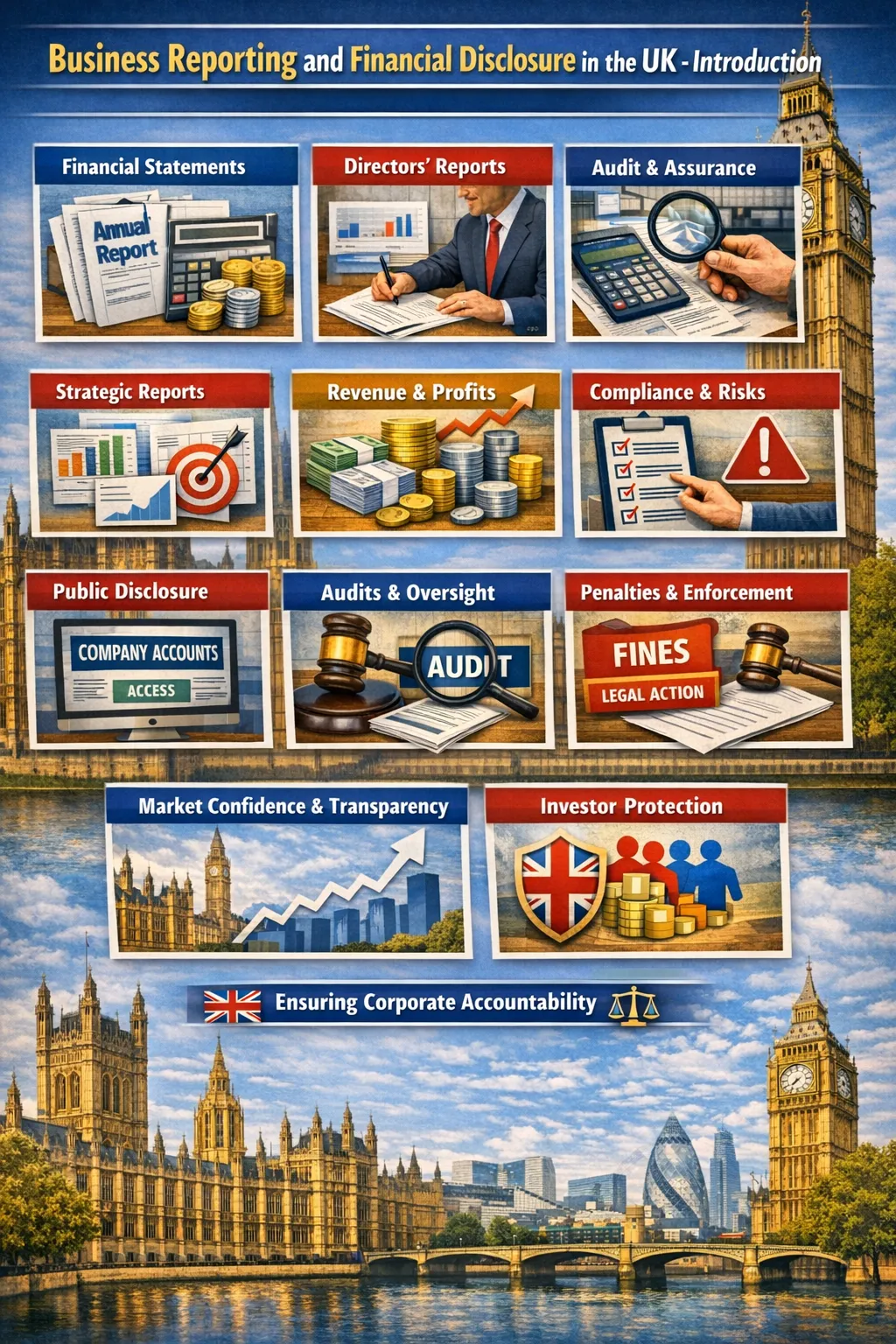
Financial reporting and disclosure are fundamental to the functioning of the UK’s business environment. Companies are required by law to prepare and publish accounts that give a true and fair view of their financial position, enabling investors, creditors, employees and the public to assess the health of the businesses they deal with. The UK has a well-established framework of reporting standards, audit requirements and regulatory oversight that aims to ensure the accuracy, transparency and comparability of corporate financial information.
This guide explains how business reporting works in the UK, what companies are required to disclose, how accounts are audited, who enforces reporting standards and why financial transparency matters.
What is business reporting?
Business reporting refers to the process by which companies prepare and publish financial and non-financial information about their activities, performance and financial position. In the UK, all limited companies are required to file annual accounts with Companies House, making them part of the public record. The level of detail required varies according to the size of the company — micro-entities, small companies, medium-sized companies and large companies each have different reporting thresholds and requirements.
The core financial statements that companies prepare include the balance sheet (showing assets, liabilities and equity at a point in time), the profit and loss account or income statement (showing revenue, costs and profit over a period), the cash flow statement (showing how cash has moved in and out of the business), and notes to the accounts providing additional detail and explanation. Listed companies and large private companies must also prepare a strategic report, which provides a narrative overview of the company’s business model, strategy, risks and performance.
What accounting standards apply in the UK?
UK companies prepare their accounts under one of two sets of accounting standards, depending on their size and type. Companies listed on the London Stock Exchange and other regulated markets are required to use International Financial Reporting Standards (IFRS) as adopted by the UK, which provide a globally recognised framework for financial reporting that facilitates comparison between companies across different countries.
Non-listed companies may use UK Generally Accepted Accounting Practice (UK GAAP), which consists of Financial Reporting Standards (FRS) issued by the Financial Reporting Council. FRS 102 is the main standard for most UK companies, while FRS 105 provides a simplified framework for micro-entities. The UK accounting standards are designed to be proportionate — smaller companies face less complex reporting requirements than larger ones, reducing the administrative burden on the smallest businesses.
The endorsement of international accounting standards for use in the UK is managed by the UK Endorsement Board, which was established following Brexit to take over the function previously performed by the European Financial Reporting Advisory Group (EFRAG). The Board assesses whether new or amended IFRS standards are appropriate for adoption in the UK, considering their impact on UK companies, investors and the public interest.
What is the role of auditing?
Auditing is the process by which an independent external auditor examines a company’s financial statements and expresses an opinion on whether they give a true and fair view of the company’s financial position and performance. In the UK, all companies that exceed certain size thresholds — turnover above £10.2 million, balance sheet total above £5.1 million or more than 50 employees (meeting any two of these three criteria) — are required to have their accounts audited. All public companies must be audited regardless of size.
Auditors are appointed by the shareholders and are expected to act independently of the company’s management. The audit opinion is addressed to the shareholders and provides assurance that the accounts are free from material misstatement. If the auditor identifies significant concerns about the company’s financial position, accounting practices or ability to continue as a going concern, they are required to draw attention to these matters in their audit report.
The audit profession in the UK is regulated by the Financial Reporting Council (FRC), which sets auditing standards, inspects audit quality and can impose sanctions on audit firms and individual auditors who fall below required standards. The audit market for the UK’s largest companies is highly concentrated, with the Big Four accounting firms — Deloitte, EY, KPMG and PwC — auditing the vast majority of FTSE 350 companies. This concentration has been the subject of significant scrutiny by the CMA, parliamentary committees and policymakers, leading to proposals for managed shared audits and other measures to increase competition.
What must companies file at Companies House?
All UK limited companies must file annual accounts at Companies House within specified deadlines — nine months after the end of the accounting period for private companies and six months for public companies. Late filing results in automatic penalties ranging from £150 to £7,500 depending on the length of the delay and the type of company.
In addition to accounts, companies must file an annual confirmation statement confirming that the information held by Companies House about the company’s directors, shareholders, registered address, share capital and persons with significant control is accurate and up to date. Companies must also file notifications of changes to their directors, registered office, share capital and other key details as and when they occur.
The Economic Crime and Corporate Transparency Act 2023 is transforming Companies House from a passive registry into a more active gatekeeper. Under the new powers, Companies House can query and reject filings that appear inconsistent, verify the identities of directors and persons with significant control, cross-reference data with other government databases, and share information proactively with law enforcement agencies. These changes are designed to improve the quality and reliability of the UK’s corporate register and reduce its exploitation for economic crime.
What additional disclosures do listed companies make?
Companies listed on the London Stock Exchange or other UK-regulated markets face a significantly more extensive set of disclosure requirements than private companies. These are governed by the FCA’s Listing Rules, the Disclosure Guidance and Transparency Rules (DTR) and the UK Market Abuse Regulation (UK MAR).
Listed companies must publish annual reports including audited financial statements, a strategic report, a corporate governance statement, a directors’ remuneration report and, for the largest companies, a viability statement assessing the company’s prospects over a period of at least three years. They must also publish half-yearly financial reports and may issue quarterly trading updates.
Under UK MAR, listed companies must disclose inside information — any information that would be likely to have a significant effect on the company’s share price if made public — as soon as possible through a Regulatory News Service. Failure to disclose inside information promptly, or trading on inside information, constitutes market abuse and can result in significant fines and criminal prosecution. The FCA actively monitors market activity for signs of insider dealing and market manipulation.
How is sustainability and non-financial reporting evolving?
Corporate reporting in the UK is expanding beyond traditional financial information to include a growing range of non-financial disclosures. Climate-related financial disclosures, aligned with the Task Force on Climate-related Financial Disclosures (TCFD) framework, are now mandatory for the largest UK companies and financial institutions. These disclosures cover governance arrangements for managing climate risks, the strategic implications of climate change for the business, the processes used to identify and manage climate-related risks and opportunities, and the metrics and targets used to assess climate performance.
The UK is also moving towards the adoption of sustainability reporting standards developed by the International Sustainability Standards Board (ISSB), which provide a comprehensive global framework for sustainability disclosure. The UK Sustainability Disclosure Standards (UK SDS) are expected to be introduced progressively, requiring companies to report on a broader range of sustainability-related risks and opportunities beyond climate alone.
Other non-financial reporting requirements include the Section 172 statement on stakeholder engagement, the modern slavery statement, gender pay gap reporting, streamlined energy and carbon reporting (SECR) for large companies, and directors’ reports covering employee engagement, business relationships and environmental matters. The cumulative effect of these requirements means that UK corporate reporting has become significantly more comprehensive than the purely financial accounts that were the norm a generation ago.
How is digital reporting changing business disclosure?
The digitisation of business reporting is transforming how companies prepare, file and communicate their financial information. Companies House has progressively moved towards digital filing, and most companies now submit their accounts electronically. The government’s Making Tax Digital programme is extending digital reporting requirements to tax returns, requiring businesses to keep digital records and submit information to HMRC through compatible software.
Listed companies in the UK are now required to prepare their annual financial reports in the European Single Electronic Format (ESEF), which uses inline XBRL (eXtensible Business Reporting Language) to tag financial data in a machine-readable format. This allows investors, analysts and regulators to extract and compare financial data across companies automatically, rather than relying on manual analysis of PDF reports. The move towards structured digital reporting is expected to improve the accessibility, comparability and usefulness of corporate financial information.
Technology is also changing how corporate reporting is consumed and analysed. Artificial intelligence and data analytics tools are increasingly being used by investors, auditors and regulators to process large volumes of corporate data, identify anomalies, detect potential fraud and assess the quality of financial reporting. These developments have implications for the future of auditing, with technology expected to complement rather than replace the role of human judgement in assessing the accuracy and reliability of corporate accounts.
How does UK financial reporting compare internationally?
The UK has historically been regarded as having one of the world’s most robust and transparent corporate reporting frameworks. The use of IFRS for listed companies provides international comparability, while the UK’s “comply or explain” approach to corporate governance has been widely influential — similar frameworks have been adopted in many other jurisdictions including Hong Kong, Singapore, South Africa and Australia.
However, the UK faces competition from other financial centres in setting the standard for corporate reporting. The United States uses its own Generally Accepted Accounting Principles (US GAAP) rather than IFRS, making direct comparison between US and UK companies more complex. The European Union has introduced its own Corporate Sustainability Reporting Directive (CSRD), which imposes more extensive sustainability disclosure requirements than those currently in force in the UK, potentially creating a competitive gap in sustainability transparency.
Post-Brexit, the UK has the opportunity to develop its own approach to corporate reporting that is tailored to the needs of UK companies, investors and markets. However, it must balance the desire for a competitive and proportionate reporting regime with the need to maintain international credibility and comparability. The adoption of ISSB sustainability standards and the continued alignment of UK accounting standards with IFRS are important elements of this balance.
What are the current challenges in UK financial reporting?
Several challenges face the UK financial reporting framework. The growing volume and complexity of reporting requirements — spanning financial accounts, corporate governance, remuneration, climate, sustainability, modern slavery, gender pay and tax strategy — have created concerns about “reporting fatigue” among companies and investors. There is a risk that the sheer volume of disclosure obscures the most important information rather than illuminating it.
Audit quality remains a significant concern. The FRC’s annual inspections of audit firms consistently identify cases where audit work has fallen below the required standard, particularly in areas such as revenue recognition, asset valuation, going concern assessments and the auditing of estimates and judgements. The transition from the FRC to ARGA is expected to bring stronger enforcement powers and greater accountability for audit failures.
The concentration of the audit market among the Big Four firms raises concerns about competition, conflicts of interest and systemic risk. If one of the Big Four were to fail or withdraw from the market, the remaining firms would struggle to absorb its clients, creating significant disruption. Proposals for managed shared audits, in which a challenger firm would audit a material portion of a FTSE 350 company alongside the main auditor, are intended to build capacity in the mid-tier audit market and reduce concentration over time.
How are reporting standards enforced?
The enforcement of financial reporting standards in the UK is carried out by several bodies. The FRC’s Corporate Reporting Review team examines the annual reports of listed and large private companies and can require companies to restate their accounts if they find material departures from accounting standards. The FRC also monitors audit quality through regular inspections of audit firms and can impose sanctions — including unlimited fines — on firms and individuals who fall below required standards.
Companies House enforces filing deadlines through automatic penalties and can ultimately strike off companies that persistently fail to file. The FCA can take enforcement action against listed companies that breach disclosure rules, including market abuse and failures to disclose inside information. HMRC scrutinises the tax aspects of corporate accounts and can investigate companies where the tax treatment of transactions appears inconsistent with their financial reporting.
Why does financial disclosure matter?
Transparent financial reporting is essential to the functioning of the UK economy. It enables investors to make informed decisions about where to allocate capital, allows creditors and suppliers to assess the creditworthiness of the companies they deal with, helps employees understand the financial health of their employers, and gives the public visibility into the activities of companies that affect their communities and the broader economy.
High-profile corporate failures — including the collapses of Carillion, BHS, London Capital and Finance, and Wirecard’s UK operations — have highlighted the consequences of inadequate financial reporting, weak auditing and insufficient regulatory oversight. These failures have cost thousands of jobs, left creditors and pensioners with significant losses and damaged public confidence in the integrity of corporate financial information. The ongoing programme of reform to UK reporting and audit standards is intended to address these weaknesses and ensure that the UK maintains its reputation as a jurisdiction where corporate information can be trusted.
Related guides
These guides explain related topics in more detail:
- How UK Companies Are Regulated
- Company Directors and Corporate Governance in the UK
- How the UK Economy Works
- UK Inflation and Cost of Living Explained
- UK Government Departments and Public Bodies Explained
Related coverage:
Read our latest UK business and economy news
Prepared by: