
Company Directors and Corporate Governance in the UK
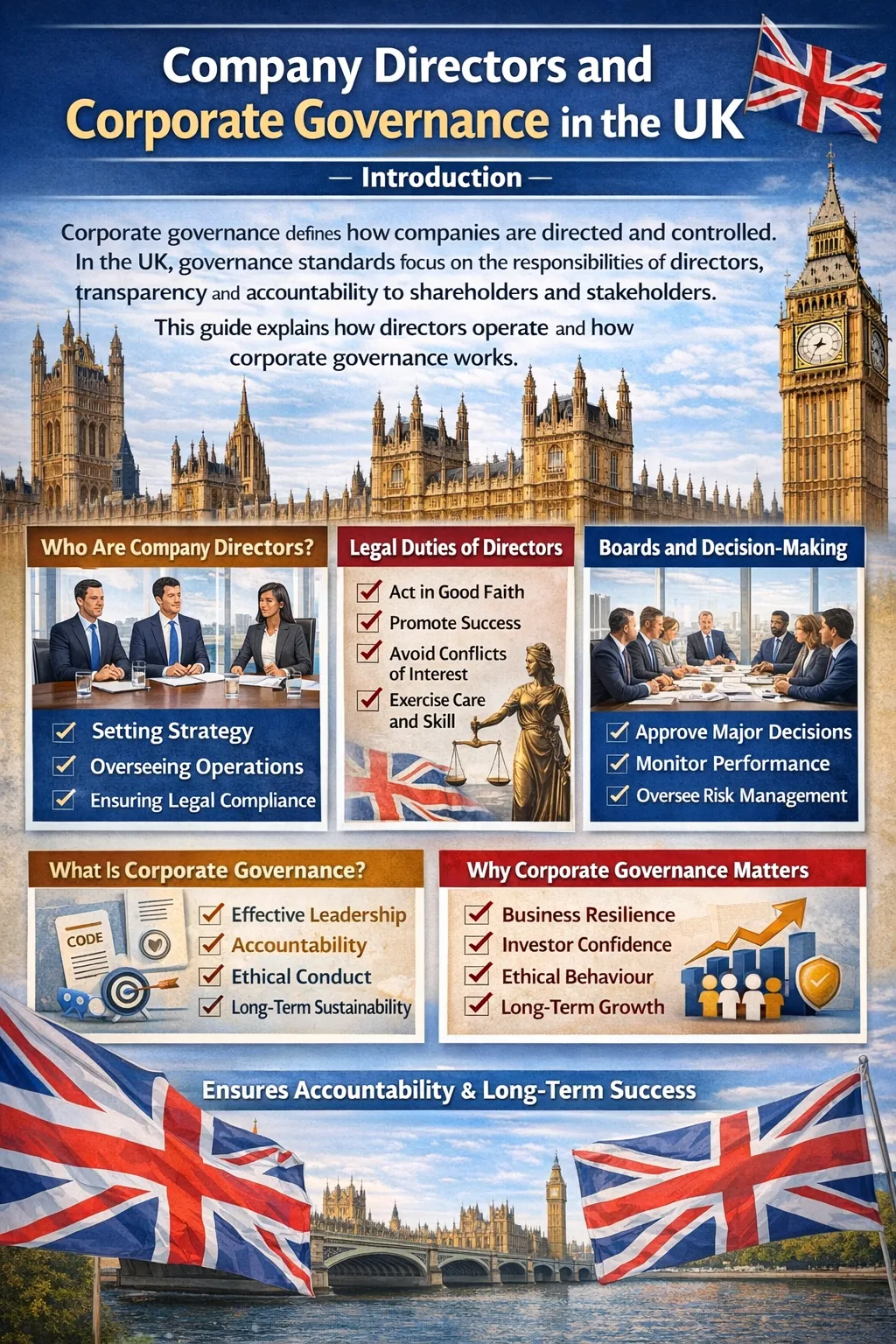
Company directors are legally responsible for the management and strategic direction of the companies they lead. In the United Kingdom, directors’ duties are set out in statute law — primarily the Companies Act 2006 — and are reinforced by a system of corporate governance codes, regulatory oversight and accountability to shareholders and stakeholders. Understanding how directors’ responsibilities work and how corporate governance operates is essential for anyone involved in business, investment or public policy.
This guide explains who company directors are, what legal duties they owe, how corporate governance works in the UK, what happens when directors fail in their responsibilities and why good governance matters for the economy and society.
Who are company directors?
A company director is any person who occupies the position of director in a company, regardless of their formal title. Directors can be executive (involved in day-to-day management) or non-executive (providing independent oversight and strategic guidance). Every UK company must have at least one director who is a natural person — a requirement introduced to improve transparency and accountability. Public companies must have at least two directors.
Directors are appointed by the company’s shareholders in accordance with the company’s articles of association. In listed companies, directors are typically elected or re-elected at the annual general meeting (AGM), giving shareholders a regular opportunity to approve or reject the board’s composition. The names and details of all directors are recorded at Companies House and are publicly accessible, ensuring transparency about who is responsible for running the company.
In addition to formally appointed directors, UK law recognises the concept of “shadow directors” — persons in accordance with whose directions or instructions the directors of the company are accustomed to act. Shadow directors are subject to many of the same legal duties and liabilities as formally appointed directors, which prevents individuals from exercising control over a company while avoiding legal responsibility.
What are the legal duties of directors?
The Companies Act 2006 codified directors’ duties for the first time in UK law, setting out seven general duties that every director owes to the company. These are the duty to act within powers granted by the company’s constitution, the duty to promote the success of the company for the benefit of its members as a whole, the duty to exercise independent judgement, the duty to exercise reasonable care, skill and diligence, the duty to avoid conflicts of interest, the duty not to accept benefits from third parties, and the duty to declare any interest in a proposed transaction or arrangement with the company.
The duty to promote the success of the company (Section 172) is particularly significant. It requires directors to have regard to a range of factors beyond the interests of shareholders, including the likely long-term consequences of decisions, the interests of employees, the need to foster business relationships with suppliers, customers and others, the impact of the company’s operations on the community and the environment, the desirability of maintaining a reputation for high standards of business conduct, and the need to act fairly between different members of the company.
Since 2019, all companies with more than 250 employees have been required to include a Section 172 statement in their annual strategic report, explaining how the directors have had regard to these broader stakeholder considerations in their decision-making. This reporting requirement has increased transparency about how boards balance competing interests, though critics argue that it has not fundamentally changed corporate behaviour.
What is corporate governance?
Corporate governance refers to the system of rules, practices and processes by which a company is directed and controlled. Good corporate governance ensures that companies are managed in the interests of their shareholders and other stakeholders, that risks are properly managed, that financial reporting is accurate and transparent, and that the board of directors exercises effective oversight of the company’s management.
In the UK, corporate governance for listed companies is guided by the UK Corporate Governance Code, published by the Financial Reporting Council (FRC). The Code operates on a “comply or explain” basis — companies listed on the London Stock Exchange’s premium segment are required to report on how they have applied the Code’s principles, and to explain any areas where they have not complied. This approach gives companies flexibility to adapt governance arrangements to their specific circumstances while maintaining transparency for investors.
Key principles of the UK Corporate Governance Code include the separation of the roles of chair and chief executive, the appointment of a sufficient number of independent non-executive directors to provide objective scrutiny, the establishment of board committees for audit, remuneration and nomination, annual evaluation of board effectiveness, regular engagement with shareholders, and transparency in reporting on executive remuneration.
How do board committees work?
Listed companies in the UK are expected to establish several board committees to oversee specific areas of governance. The audit committee, composed entirely of independent non-executive directors, oversees financial reporting, internal controls and the relationship with the external auditor. It reviews the company’s annual and interim accounts, monitors the integrity of financial statements and assesses whether the company’s risk management systems are effective.
The remuneration committee, also composed of independent non-executive directors, sets the remuneration of executive directors and senior management. Listed companies must publish a directors’ remuneration report and put it to a binding shareholder vote at least every three years. Executive pay has been one of the most contentious governance issues in the UK, with concerns about the gap between executive remuneration and the pay of ordinary workers featuring regularly in public debate and political commentary.
The nomination committee leads the process for appointing new directors and reviews the structure, size and composition of the board. It is expected to ensure that the board has an appropriate balance of skills, experience, independence and diversity. Diversity in the boardroom — including gender and ethnic diversity — has been the subject of significant policy attention, with targets set by the FCA’s Listing Rules requiring listed companies to report on the representation of women and ethnic minorities on their boards.
What happens when directors fail in their duties?
Directors who breach their legal duties can face a range of consequences. The company itself (usually acting through its shareholders or a liquidator in the event of insolvency) can bring civil proceedings against a director to recover losses caused by their breach of duty. Directors may be required to pay compensation, account for profits made in breach of their duties or return property to the company.
The Insolvency Service investigates allegations of director misconduct, particularly in the context of companies that have become insolvent. Directors who are found to have acted dishonestly, failed to maintain adequate accounting records, traded while knowing the company was insolvent, or otherwise acted unfit to be concerned in the management of a company can be disqualified from acting as a director for a period of between 2 and 15 years under the Company Directors Disqualification Act 1986. Disqualification prevents the individual from being a director of any UK company during the disqualification period.
In the most serious cases, directors can face criminal prosecution for offences such as fraudulent trading, making false statements to auditors or regulators, or participating in bribery or corruption. The Serious Fraud Office (SFO), the FCA and HMRC all have powers to investigate and prosecute criminal offences committed by company directors. High-profile cases of director misconduct — such as those arising from the collapse of BHS, Carillion and the Patisserie Valerie fraud — have attracted significant public and parliamentary scrutiny and have contributed to calls for stronger enforcement of directors’ duties.
What rights do shareholders have in corporate governance?
Shareholders are the owners of a company and have a range of legal rights that enable them to influence corporate governance. These include the right to attend and vote at general meetings, the right to receive the company’s annual report and accounts, the right to appoint and remove directors, the right to approve significant transactions, and the right to receive dividends if declared by the board. In listed companies, shareholders also have the right to vote on the directors’ remuneration policy (a binding vote at least every three years) and the annual remuneration report (an advisory vote each year).
Institutional investors — pension funds, insurance companies, asset managers and sovereign wealth funds — hold the majority of shares in UK listed companies and play a significant role in corporate governance through their voting and engagement activities. The UK Stewardship Code, published by the FRC, sets out expectations for institutional investors to be active and responsible owners, engaging with the companies they invest in on governance, strategy, risk and social and environmental issues.
Shareholder activism — where investors use their ownership rights to push for changes in corporate strategy, governance or behaviour — has become increasingly common in the UK. This can range from private engagement between investors and boards to public campaigns, shareholder resolutions and contested votes at AGMs. Environmental and social issues, including climate change, executive pay and workforce treatment, have become increasingly prominent topics for shareholder engagement.
How do ESG and sustainability affect corporate governance?
Environmental, social and governance (ESG) considerations have become increasingly important in UK corporate governance. Companies are expected to consider the environmental impact of their operations, their treatment of employees and communities, and the quality of their governance arrangements. Investors, regulators and the public increasingly judge companies not only on their financial performance but also on their broader contribution to society and their management of sustainability-related risks.
Listed companies in the UK are required to make climate-related financial disclosures aligned with the Task Force on Climate-related Financial Disclosures (TCFD) framework, covering governance, strategy, risk management, metrics and targets related to climate change. The UK is also developing its own sustainability reporting standards through the endorsement of International Sustainability Standards Board (ISSB) standards, which will provide a more comprehensive and globally consistent framework for sustainability disclosure.
Social issues such as workforce diversity, modern slavery, supply chain ethics, community impact and employee wellbeing have also risen up the corporate governance agenda. The Modern Slavery Act 2015 requires large companies to publish annual statements on the steps they are taking to prevent modern slavery in their operations and supply chains. Gender pay gap reporting, introduced in 2017 for employers with more than 250 employees, has increased transparency about pay disparities and created pressure on companies to address them.
The integration of ESG considerations into corporate governance is still evolving, and there is ongoing debate about the extent to which directors should prioritise sustainability alongside financial returns. However, the trend towards greater transparency, accountability and stakeholder engagement on ESG issues is likely to continue, driven by investor expectations, regulatory requirements and growing public awareness of the role that businesses play in addressing societal challenges.
How is corporate governance for private companies different?
While the UK Corporate Governance Code applies primarily to listed companies, private companies are also subject to directors’ duties under the Companies Act 2006 and must comply with their own articles of association. The Wates Corporate Governance Principles, published in 2018, provide a voluntary framework for large private companies to apply, covering board composition, purpose, responsibilities, opportunity and risk, remuneration, and stakeholder relationships.
Large private companies — those with more than 2,000 employees or turnover above £200 million and a balance sheet above £2 billion — are required to include a corporate governance statement in their annual report, disclosing which governance code they have applied and how. This requirement was introduced to ensure that the largest private companies, which can have significant economic and social impact, are subject to a degree of governance transparency comparable to their listed counterparts.
How is the UK corporate governance framework being reformed?
The UK corporate governance framework is undergoing significant reform. The government has announced plans to replace the Financial Reporting Council (FRC) with a new, more powerful regulator — the Audit, Reporting and Governance Authority (ARGA). ARGA will have stronger enforcement powers, including the ability to direct companies to restate their accounts, impose sanctions on directors for breaches of corporate reporting requirements and oversee a wider range of companies than the current FRC.
Audit reform has been a major focus following a series of high-profile corporate failures where the quality of auditing was called into question. Proposals include measures to increase competition in the audit market for the largest companies (which is currently dominated by the “Big Four” firms — Deloitte, EY, KPMG and PwC), to strengthen the role of audit committees, to introduce “managed shared audits” for FTSE 350 companies and to expand the scope of audit to cover a wider range of corporate reporting beyond the financial statements.
The UK Corporate Governance Code itself is periodically updated to reflect evolving best practice. The most recent revision, effective from January 2025, includes strengthened provisions on internal controls reporting, board diversity, shareholder engagement and the governance of workforce policies. These changes reflect the continued evolution of expectations about the role of boards and the standards to which UK companies should be held.
Why does corporate governance matter?
Good corporate governance protects shareholders, employees, creditors and the wider public from the consequences of poorly managed or dishonest companies. It supports the efficient allocation of capital, promotes long-term business performance and maintains confidence in the UK as a place to invest and do business. Companies with strong governance tend to perform better over the long term, manage risks more effectively and maintain stronger relationships with their stakeholders.
Conversely, failures of corporate governance can have devastating consequences — the collapse of major companies can result in job losses, pension fund deficits, losses for suppliers and creditors, and damage to public confidence in the business sector. The ongoing reform of UK corporate governance — including the transition from the FRC to the Audit, Reporting and Governance Authority (ARGA) and the strengthening of audit and reporting standards — reflects the importance that policymakers attach to ensuring that the UK’s governance framework remains robust and fit for purpose.
Related guides
These guides explain related topics in more detail:
- How UK Companies Are Regulated
- Business Reporting and Financial Disclosure in the UK
- How the UK Economy Works
- UK Public Finances and Government Spending Explained
- UK Government Departments and Public Bodies Explained
Related coverage:
Read our latest UK business and economy news
Prepared by:
