
UK Inflation and Cost of Living Explained
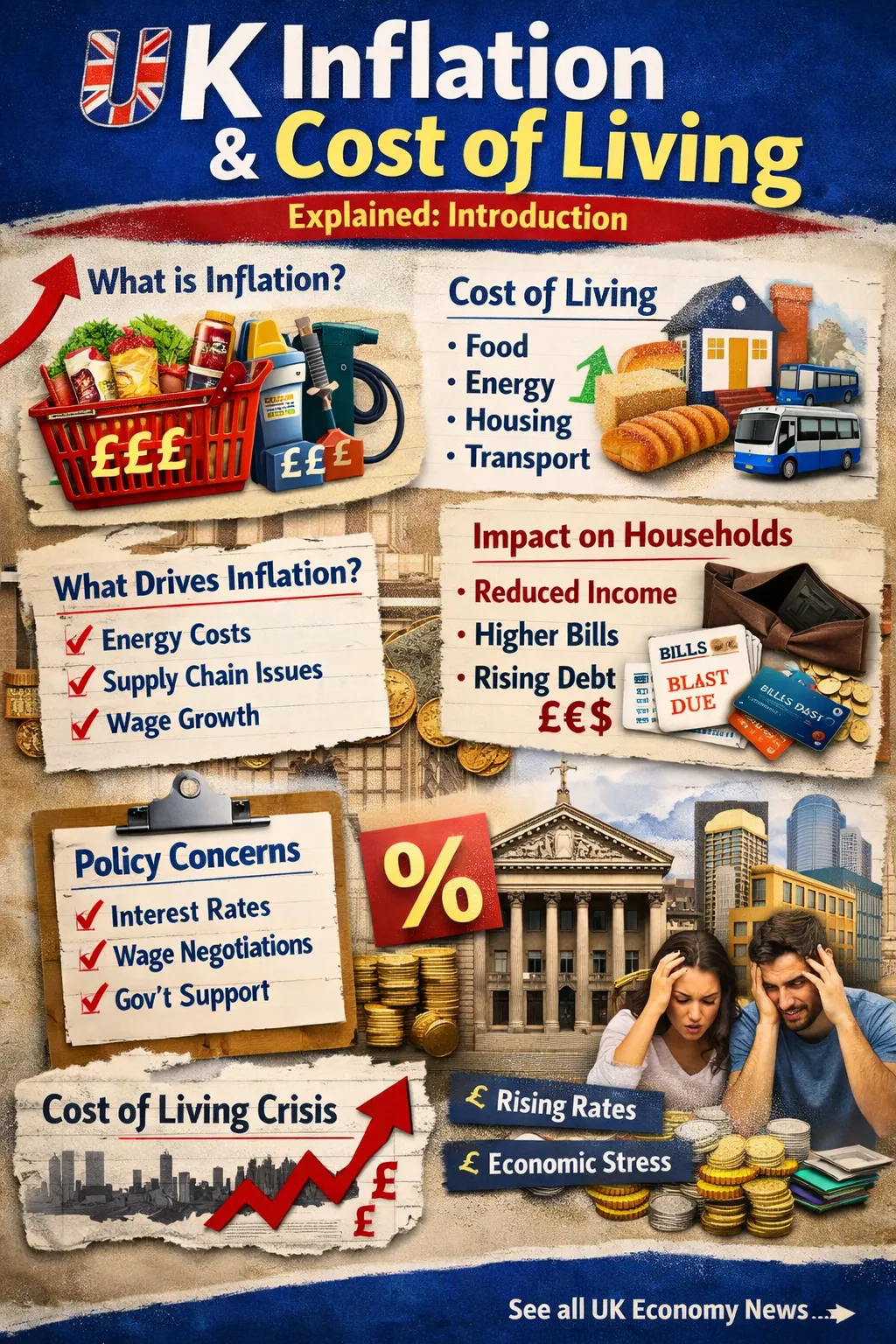
Inflation is one of the most important economic forces affecting daily life in the United Kingdom. It measures the rate at which prices for goods and services rise over time, reducing the purchasing power of money. When inflation is high, the cost of essentials such as food, energy, housing and transport increases faster than many household incomes can keep pace with, creating a cost of living squeeze that affects millions of people across the country.
This guide explains what inflation is, how it is measured in the UK, what causes prices to rise, how inflation affects households and businesses, how the government and the Bank of England respond, and why inflation is one of the most closely watched economic indicators in the country.
What is inflation?
Inflation is a sustained increase in the general level of prices across the economy. It is usually expressed as a percentage rate — for example, if inflation is 4 per cent, then on average prices are 4 per cent higher than they were a year ago. A small amount of inflation is considered normal and even desirable in a healthy economy, as it encourages spending and investment rather than hoarding cash. However, high or unpredictable inflation erodes the value of savings, distorts economic decision-making and can cause significant hardship, particularly for people on fixed incomes or low wages.
Deflation — a sustained fall in the general price level — is generally considered more dangerous than moderate inflation, as it can lead to a downward spiral of falling spending, declining business revenues, job losses and further price falls. Central banks in most developed economies, including the Bank of England, aim to keep inflation at a low, stable and predictable rate.
How is inflation measured in the UK?
The UK’s main measure of inflation is the Consumer Prices Index (CPI), calculated and published monthly by the Office for National Statistics (ONS). CPI tracks the prices of a representative “basket” of around 700 goods and services that a typical household might purchase, including food, clothing, transport, energy, recreation, communications and household goods. The contents of the basket are updated each year to reflect changing consumer habits — items that have become more popular are added, while those falling out of use are removed.
The government’s inflation target, set for the Bank of England, is 2 per cent as measured by CPI. This target is symmetric — the Bank is expected to treat inflation that is too far below 2 per cent as seriously as inflation that is too far above. If CPI inflation moves more than one percentage point away from the target in either direction, the Governor of the Bank of England is required to write an open letter to the Chancellor of the Exchequer explaining why and what action is being taken.
Another measure, CPIH, includes owner-occupiers’ housing costs and is considered by the ONS to be the most comprehensive measure of consumer price inflation. The Retail Prices Index (RPI), an older measure that uses a different methodology and tends to produce higher readings, is still used for some purposes including the indexation of student loan repayments, some pension schemes and government bond payments, but it is no longer classified as a National Statistic due to methodological shortcomings.
What causes inflation in the UK?
Inflation can be driven by several factors, which economists broadly categorise as demand-pull inflation and cost-push inflation. Demand-pull inflation occurs when demand for goods and services exceeds the economy’s ability to supply them — for example, when consumer spending grows rapidly, when government spending increases sharply, or when loose monetary policy makes borrowing very cheap. In these circumstances, businesses can raise prices because customers are willing and able to pay more.
Cost-push inflation occurs when the costs of producing goods and services increase, forcing businesses to pass those costs on to consumers through higher prices. Common drivers include rising energy prices, increases in the cost of raw materials, supply chain disruptions, higher wage costs and currency depreciation (which makes imports more expensive). The UK experienced severe cost-push inflation in 2022-2023, driven primarily by the global energy price shock following Russia’s invasion of Ukraine, combined with post-pandemic supply chain disruptions and food price increases.
Expectations also play an important role in inflation dynamics. If businesses and workers expect inflation to remain high, they may raise prices and demand higher wages in anticipation, creating a self-reinforcing cycle known as a wage-price spiral. This is why central banks pay close attention to inflation expectations and take action to anchor them at or near the target rate. The Bank of England uses surveys, financial market data and its own models to monitor inflation expectations among households, businesses and financial market participants.
What is the cost of living and how does it differ from inflation?
The “cost of living” refers to the amount of money needed to cover basic expenses such as housing, food, energy, transport, childcare and clothing. While inflation measures the rate of change in prices, the cost of living reflects the absolute level of expenses that households face. Two households may experience the same rate of inflation but have very different costs of living depending on where they live, their housing tenure, the size of their family and their income level.
The cost of living crisis that dominated UK political and economic debate from 2021 onwards was driven by a combination of rapidly rising energy prices, food price increases, higher mortgage costs following interest rate rises, and real wages failing to keep pace with inflation. The crisis disproportionately affected lower-income households, who spend a larger share of their income on essentials and have less capacity to absorb price increases by reducing discretionary spending or drawing on savings.
The government responded with a range of interventions including the Energy Price Guarantee, which capped the unit price of gas and electricity for households, cost of living payments to households receiving means-tested benefits, an increase in the National Living Wage, and uprating of benefits and the state pension in line with inflation. The ability to fund such interventions depends on the state of the public finances and the willingness to increase borrowing or reallocate spending from other areas.
How does the Bank of England respond to inflation?
The Bank of England’s primary tool for managing inflation is the Bank Rate, set by the Monetary Policy Committee (MPC). When inflation is above the 2 per cent target, the MPC typically raises the Bank Rate to increase the cost of borrowing, which reduces spending and investment and puts downward pressure on prices. When inflation is below target, the MPC may cut rates to stimulate economic activity. The MPC’s decisions on interest rates affect the economy with a lag of 12 to 24 months, meaning the Committee must base decisions on forecasts rather than current data alone.
In exceptional circumstances, the Bank has used unconventional monetary policy tools. Quantitative easing (QE) — the large-scale purchase of government bonds and other financial assets — was used extensively following the 2008 financial crisis and during the COVID-19 pandemic to support the economy when the Bank Rate was already at or near zero. The Bank has since begun unwinding its QE programme through quantitative tightening (QT), gradually reducing its holdings of government bonds by allowing them to mature without reinvestment and through active sales.
What happened to UK inflation in 2021–2024?
After more than a decade of relatively low and stable inflation following the 2008 financial crisis, the UK experienced a sharp increase in consumer prices from mid-2021 onwards. CPI inflation rose from below 1 per cent in early 2021 to a peak of 11.1 per cent in October 2022 — the highest rate in over 40 years. The surge was driven primarily by dramatic increases in wholesale gas and electricity prices following Russia’s invasion of Ukraine, global supply chain disruptions as the world economy recovered from COVID-19, rising food prices driven by energy costs and extreme weather, and strong consumer demand fuelled by pandemic savings.
Food price inflation was particularly acute, reaching over 19 per cent in early 2023 — the highest rate since the 1970s. The cost of staple items including bread, milk, eggs, cheese and cooking oil increased dramatically, placing severe strain on household budgets. Charities and food banks reported record levels of demand, and surveys showed that millions of households were cutting back on food, skipping meals or reducing heating to manage their finances.
The Bank of England responded by raising the Bank Rate from 0.1 per cent in December 2021 to 5.25 per cent by August 2023 — the fastest tightening cycle in decades. Higher interest rates contributed to a gradual decline in inflation through 2023 and 2024, though the process was slower than initially forecast. Mortgage holders faced significant increases in their monthly payments as fixed-rate deals expired and were replaced at much higher rates, creating a secondary squeeze on household finances even as headline inflation began to fall.
How does inflation affect different groups in society?
Inflation does not affect everyone equally. Lower-income households typically experience higher effective inflation rates because they spend a larger proportion of their income on essentials such as food, energy and housing, which have often seen above-average price increases. The ONS publishes data on inflation rates experienced by different household types, consistently showing that the poorest households face higher inflation than the wealthiest.
Pensioners on fixed incomes are particularly vulnerable unless their pensions are indexed to price increases. The state pension is protected by the “triple lock,” which increases it each year by the highest of CPI inflation, average earnings growth or 2.5 per cent. Private pension schemes may or may not provide inflation protection depending on their design. Savers are affected because inflation erodes the real value of cash holdings — if inflation is higher than the interest rate earned on savings, the purchasing power of those savings declines.
Borrowers can benefit from inflation if their debts are fixed in nominal terms, as the real value of their debt falls over time. However, when central banks raise interest rates to combat inflation, borrowers with variable-rate or expiring fixed-rate mortgages face significant increases in their monthly payments. Businesses face inflation through higher input costs, wage demands, energy bills and uncertainty that makes planning and investment more difficult.
How does UK inflation compare internationally?
The inflationary episode of 2021-2023 was a global phenomenon, though its severity varied between countries. The UK experienced higher peak inflation than many comparable economies, including the United States, France and Japan, partly due to its particular exposure to wholesale gas prices, post-Brexit labour shortages in some sectors, and the structure of the UK energy market. International comparisons are complicated by differences in measurement methodology, consumer spending patterns and energy pricing structures, but the UK’s relatively high inflation rate attracted significant attention and fuelled debate about whether domestic factors contributed to worse outcomes.
What can households do to manage the impact of inflation?
While individuals cannot control macroeconomic forces, there are steps that households can take to manage the impact of inflation on their finances. Reviewing and switching energy tariffs, broadband, insurance and other regular bills can reduce costs, particularly as competition between providers creates opportunities for savings. Government-backed comparison tools and organisations such as Citizens Advice and MoneySavingExpert provide guidance on finding the best deals.
For savers, moving cash from low-interest current accounts to higher-paying savings accounts, including fixed-rate bonds and Individual Savings Accounts (ISAs), can help protect the real value of savings during periods of high inflation. For those with debts, particularly credit cards and personal loans, paying down high-interest debt can reduce the overall cost of borrowing and free up income for essentials.
Workers may seek to negotiate pay rises or move to higher-paying roles to keep pace with inflation. Trade union membership, which provides collective bargaining power, tends to increase during periods of high inflation as workers seek to protect their real wages. The government sets the National Living Wage and National Minimum Wage, which are reviewed annually by the Low Pay Commission and adjusted to reflect economic conditions including inflation.
Households eligible for government support — including Universal Credit, Housing Benefit, Council Tax Reduction, the Warm Home Discount and free school meals — should ensure they are claiming all the benefits to which they are entitled. Research consistently shows that significant sums of benefits go unclaimed each year, particularly among older people, working households and private renters. Local council websites, Citizens Advice and the government’s benefits calculator on GOV.UK can help identify available support.
What is the outlook for UK inflation?
The outlook for inflation depends on a range of domestic and global factors. Energy prices remain a significant source of uncertainty — further disruption to global oil and gas markets, whether from geopolitical conflict, production decisions by OPEC+ countries or extreme weather events, could push inflation higher again. Food prices are influenced by global agricultural conditions, supply chains and trade policy.
Domestically, the pace of wage growth, the tightness of the labour market, the trajectory of housing costs and the government’s fiscal policies all influence the inflation outlook. The Bank of England publishes its inflation forecasts in the quarterly Monetary Policy Report and updates its assessment at each MPC meeting. Financial markets price in expectations for future interest rate changes based on their assessment of inflation prospects, and these market-implied expectations provide a useful guide to the likely path of monetary policy.
The transition to net zero, while essential for addressing climate change, may also have inflationary implications in the short to medium term, as the costs of upgrading energy systems, buildings and transport infrastructure are absorbed by the economy. Understanding how these structural forces interact with cyclical factors will be important for policymakers, businesses and households navigating the UK’s economic future.
Why is inflation a major policy concern?
Inflation matters because it affects the purchasing power of wages, the value of savings, the cost of borrowing, the competitiveness of UK businesses, the sustainability of public finances and the overall stability of the economy. High inflation creates uncertainty for businesses planning investment, distorts price signals that guide economic decision-making and can lead to social and political discontent when living standards fall. Maintaining low and stable inflation is considered essential to sustainable economic growth, and understanding how inflation works is essential for making informed decisions about spending, saving, borrowing and engaging with economic policy debates.
Related guides
These guides explain related topics in more detail:
- How the UK Economy Works
- UK Interest Rates and Monetary Policy Explained
- UK Public Finances and Government Spending Explained
- How the UK Government Works
Related coverage:
Read our latest UK business and economy news
Prepared by:
