
How UK Government Policy Is Made
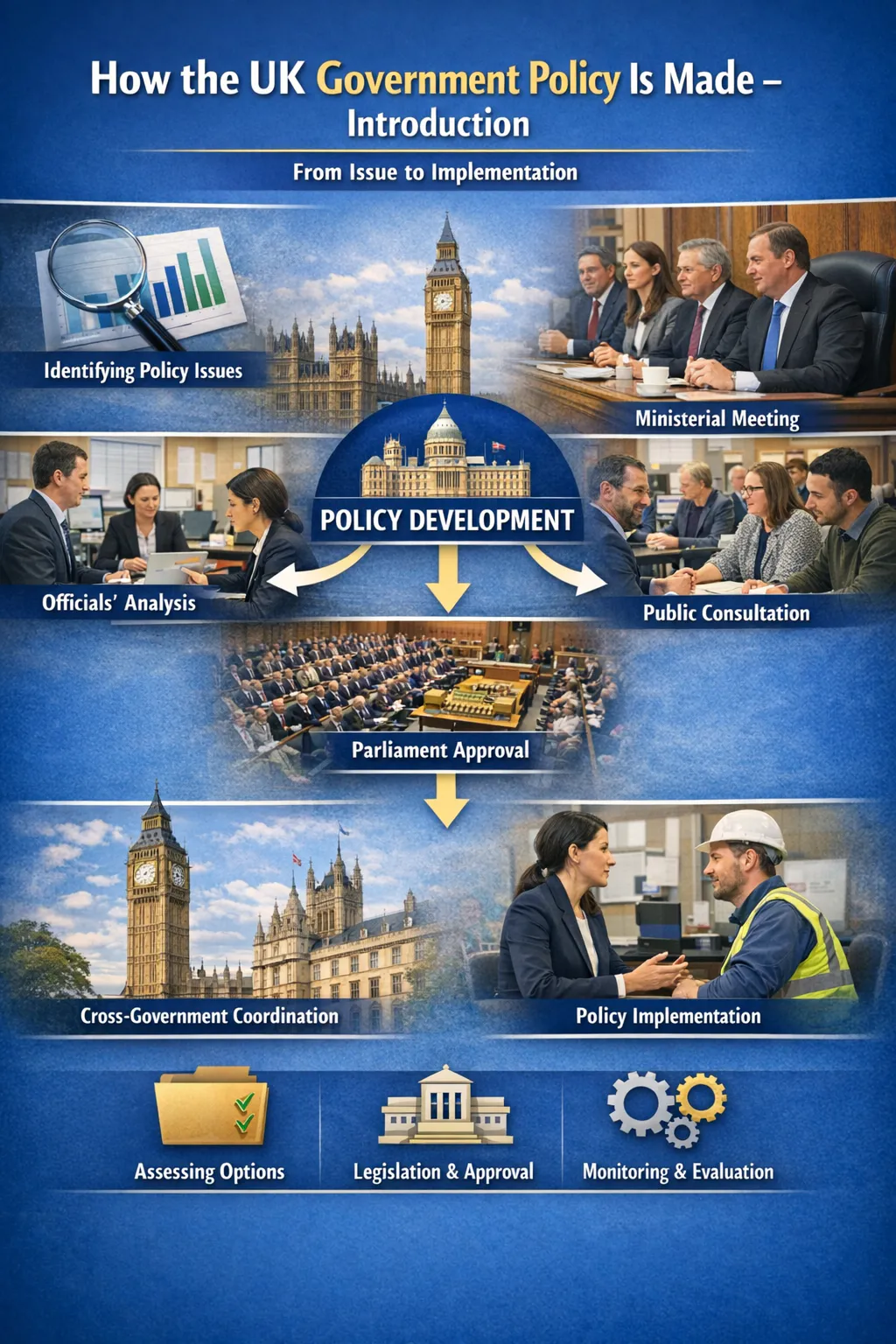
Public policy in the United Kingdom is developed through a structured process that involves ministers, civil servants, Parliament and, in many cases, public consultation. Policy-making is the mechanism through which the government responds to social, economic and political challenges — translating political priorities into practical action that affects the lives of people across the UK.
This guide explains how government policy is created, approved and implemented, from the initial identification of an issue through to delivery and review.
What is government policy?
Government policy is a course of action adopted by the state to address a particular issue or achieve a specific objective. Policies can take many forms — they may involve new legislation, changes to regulations, spending decisions, the creation of new programmes or reforms to existing public services. Some policies are set out in party manifestos before elections and then implemented by the incoming government. Others emerge in response to events, public pressure, expert advice or changing circumstances.
In the UK, the Prime Minister and Cabinet set the overall direction of policy, while individual government departments take the lead on policy development in their areas of responsibility.
The policy-making process in the UK is not defined by a single piece of legislation. It has developed over decades through practice, convention and institutional learning. Key guidance documents include HM Treasury’s Green Book, which sets out the framework for policy appraisal, and the Cabinet Office’s Guide to Making Legislation. The process is intended to be evidence-based, consultative and subject to scrutiny, though in practice the quality and rigour of policy-making varies across departments and issues.
How does the policy process begin?
Policy development typically begins when a problem or opportunity is identified that requires government action. This can happen through several channels. Ministers may set priorities based on their party’s manifesto commitments or political agenda. Civil servants may identify emerging issues through data analysis, research or feedback from delivery organisations. External events — such as economic shocks, public health emergencies or international developments — can force rapid policy responses. Select committees, think tanks, industry bodies and campaigning organisations also play a role in placing issues on the political agenda.
Once an issue is recognised as requiring action, the relevant government department takes the lead in analysing the problem and developing options for ministers to consider.
How are policy options developed?
Civil servants in the relevant department prepare detailed analysis of the issue, including evidence reviews, cost-benefit assessments, legal considerations and delivery feasibility. They develop a range of policy options — from minimal intervention to more significant reforms — along with an assessment of the likely impacts, risks and trade-offs of each.
Impact assessments are a formal part of the policy process. They evaluate the potential economic, social and environmental effects of proposed policies and are published alongside legislation to help Parliament and the public understand the expected consequences. The Regulatory Policy Committee provides independent scrutiny of impact assessments to ensure they meet minimum quality standards.
Officials present their analysis and recommendations to ministers, who then decide which option to pursue. Ministers may request further work, modify proposals or reject options entirely. Special advisers — politically appointed staff who work alongside civil servants — also play a role in shaping policy advice, particularly on issues with significant political dimensions.
What role does public consultation play?
Many significant policies involve a period of public consultation before final decisions are made. The government publishes consultation documents — sometimes called Green Papers (for open discussion) or White Papers (for firmer proposals) — that set out the issues and invite responses from businesses, local authorities, professional bodies, civil society organisations and members of the public.
Consultations are governed by the Cabinet Office’s Consultation Principles, which require that consultations should be proportionate, targeted, clear about the questions being asked and allow sufficient time for responses. The government is expected to publish a summary of consultation responses and explain how they have influenced the final policy.
In practice, the quality and influence of consultations varies. Some consultations lead to significant changes in policy, while others are criticised for being conducted after the government has already reached a decision. Parliamentary committees have repeatedly called for consultation processes to be more meaningful and better integrated into the policy cycle.
How are policies approved within government?
Major policies must be approved through the collective decision-making process before they can be announced or implemented. The most significant proposals are discussed and agreed at Cabinet or in Cabinet committees — smaller groups of ministers tasked with specific policy areas such as economic affairs, national security or social policy.
The Cabinet Office manages the “write-round” process, in which policy proposals are circulated to all relevant departments for comment before they are formally agreed. This ensures that policies are consistent with the government’s wider agenda and that potential conflicts between departments are identified and resolved. The principle of collective responsibility means that once a policy has been agreed, all ministers are expected to support it publicly.
Spending commitments must be agreed with HM Treasury, which controls the allocation of public finances and ensures that new policies are affordable within existing budgets or are accompanied by identified funding sources.
How does policy become legislation?
Some policies require new primary legislation — an Act of Parliament — to take effect. In these cases, the government drafts a Bill, which is introduced to Parliament and must pass through both the House of Commons and the House of Lords before receiving Royal Assent and becoming law.
The legislative process includes several stages of scrutiny: first and second readings, detailed examination by a Public Bill Committee, report stage and third reading. The House of Lords provides additional scrutiny and can propose amendments, although the Commons has the final say under the Parliament Acts. The government controls the parliamentary timetable and decides which Bills are given priority in each session.
Many policies are implemented through secondary legislation — statutory instruments (SIs) made under powers granted by existing Acts of Parliament. Secondary legislation allows the government to update rules, set detailed regulations and respond to changing circumstances without the need for a full new Act. There are around 3,000 statutory instruments made each year, and they are subject to varying levels of parliamentary scrutiny depending on the procedure specified in the parent Act.
Under the negative procedure, a statutory instrument becomes law unless either House of Parliament votes to reject it within a specified period — typically 40 sitting days. Under the affirmative procedure, the instrument must be actively approved by a vote in both Houses before it can take effect. In practice, statutory instruments are rarely rejected by Parliament, which has led to concerns that secondary legislation receives insufficient scrutiny given its volume and practical importance. The House of Lords Secondary Legislation Scrutiny Committee and the Joint Committee on Statutory Instruments play important roles in reviewing SIs and drawing Parliament’s attention to those that raise policy or legal concerns.
How does devolution affect policy-making?
Devolution has fundamentally changed the landscape of policy-making in the United Kingdom. The Scottish Government, the Welsh Government and the Northern Ireland Executive each have authority to make policy in devolved areas such as health, education, housing, transport and the environment. This means that on many issues, four different governments are making policy simultaneously across the UK, and the policies they adopt can differ significantly.
For example, Scotland has pursued different policies on university tuition fees, prescription charges and social care from those in England. Wales has maintained different approaches to school testing and the curriculum. Northern Ireland has distinct arrangements reflecting the requirements of the Belfast (Good Friday) Agreement. The UK government makes policy for England on devolved matters and for the whole of the UK on reserved matters such as defence, foreign affairs, immigration and most taxation.
Where UK-wide and devolved policies intersect — for example, on environmental standards, trade policy or social security — intergovernmental coordination is required. The Intergovernmental Relations Framework, agreed in 2022, provides a formal structure for managing these relationships, but tensions between the UK government and devolved administrations remain a regular feature of British politics. Policy divergence across the UK is likely to increase as devolution matures and as different political parties pursue different priorities in different parts of the country.
How are policies implemented and delivered?
Once approved, policies are delivered through a range of channels depending on their nature and scale. Departments may deliver policies directly, or they may work through executive agencies, local authorities, NHS bodies, schools, police forces or contracted service providers. Complex programmes often involve multiple delivery partners working together.
The Implementation Unit within the Cabinet Office monitors the delivery of the government’s top priorities and provides regular progress reports to the Prime Minister. Departments also track delivery through internal performance frameworks, data systems and regular reporting.
A significant gap can exist between policy announcement and effective delivery. Factors such as resource constraints, workforce capacity, IT systems, local variation and stakeholder resistance can all affect how well a policy works in practice. The National Audit Office (NAO) regularly examines major programmes and publishes reports on whether they are being delivered on time, on budget and to the intended standard.
High-profile examples of implementation challenges include the rollout of Universal Credit, which took over a decade from announcement to full deployment, the introduction of the NHS Test and Trace system during the COVID-19 pandemic, and successive attempts to digitise government services. The Infrastructure and Projects Authority (IPA), which sits within the Cabinet Office and HM Treasury, monitors the government’s largest projects and publishes an annual assessment rating each project as red, amber or green based on its likelihood of successful delivery.
What role do external organisations play in shaping policy?
While the formal policy process is led by ministers and civil servants, a wide range of external organisations seek to influence government policy. Think tanks such as the Institute for Fiscal Studies (IFS), the Institute for Government, the Resolution Foundation, Policy Exchange, the Centre for Policy Studies and the Social Market Foundation produce research and policy recommendations that are widely cited in political debate and media coverage.
Industry bodies, trade associations, professional organisations, trade unions and charities all engage with government through lobbying, formal consultation responses, evidence submissions to select committees and informal contact with ministers and officials. The regulation of lobbying activity is governed by the Transparency of Lobbying, Non-Party Campaigning and Trade Union Administration Act 2014, which established a register of consultant lobbyists, although critics argue that the regime covers only a fraction of lobbying activity.
Academic research also plays a role in policy development, particularly in areas such as public health, education, criminal justice and economic policy. Government departments commission research from universities and independent organisations, and bodies such as the What Works Network provide evidence syntheses to help policy-makers understand which interventions are most effective. Select committees frequently invite academic experts to give evidence alongside practitioners and campaigners.
How are policies reviewed and evaluated?
The government evaluates policies to assess whether they are achieving their intended outcomes, delivering value for money and producing any unintended consequences. Evaluation methods include statistical analysis, independent research, feedback from delivery organisations and comparison with international approaches.
HM Treasury’s Green Book and Magenta Book provide the official guidance on policy appraisal and evaluation across government. Post-implementation reviews are expected for significant regulatory changes, and the government’s What Works Network provides evidence on the effectiveness of policies in areas such as education, crime reduction and local economic growth.
Select committees in Parliament also play an important role in evaluating policy, calling ministers and officials to give evidence on how policies are working and whether they should be reformed or discontinued.
How has policy-making changed in recent years?
The process of policy-making in the UK has evolved significantly in recent decades. The rise of digital government has introduced new tools for evidence gathering, including real-time data analytics, digital consultation platforms and behavioural science techniques. The Behavioural Insights Team, originally established within the Cabinet Office in 2010 and now operating as a social purpose company, pioneered the use of “nudge” theory — applying insights from behavioural psychology to policy design to encourage better outcomes without resorting to regulation or legislation.
Brexit has also had a profound impact on the policy-making process. The transfer of regulatory competences from the European Union to UK domestic institutions required the creation of new regulatory frameworks in areas such as agriculture, fisheries, trade, environmental standards, chemicals regulation and financial services. The volume of post-Brexit statutory instruments has been enormous, and new bodies such as the Trade Remedies Authority and the Office for Environmental Protection have been established to take on functions previously performed by EU institutions.
The COVID-19 pandemic tested the UK policy-making system in unprecedented ways, requiring rapid decision-making under extreme uncertainty. Emergency legislation such as the Coronavirus Act 2020 granted the government sweeping temporary powers. The pandemic exposed both strengths and weaknesses in the policy process — the speed of the vaccine procurement programme was widely praised, while the initial response to care home protection and the management of public health communications attracted significant criticism in the COVID-19 Inquiry.
Looking ahead, emerging challenges such as artificial intelligence governance, climate adaptation, an ageing population and fiscal pressures on public services will continue to test the capacity and agility of the UK policy-making system. The ability of government to develop well-evidenced, effectively delivered and publicly legitimate policy will remain central to the country’s ability to respond to the challenges of the coming decades.
Why understanding policy-making matters
Government policy shapes almost every aspect of life in the United Kingdom — from the economy and taxation to healthcare, education, housing, transport and the environment. Understanding how policies are made helps explain why some issues receive attention and others do not, why there can be a gap between political promises and real-world outcomes, and how citizens, businesses and organisations can engage with the process.
The policy-making process is complex and often slow, but it is designed to balance evidence, political judgement, public input and practical deliverability. Knowing how it works helps citizens, journalists, businesses and civil society organisations engage more effectively with government, challenge poor decisions and contribute to better outcomes.
For ongoing coverage of how government policy is developed and implemented, including analysis of major legislative programmes, spending decisions and delivery challenges, follow our political reporting.
Related guides
These guides explain related topics in more detail:
- How the UK Government Works
- UK Government Departments and Public Bodies Explained
- UK Public Finances and Government Spending Explained
- How UK General Elections Work
- UK Climate Change Policy Explained
- How the UK Housing Market Works
Related coverage:
See current political developments in the UK
Prepared by:
