
How the NHS Works in the UK
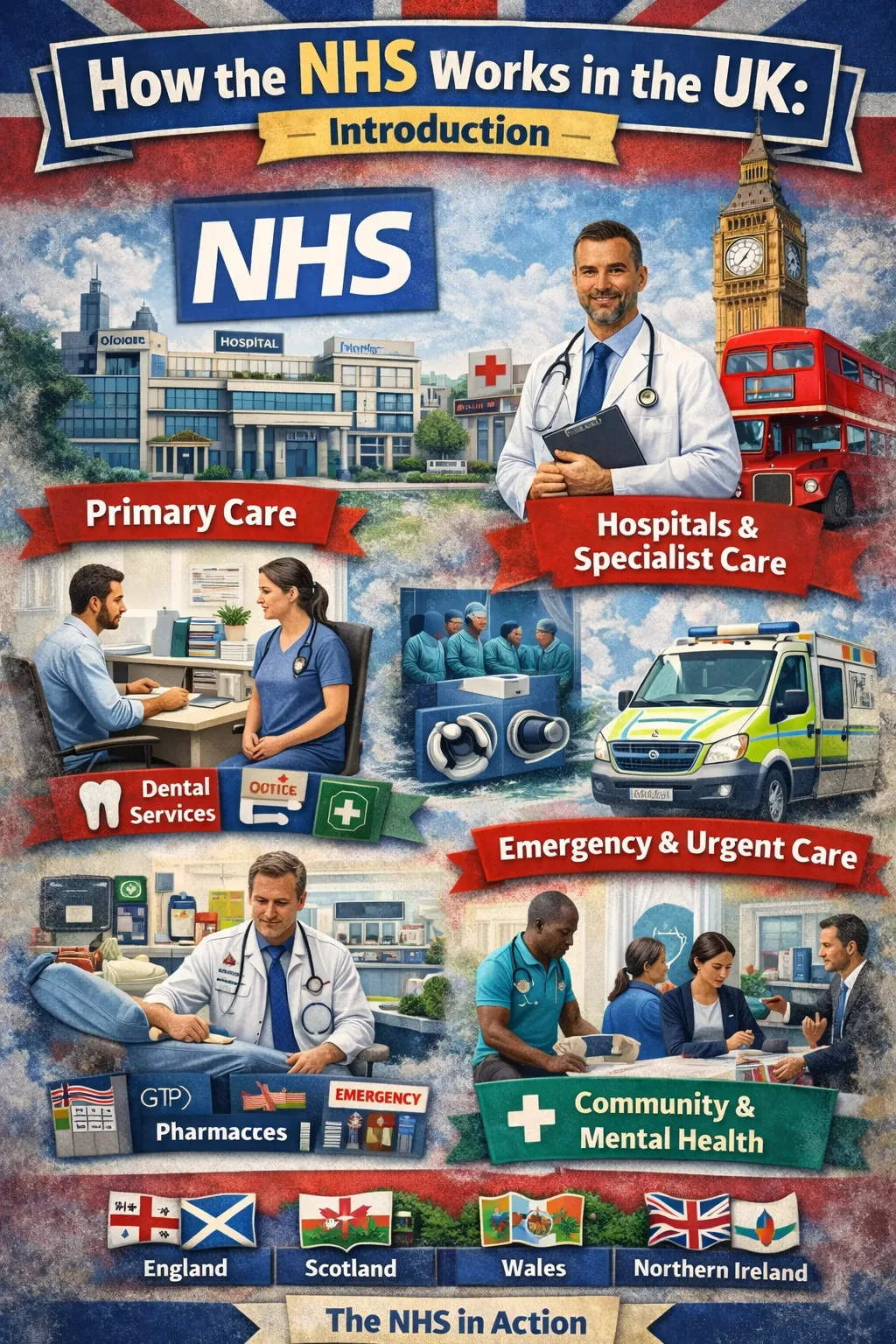
The National Health Service is one of the United Kingdom’s most important and cherished institutions. Founded in 1948 on the principle that healthcare should be available to all, free at the point of use and funded from general taxation, the NHS provides comprehensive healthcare to over 67 million people. It is the largest employer in Europe and one of the largest publicly funded health systems in the world, delivering everything from routine GP appointments and emergency care to complex surgery, cancer treatment and mental health services.
This guide explains how the NHS is structured and managed, how it is funded, how services are delivered, what challenges the system faces and why the NHS matters to everyone in the United Kingdom.
How is the NHS structured?
The NHS is not a single organisation but a collective term for the publicly funded healthcare systems in each of the four UK nations. NHS England is by far the largest, serving approximately 56 million people. NHS Scotland, NHS Wales and Health and Social Care in Northern Ireland each operate independently under the direction of their respective devolved governments. While all four systems share the founding principles of universal coverage and care free at the point of use, they have developed different structures, policies and performance characteristics over time.
In England, the NHS is overseen by the Department of Health and Social Care (DHSC), which sets overall policy and the legislative framework. NHS England, an arm’s-length body, is responsible for commissioning and overseeing the delivery of NHS services. Following reforms introduced by the Health and Care Act 2022, England is divided into 42 Integrated Care Systems (ICSs), each comprising an Integrated Care Board (ICB) responsible for planning and commissioning healthcare services and an Integrated Care Partnership (ICP) that brings together NHS organisations, local authorities, voluntary organisations and other partners to coordinate health and care in the area.
NHS trusts are the organisations that directly provide healthcare services. Acute trusts run hospitals, ambulance trusts provide emergency transport, mental health trusts deliver psychiatric and psychological services, and community trusts provide services such as district nursing, health visiting and rehabilitation outside hospitals. Many of the larger and higher-performing trusts have been designated as NHS Foundation Trusts, which have greater financial and managerial autonomy.
How is the NHS funded?
The NHS is funded primarily from general taxation, with a smaller contribution from National Insurance contributions. Total NHS spending in England is approximately £170-180 billion per year, making it the single largest area of government spending. The NHS budget is set by the government through Spending Reviews and announced in the annual Budget, with multi-year funding settlements providing a degree of certainty for planning purposes.
NHS funding has increased significantly in cash terms over the past two decades, but the rate of increase has varied considerably. The period from 2000 to 2010 saw historically large increases in NHS spending, while the austerity period from 2010 to 2018 saw much slower growth, leading to widespread concerns about the impact on service quality and waiting times. Since 2018, the government has provided above-inflation increases, though many health economists argue that funding growth has not kept pace with the rising demand driven by population ageing, the increasing prevalence of chronic conditions and the cost of new medical technologies.
The devolved NHS systems in Scotland, Wales and Northern Ireland are funded through the Barnett formula, which adjusts their block grants based on changes to comparable spending in England. Scotland, Wales and Northern Ireland each decide how to allocate their health budgets independently, which has led to different levels of per-capita health spending and different policy choices across the four nations.
How does primary care work?
Primary care is the first point of contact for most patients with the NHS and is delivered primarily through general practice (GP) surgeries. There are approximately 6,500 GP practices in England, staffed by around 27,000 fully qualified GPs alongside practice nurses, pharmacists, physiotherapists, mental health practitioners, physician associates and other members of the primary care team. GPs handle an estimated 300 million consultations per year, covering everything from acute illness and chronic disease management to health screening, vaccination, contraception and referrals to specialist services.
Most GP practices in England operate as independent businesses that contract with the NHS to provide services, rather than being directly employed by the NHS. This contractual model means that GPs are self-employed practitioners who receive funding from the NHS based on the number of patients registered with their practice and the range of services they provide. The GP contract is negotiated between NHS England and the British Medical Association (BMA).
Access to GP appointments has become one of the most prominent issues in healthcare policy. Patient surveys consistently report difficulty in getting timely appointments, with many patients waiting weeks for a routine consultation. The government has set targets for improving access, including commitments to increase the number of GP appointments, expand the use of digital consultations and online triage, and recruit additional staff to primary care teams. Community pharmacies also play an expanding role in primary care, providing services including blood pressure checks, contraception, treatment for minor illnesses and vaccination under the Pharmacy First programme.
How do hospitals and specialist services work?
Hospital and specialist services — known as secondary care — are provided by NHS acute trusts. Patients are typically referred to hospital by their GP, though emergency departments (A&E) provide direct access for urgent and life-threatening conditions. NHS hospitals provide a comprehensive range of services including emergency medicine, surgery, cancer treatment, maternity care, paediatrics, cardiology, neurology, orthopaedics and diagnostic services such as imaging and pathology.
Waiting times for hospital treatment have been one of the most persistent challenges facing the NHS. The NHS Constitution sets out the right to start consultant-led treatment within 18 weeks of GP referral, but this target has not been consistently met for over a decade. The COVID-19 pandemic caused a dramatic increase in the waiting list, which grew to over 7.5 million patient pathways in England at its peak. Reducing the waiting list through additional capacity, productivity improvements and reform of clinical pathways has been a central priority for NHS England and the government.
Tertiary care — the most specialised services, including organ transplantation, specialist cancer surgery, neurosurgery and rare disease treatment — is provided by a smaller number of specialist centres, often linked to university teaching hospitals. NHS England commissions these services nationally to ensure equitable access and maintain the clinical volumes needed for safety and expertise.
How does the NHS workforce operate?
The NHS in England employs approximately 1.4 million people, making it the largest employer in the UK and one of the largest in the world. The workforce includes doctors, nurses, midwives, allied health professionals (physiotherapists, occupational therapists, radiographers, paramedics and others), healthcare scientists, pharmacists, administrative and clerical staff, porters, cleaners and managers. Training the clinical workforce requires years of education and supervised practice — a medical degree takes five to six years, followed by at least two years of foundation training and several more years of specialty training to become a consultant or GP.
Workforce shortages are among the most critical challenges facing the NHS. There are significant vacancies across virtually all staff groups, with particular shortages in nursing, general practice, emergency medicine, psychiatry, radiology and several other specialties. The NHS Long Term Workforce Plan, published in 2023, set out a 15-year strategy to expand the domestic training pipeline, improve retention and make greater use of technology and new roles. International recruitment — particularly of nurses from countries including the Philippines, India and Nigeria — plays an important role in filling vacancies, though it raises ethical questions about the impact on health systems in source countries.
Industrial relations in the NHS have been strained in recent years, with junior doctors, consultants, nurses, paramedics and other staff groups taking strike action over pay, working conditions and the real-terms decline in NHS earnings since 2010. The BMA, the Royal College of Nursing (RCN) and other professional bodies have argued that below-inflation pay settlements have contributed to recruitment and retention difficulties, while the government has pointed to the fiscal constraints that limit its ability to offer larger increases.
How does social care interact with the NHS?
The boundary between NHS healthcare and social care is one of the most significant structural challenges in UK health policy. The NHS provides healthcare free at the point of use, but adult social care — support for people with care needs arising from age, disability or long-term conditions, including residential care homes, home care, day services and personal care — is means-tested, with many people required to pay for some or all of their care. This distinction creates a complex interface between the two systems, with patients sometimes experiencing delayed hospital discharge because suitable social care is not available, a problem known as “delayed transfers of care” or “bed blocking.”
Adult social care in England is the responsibility of local authorities, funded through a combination of council tax, central government grants and charges to service users. The sector has faced severe funding pressures, workforce shortages, and growing demand from an ageing population. The government has announced reforms including a cap on the amount any individual will pay for personal care over their lifetime and changes to the means-testing thresholds, though implementation has been repeatedly delayed.
The creation of Integrated Care Systems is intended to improve coordination between NHS services and social care, enabling better planning, joint commissioning and more seamless patient experiences. However, the fundamental difference in funding models — the NHS funded nationally from taxation and social care funded locally and means-tested — creates persistent tensions and inequities that successive governments have struggled to resolve.
How is digital technology transforming the NHS?
Digital transformation is a major priority for the NHS. The NHS App, which has been downloaded by tens of millions of people, allows patients to book and manage GP appointments, order repeat prescriptions, view their medical records, access health information and prove their vaccination status. The NHS is progressively moving towards electronic health records, digital referrals, remote consultations and AI-assisted diagnostics, with the aim of improving efficiency, reducing administrative burden and enabling more personalised care.
However, digital adoption across the NHS is uneven. Many hospitals and GP practices still rely on outdated IT systems, and interoperability between different electronic systems remains a significant challenge. The NHS’s track record on large-scale IT programmes is mixed — the National Programme for IT, launched in 2002, was one of the largest and most troubled government IT projects in history and was eventually dismantled. More recent digital initiatives, including the adoption of electronic prescribing, digital imaging and shared care records, have been more successful but progress has been slower than planned.
The use of health data for research and planning — including through the NHS Federated Data Platform and various genomics and population health databases — has enormous potential to improve clinical outcomes, accelerate research and enable more effective resource allocation. However, the use of patient data raises important questions about consent, privacy, data security and public trust that must be carefully managed.
What rights do NHS patients have?
The NHS Constitution for England, first published in 2009 and updated periodically, sets out the rights and responsibilities of patients, staff and the public in relation to the NHS. Patients have the right to receive NHS services free of charge (with some exceptions such as dental charges, prescription charges in England, and optical services), the right to access services within maximum waiting times, the right to be treated with dignity and respect, the right to accept or refuse treatment, and the right to confidentiality of their health information.
Patients who are dissatisfied with their NHS care can raise concerns through the NHS complaints procedure. If the complaint is not resolved satisfactorily, patients can escalate it to the Parliamentary and Health Service Ombudsman (PHSO), which investigates complaints about NHS organisations in England. Healthcare regulation by the Care Quality Commission provides additional accountability for the quality and safety of care.
How does the NHS differ across the UK?
The four NHS systems have diverged significantly since devolution. Scotland abolished prescription charges in 2011 and has maintained a structure based on regional health boards rather than the commissioner-provider split used in England. Wales has organised its NHS around seven health boards that are responsible for both planning and providing services, and has abolished the internal market. Northern Ireland’s health service is integrated with social care under a single structure managed by the Health and Social Care Board and five Health and Social Care Trusts.
Performance varies across the four systems. Waiting times, cancer survival rates, A&E performance, patient satisfaction and staffing levels all show different patterns in each nation, influenced by funding levels, policy choices, demographics and the structure of services. Comparisons between the four systems are frequently used in political debate, though differences in measurement and reporting make direct comparisons complex.
Why does the NHS matter?
The NHS is consistently identified in public polling as the institution that British people are most proud of. It provides universal healthcare to the entire population regardless of ability to pay, and its existence means that no one in the UK faces financial ruin as a result of illness. The NHS is also a major economic institution — one of the largest employers in the country, a significant purchaser of goods and services, and a driver of biomedical research and innovation. The challenges facing the NHS — rising demand, workforce shortages, waiting lists, ageing infrastructure and the need for digital transformation — are among the most important policy issues in British politics.
Related guides
- UK Healthcare Regulation and Quality Standards Explained
- Public Health System in the UK Explained
- Mental Health Services and Policy in the UK Explained
- UK Public Finances and Government Spending Explained
- How the UK Government Works
Related coverage:
Read our latest UK health and NHS news
Prepared by:
