
Artificial Intelligence and AI Regulation in the UK Explained
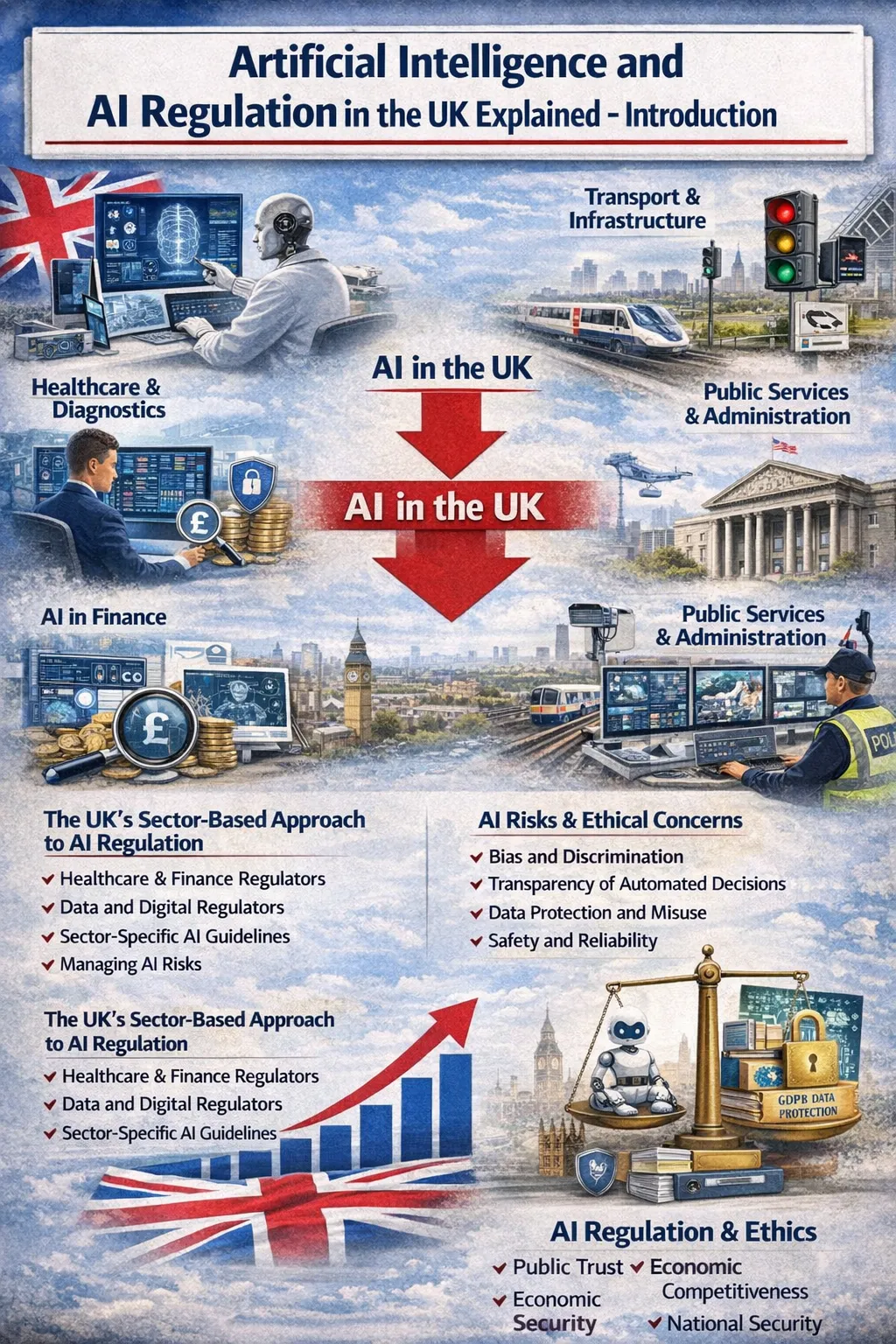
Artificial intelligence is transforming industries, public services and daily life across the United Kingdom. From healthcare diagnostics and financial trading to autonomous vehicles and creative content generation, AI technologies are being deployed at an accelerating pace. The UK has positioned itself as a global leader in AI research and development, while simultaneously grappling with fundamental questions about how this powerful technology should be governed, regulated and made accountable.
This guide explains what AI is, how it is being used in the UK, how the government approaches AI regulation, what the key institutions and strategies are, and why AI governance matters for the economy, society and individual rights.
What is artificial intelligence?
Artificial intelligence refers to computer systems designed to perform tasks that would normally require human intelligence, such as recognising patterns, making predictions, understanding language, generating content and making decisions. Modern AI is dominated by machine learning techniques, in which systems learn from large datasets rather than being explicitly programmed for every scenario. Deep learning, a subset of machine learning using neural networks with multiple layers, has driven breakthroughs in image recognition, natural language processing, speech synthesis and game playing.
Generative AI — systems capable of producing text, images, audio, video and code — has attracted enormous public and commercial interest since the launch of tools such as ChatGPT, Google Gemini, Claude and Midjourney. Large language models (LLMs), trained on vast datasets of text, underpin many of these tools and have the potential to transform knowledge work, creative industries, education, customer service and scientific research. The rapid capabilities of these systems have intensified the urgency of debates about AI safety, bias, transparency, intellectual property and the future of employment.
How is AI used in the UK?
AI is being deployed across a wide range of sectors in the UK. In healthcare, AI systems are used for medical image analysis (detecting cancers in mammograms and retinal scans), drug discovery, clinical decision support, administrative automation and operational planning within the NHS. In financial services, AI powers fraud detection, credit scoring, algorithmic trading, regulatory compliance and customer service chatbots. The UK’s financial sector is one of the largest adopters of AI globally.
In the public sector, AI is used for tax administration by HMRC, policing (including predictive policing tools and facial recognition), immigration case processing, benefits administration, traffic management and environmental monitoring. The use of AI in public sector decision-making has raised important questions about transparency, fairness and accountability — particularly where automated systems affect decisions about individuals’ access to public services, benefits or justice.
The creative industries — music, film, publishing, journalism, advertising and gaming — are experiencing significant disruption from generative AI tools. Questions about the use of copyrighted material in AI training data, the ownership of AI-generated content, the impact on creative employment and the authenticity of AI-generated media are the subject of active debate among artists, publishers, technology companies and policymakers.
What is the UK’s approach to AI regulation?
The UK has adopted a “pro-innovation” approach to AI regulation, set out in the government’s AI white paper of 2023. Rather than introducing a single comprehensive AI law — as the European Union has done with its AI Act — the UK relies on existing sector regulators (such as the FCA, Ofcom, the CMA, the ICO, the Medicines and Healthcare products Regulatory Agency and the Health and Safety Executive) to apply a set of cross-cutting principles to AI within their respective domains.
The five principles underpinning the UK’s approach are: safety, security and robustness; transparency and explainability; fairness; accountability and governance; and contestability and redress. Regulators are expected to interpret and apply these principles in ways that are proportionate to the risks in their sectors, avoiding a one-size-fits-all approach. The government has established a central AI Safety Institute (AISI) to support frontier AI safety research and testing, and has tasked regulators with developing their AI strategies and capabilities.
The current approach is non-statutory — the principles are not backed by legislation, and there is no dedicated AI regulator. The government has indicated that it may introduce legislation if the voluntary approach proves insufficient, but for now the emphasis is on flexibility, experimentation and maintaining the UK’s attractiveness to AI companies and investors. This approach has been praised by the technology industry but criticised by civil society groups, academics and some regulators who argue that voluntary principles lack teeth and leave significant gaps in protection.
What is the AI Safety Institute?
The UK AI Safety Institute (AISI), announced at the AI Safety Summit held at Bletchley Park in November 2023, is a government body dedicated to evaluating and testing the safety of frontier AI systems — the most advanced and potentially most dangerous AI models. AISI conducts pre-deployment and post-deployment safety evaluations of AI models, develops technical tools and methodologies for assessing AI risks, and collaborates with international partners on AI safety research.
The Bletchley Park summit itself was a landmark event in international AI governance, bringing together governments, technology companies, academics and civil society from 28 countries. The resulting Bletchley Declaration acknowledged the potential risks from frontier AI and committed signatories to international cooperation on AI safety. The UK has continued to play a leading role in international AI governance discussions, though the rapidly evolving landscape — with new institutions, agreements and technical developments emerging constantly — means that the governance framework is far from settled.
What are the risks and ethical concerns around AI?
AI presents a range of risks and ethical concerns that are the subject of active research, debate and policy development. Bias and discrimination are significant concerns — AI systems trained on historical data can perpetuate and amplify existing biases related to race, gender, age, disability and socioeconomic status, leading to unfair outcomes in areas such as recruitment, lending, criminal justice and healthcare. Ensuring that AI systems are fair and non-discriminatory requires careful attention to training data, model design, testing and ongoing monitoring.
Transparency and explainability are challenging for many AI systems, particularly deep learning models that operate as “black boxes” — producing outputs without providing a human-understandable explanation of how the decision was reached. This is problematic in high-stakes contexts such as medical diagnosis, criminal sentencing or financial regulation, where individuals and regulators need to understand and challenge the basis of decisions that affect them.
The impact of AI on employment is a major concern. While AI is expected to create new jobs and increase productivity in many sectors, it also has the potential to automate tasks currently performed by millions of workers, particularly in areas such as administration, customer service, data analysis, content creation and routine professional work. The speed and scale of displacement, the adequacy of retraining programmes, and the distribution of economic gains from AI-driven productivity improvements are critical questions for government policy.
At the frontier, existential risks from highly capable AI systems — including the possibility of AI systems pursuing goals misaligned with human values, or being used by hostile actors for catastrophic harm — are taken seriously by researchers, governments and some of the AI companies themselves. The field of AI alignment, which seeks to ensure that advanced AI systems reliably act in accordance with human intentions, is a growing area of research at institutions including AISI, the Centre for AI Safety and leading university departments.
What is the UK’s AI ecosystem?
The UK has one of the strongest AI ecosystems in the world, ranked third globally behind the United States and China by most measures. London is Europe’s largest hub for AI companies, with significant clusters also in Cambridge, Oxford, Edinburgh, Manchester and Bristol. The UK is home to world-leading AI research institutions, including the Alan Turing Institute (the national institute for data science and artificial intelligence), DeepMind (a Google-owned AI research laboratory based in London), and strong AI research groups at universities including Oxford, Cambridge, Imperial College London, Edinburgh and UCL.
The UK’s AI sector attracted over £3.5 billion in private investment in 2023, and the country has produced a significant number of AI startups across healthcare, financial services, defence, climate technology, education and creative industries. The government has supported the growth of the AI sector through R&D tax credits, Innovate UK grants, the Industrial Strategy Challenge Fund and dedicated AI funding programmes. The Alan Turing Institute receives strategic funding from UKRI to conduct foundational AI research and provide expert advice to government and industry.
However, the UK faces competitive challenges. The scale of investment in AI research and compute infrastructure in the United States and China dwarfs that of the UK, and there are concerns about the UK’s ability to retain top AI talent in the face of higher salaries and greater resources available elsewhere. The availability of computing power — large-scale GPU clusters needed to train frontier AI models — has been identified as a strategic bottleneck, and the government has announced investments in national AI compute infrastructure, including through partnerships with cloud computing providers.
How is the UK developing AI skills and talent?
The development of a skilled AI workforce is critical to the UK’s ability to maintain its position as a global AI leader. The government has invested in AI education and training through several programmes, including the Turing AI Fellowships (supporting the UK’s top AI researchers), AI doctoral training centres at leading universities, conversion courses for graduates from non-STEM backgrounds, and the National Centre for Computing Education, which supports computing teaching in schools.
The demand for AI skills extends well beyond specialist researchers and engineers. Businesses across all sectors increasingly need employees who understand AI concepts, can work with AI tools, can critically evaluate AI outputs and can manage the ethical and governance challenges that AI presents. The integration of AI literacy into the education system — from schools through to universities and vocational training — is recognised as a priority, though progress has been uneven.
Immigration policy plays an important role in the UK’s AI talent pipeline. The Global Talent visa route provides a pathway for leading researchers and innovators to work in the UK, and the High Potential Individual visa allows graduates of top international universities to come to the UK without a job offer. However, the broader tightening of immigration rules and the political environment around migration have created uncertainty for some international AI researchers and companies considering the UK as a base.
How does UK AI regulation compare with the EU AI Act?
The most significant international comparator for UK AI regulation is the European Union’s AI Act, which entered into force in 2024 as the world’s first comprehensive AI-specific legislation. The EU AI Act classifies AI systems by risk level — from unacceptable risk (banned) through high risk (heavily regulated) to limited and minimal risk (lighter requirements) — and imposes detailed obligations on developers and deployers of AI systems, including conformity assessments, transparency requirements, data governance standards and human oversight mechanisms.
The UK’s approach differs fundamentally from the EU model. Where the EU has created a horizontal, binding legal framework that applies across all sectors, the UK relies on existing sector regulators to apply cross-cutting principles on a voluntary basis. The UK government has argued that this approach is more flexible, less bureaucratic and better suited to the pace of AI development. However, critics note that the voluntary nature of the UK framework means there is no legal requirement for companies to comply with the principles, no dedicated enforcement mechanism for AI-specific harms and no statutory right for individuals affected by AI decisions to seek redress.
For companies operating across both the UK and EU markets, the divergence in regulatory approaches creates compliance complexity. Some businesses may choose to adopt the more stringent EU standards globally for simplicity, which could reduce the practical impact of the UK’s lighter-touch approach. The long-term effectiveness of the two approaches — and which better serves the interests of citizens, businesses and innovation — will be closely watched by policymakers around the world.
Why does AI regulation matter?
Artificial intelligence is one of the most consequential technologies in human history. The decisions that governments, companies and societies make now about how AI is developed, deployed and governed will shape the economy, employment, public services, national security and individual rights for decades to come. The UK’s approach to AI governance — balancing innovation with safety, economic opportunity with ethical responsibility, and national strategy with international cooperation — will be a defining feature of the country’s technology policy for the foreseeable future.
Related guides
These guides explain related topics in more detail:
- UK Technology Policy and Regulation Explained
- Cybersecurity and Digital Security in the UK Explained
- UK Digital Economy and Technology Sector Explained
- Cybercrime and Fraud in the UK Explained
- How the UK Economy Works
Related coverage:
Read our latest UK technology and AI news
Prepared by:
