How Policing Works in the UK
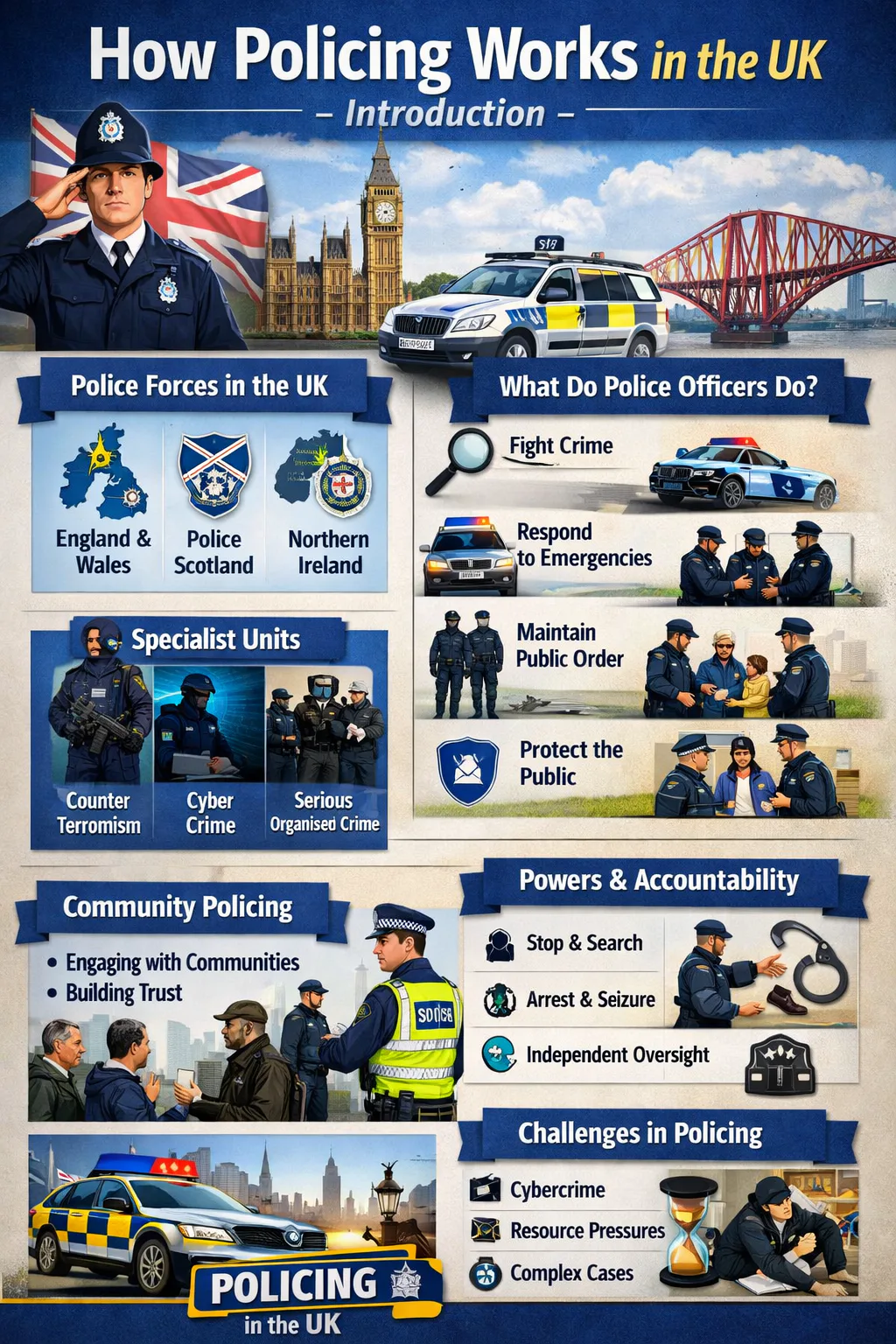
Policing is the frontline of the criminal justice system in the United Kingdom, responsible for preventing and detecting crime, maintaining public order, protecting communities and upholding the law. The UK operates a distinctive model of policing by consent, in which police officers are seen as citizens in uniform rather than agents of the state, and their authority derives from public trust and cooperation rather than from the power of the state alone.
This guide explains how policing is structured in the UK, how police forces are governed and funded, what powers officers have, how policing is held accountable and what challenges the service faces.
How is policing structured in the UK?
Policing in England and Wales is organised through 43 territorial police forces, each responsible for a specific geographic area. These range from large metropolitan forces such as the Metropolitan Police Service (which covers Greater London and is the largest force in the UK with approximately 34,000 officers), Greater Manchester Police and West Midlands Police, to smaller forces such as Dyfed-Powys Police and City of London Police. Each force is operationally independent and led by a Chief Constable (or, in the case of the Metropolitan Police, the Commissioner).
Scotland has a single national police force, Police Scotland, created in 2013 by merging the country’s eight regional forces. Police Scotland is the second-largest force in the UK and is accountable to the Scottish Police Authority. Northern Ireland is policed by the Police Service of Northern Ireland (PSNI), which was established in 2001 as a successor to the Royal Ulster Constabulary following the Patten Report recommendations that emerged from the peace process.
In addition to territorial forces, several national agencies and specialist bodies operate across the UK. The National Crime Agency (NCA) leads the fight against serious and organised crime, including drug trafficking, people smuggling, modern slavery, cybercrime and large-scale fraud. British Transport Police provides policing for the railway network across England, Wales and Scotland. The Civil Nuclear Constabulary protects nuclear sites, and the Ministry of Defence Police provides security at military installations.
How are police forces governed?
In England and Wales, each territorial police force is overseen by a directly elected Police and Crime Commissioner (PCC), whose role is to hold the Chief Constable to account, set the local policing priorities through a Police and Crime Plan, decide the police precept (the portion of council tax that funds the police), commission victim support services and appoint and, if necessary, dismiss the Chief Constable. PCCs were introduced by the Police Reform and Social Responsibility Act 2011, replacing the previous system of unelected police authorities.
PCC elections are held every four years, most recently in 2024. In some areas, the PCC role has been combined with that of the metro mayor — for example, the Mayor of London is the equivalent of a PCC for the Metropolitan Police, working through the Mayor’s Office for Policing and Crime (MOPAC), and the Mayor of Greater Manchester holds PCC responsibilities alongside mayoral powers. The PCC model has been praised for increasing democratic accountability over policing but criticised for concentrating significant power in a single individual and for consistently low voter turnout in PCC elections.
In Scotland, Police Scotland is governed by the Scottish Police Authority (SPA), a public body appointed by Scottish ministers. In Northern Ireland, the PSNI is overseen by the Northern Ireland Policing Board, a body comprising elected politicians and independent members established under the Police (Northern Ireland) Act 2000 as part of the post-Good Friday Agreement policing arrangements.
How is policing funded?
Police forces in England and Wales are funded through a combination of central government grants (distributed by the Home Office through the police funding formula) and locally raised council tax (the police precept). The proportion of funding from each source varies by force — more affluent areas tend to generate more from the police precept, while forces in less affluent areas are more dependent on the central grant. Total police spending in England and Wales is approximately £18-19 billion per year.
Police funding was reduced significantly in real terms between 2010 and 2019, leading to a reduction of approximately 20,000 officer posts and widespread concerns about the impact on frontline policing. The government launched a recruitment campaign in 2019 to recruit 20,000 additional officers by 2023, a target that was broadly met, though many experienced officers left the service during the same period. The overall capacity and capability of police forces remains the subject of active debate, particularly in relation to their ability to investigate complex crimes such as fraud, cybercrime and sexual offences.
Police Scotland is funded primarily by the Scottish Government, supplemented by a police precept within council tax. The PSNI is funded through the Northern Ireland block grant, with additional security-related funding reflecting the particular challenges of policing in Northern Ireland.
What powers do police officers have?
Police officers in England and Wales exercise powers conferred by statute law, principally the Police and Criminal Evidence Act 1984 (PACE) and the Criminal Justice and Public Order Act 1994. Key powers include the power to stop and search individuals where there are reasonable grounds to suspect they are carrying prohibited items (such as weapons, drugs or stolen property), the power to arrest suspects where there are reasonable grounds to suspect an offence has been committed and the arrest is necessary, the power to detain suspects in custody for questioning, and the power to search premises under warrant or in certain emergency circumstances.
PACE and its associated codes of practice set out detailed rules governing how these powers must be exercised, including requirements for officers to identify themselves, explain the grounds for their actions, treat detained persons humanely and keep accurate records. The use of stop and search has been one of the most contentious policing powers, with longstanding concerns about its disproportionate use against Black and minority ethnic individuals. Data published by the Home Office consistently shows significant racial disparities in stop and search rates, and the issue has been the subject of multiple reviews and policy interventions.
The police also have powers to manage public order, including the authority to impose conditions on marches and protests under the Public Order Act 1986, and enhanced powers introduced by the Police, Crime, Sentencing and Courts Act 2022 and the Public Order Act 2023 to manage disruptive protests. The balance between the right to peaceful protest (protected by Articles 10 and 11 of the European Convention on Human Rights, incorporated into UK law by the Human Rights Act 1998) and the need to prevent serious disruption has been the subject of intense political and legal debate.
How do police investigate crime?
Criminal investigation involves gathering evidence to identify offenders and build cases for prosecution. The complexity and resources dedicated to an investigation depend on the nature of the offence. Major crimes such as murder, terrorism and organised crime are investigated by specialist teams — for example, the Metropolitan Police’s Specialist Crime Command handles murders in London, while Counter Terrorism Policing coordinates the national counter-terrorism effort across UK forces.
Modern policing relies heavily on technology and data. Digital forensics, including the analysis of mobile phones, computers, social media accounts and online communications, has become central to many investigations. CCTV networks, automatic number plate recognition (ANPR) systems, the Police National Computer (PNC) and the Police National Database (PND) provide investigators with powerful tools for identifying suspects and tracking movements. DNA evidence, managed through the National DNA Database, and fingerprint evidence remain important tools, particularly in serious crime investigations.
The use of advanced surveillance technologies — including facial recognition, predictive policing algorithms and communications data — has raised significant civil liberties concerns. The Investigatory Powers Act 2016, sometimes called the “Snoopers’ Charter,” governs how law enforcement agencies can access communications data and conduct surveillance, subject to judicial authorisation and oversight by the Investigatory Powers Commissioner’s Office. The tension between the need for effective investigative tools and the protection of privacy and civil liberties is one of the most active areas of debate in policing policy.
How is policing held accountable?
The accountability of policing is maintained through multiple mechanisms. His Majesty’s Inspectorate of Constabulary and Fire and Rescue Services (HMICFRS) independently inspects police forces and publishes assessments of their effectiveness, efficiency and legitimacy — known as PEEL inspections. These reports are influential in identifying good practice, highlighting areas of concern and driving improvement across the service.
The Independent Office for Police Conduct (IOPC), which replaced the Independent Police Complaints Commission in 2018, investigates the most serious complaints and incidents involving the police, including deaths in custody, police shootings and allegations of corruption or serious misconduct. The IOPC can conduct independent investigations, direct forces to conduct supervised investigations, and make recommendations for disciplinary action or criminal prosecution.
At a local level, PCCs provide democratic accountability, holding Chief Constables to account for the performance of their forces. The Home Affairs Select Committee in Parliament scrutinises policing policy and the work of the Home Office, and can call police leaders to give evidence. Public trust in the police — measured through surveys such as the Crime Survey for England and Wales — is considered a critical measure of policing legitimacy, and has been affected in recent years by high-profile cases involving police misconduct, most notably the institutional failures identified in the Metropolitan Police following the murder of Sarah Everard by a serving officer.
How does neighbourhood and community policing work?
Neighbourhood policing is the model through which police forces maintain a visible, accessible presence in local communities. Neighbourhood teams typically consist of police constables, police community support officers (PCSOs) and special constables (volunteer officers with full police powers) who are assigned to specific areas and build relationships with residents, businesses, schools and community organisations. Their role includes crime prevention, community engagement, gathering local intelligence, addressing anti-social behaviour and providing reassurance through regular patrols and community meetings.
PCSOs, introduced by the Police Reform Act 2002, have a more limited set of powers than warranted constables but play a valuable role in community engagement, particularly in areas where building trust and long-term relationships is essential to effective policing. Special constables volunteer their time alongside their regular employment and bring diverse skills and perspectives to policing. The College of Policing, the professional body for policing in England and Wales, sets standards for neighbourhood policing and promotes evidence-based approaches to community safety.
The effectiveness of neighbourhood policing has been affected by resource pressures since 2010, with many forces reducing the number of dedicated neighbourhood officers and PCSOs to maintain capacity in other areas such as response policing, criminal investigation and safeguarding. The government and police leaders have acknowledged the importance of restoring neighbourhood policing as a priority, recognising that visible, community-focused policing is essential to building public trust, gathering intelligence and preventing crime before it occurs.
How does UK policing compare internationally?
The UK model of policing by consent — characterised by the principle that the police are the public and the public are the police — is distinctive in international terms. The most visible manifestation of this principle is that the vast majority of UK police officers are routinely unarmed, in contrast to police forces in almost all other countries. Firearms officers are specially trained and deployed only in specific operational circumstances, such as counter-terrorism operations, armed crime incidents and the protection of VIPs and sensitive sites.
The UK’s approach to police governance — with elected PCCs providing democratic accountability, independent inspectorates monitoring standards and a separate complaints body investigating misconduct — is regarded as a relatively strong model of police oversight, though its effectiveness depends on the vigour and independence with which these bodies exercise their functions. International comparisons highlight both strengths and weaknesses in the UK model, and police reform continues to draw on lessons from jurisdictions around the world, including in areas such as community engagement, use of technology, diversity and inclusion, and the management of public protest.
What are the major challenges facing UK policing?
UK policing faces a complex and evolving set of challenges. The changing nature of crime — with significant growth in online fraud, cybercrime, child sexual exploitation, county lines drug distribution and technology-enabled offending — requires new skills, capabilities and resources that many forces have found difficult to develop at the necessary pace. Traditional volume crime such as burglary, vehicle theft and shoplifting has also seen changing patterns, with falling detection rates for some offence types raising concerns about police effectiveness.
Public confidence and trust have been damaged by cases of police misconduct, institutional racism and the handling of sensitive cases. The Casey Review of the Metropolitan Police (2023) identified serious failings in culture, leadership and standards, describing the force as institutionally racist, misogynistic and homophobic. Rebuilding public trust — particularly among communities that have historically had difficult relationships with the police — is recognised as one of the most important challenges facing police leaders.
Demand on policing has also changed, with officers increasingly called upon to respond to incidents related to mental health crises, missing persons, child safeguarding concerns and other complex social issues that do not primarily require a law enforcement response. The extent to which policing should fill gaps left by reductions in other public services — particularly mental health provision, social care and youth services — is a significant strategic question for the future of the service.
Why does policing matter?
Policing is the most visible face of the state’s relationship with its citizens. The way police officers exercise their powers, interact with communities, investigate crime and respond to emergencies shapes public confidence in the rule of law and in the fairness of the justice system. Effective, accountable and trusted policing is essential to public safety, social cohesion and democratic governance. Understanding how the police are structured, governed and held to account helps citizens engage with the institutions that serve and protect them.
Related guides
These guides explain related topics in more detail:
- How the UK Criminal Justice System Works
- UK Courts and Sentencing Explained
- Cybercrime and Fraud in the UK Explained
- How the UK Government Works
- UK Local and Devolved Elections Explained
Related coverage:
Read our latest UK crime and policing news
Prepared by: